Zhang Zhu, Wu Yifan, Liu Qingxia, Dong Fen, Pang Wenyi, Zhe Kaiyuan, Wan Jun, Xie Wanmu, Wang Wei, Yang Peiran, Sun Aihua, Zhai Zhenguo
Department of Pulmonary and Critical Care Medicine, Center of Respiratory Medicine, China-Japan Friendship Hospital, Beijing, People's Republic of China.
National Center for Respiratory Medicine, Beijing, People's Republic of China.
TH Open. 2022 Jul 21;6(3):e184-e193. doi: 10.1055/s-0042-1749170. eCollection 2022 Jul.
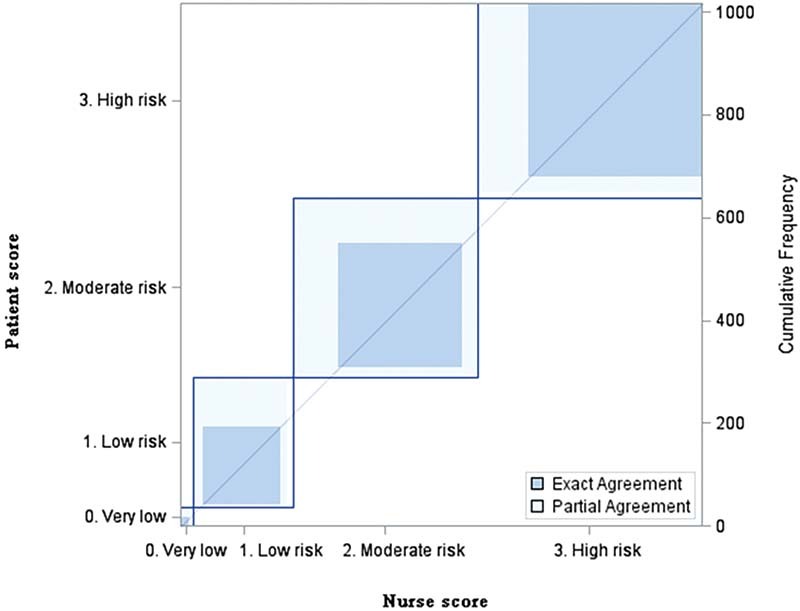
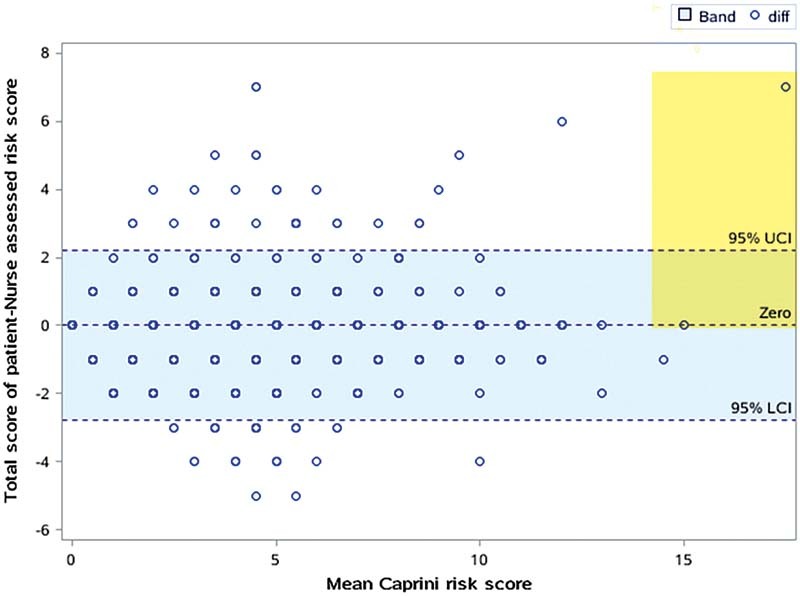
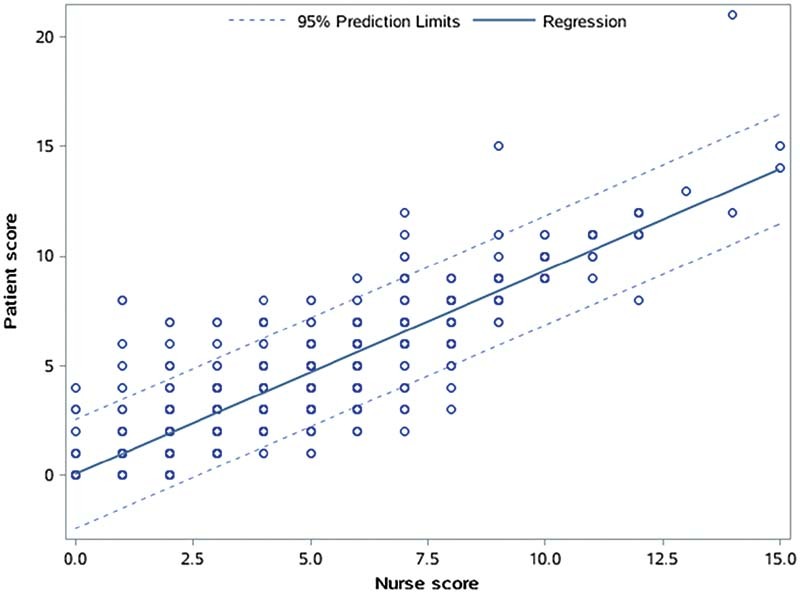
The Caprini Risk Score (CRS) is one of the most widely used risk assessment models for venous thromboembolism (VTE). A well-validated patient-completed CRS form may allow patients to self-report and simplify the evaluation by health care workers. The Chinese version of the CRS was optimized for easy understanding in a pilot study. The amended CRS form was completed by prospectively recruited patients and blinded nurses. The agreement levels of the individual questions and the total scores of patient and nurse-completed forms were compared using the Kappa value. The total scores were used for risk stratification of patients. Correlation and differences between patient and nurse-completed forms were analyzed using the Spearman correlation and Bland-Altman method, respectively. We recruited 504 medical patients and 513 surgical patients, aged 52.7 ± 16.3 years, of which 443 (43.6%) were men, and 91.6% of the patients were educated beyond junior high school. The patients spent less time to complete the form compared with trained nurses. There was good question-to-question agreement between patient and nurse-completed CRS ( >0.6 for most questions, < 0.0001). The total scores also showed good agreement ( = 0.6097, < 0.0001), and enabled the classification of patients into different risk groups. The patient and nurse-derived scores were highly correlated (Spearman's = 0.84), and without extreme values ( < 0.0001). We have created and verified a Chinese version of the patient-completed CRS, which showed good agreement and correlation with nurse-completed CRS. CRS represents a suitable tool for VTE risk assessment of hospitalized patients in China.
卡普里尼风险评分(CRS)是静脉血栓栓塞症(VTE)应用最广泛的风险评估模型之一。经过充分验证的患者填写版CRS表格可让患者进行自我报告,并简化医护人员的评估工作。 在一项试点研究中,对CRS的中文版进行了优化,以使其易于理解。修订后的CRS表格由前瞻性招募的患者和不知情的护士填写。使用Kappa值比较各个问题的一致性水平以及患者和护士填写表格的总分。总分用于对患者进行风险分层。分别使用Spearman相关性分析和Bland-Altman方法分析患者与护士填写表格之间的相关性和差异。 我们招募了504名内科患者和513名外科患者,年龄为52.7±16.3岁,其中443名(43.6%)为男性,91.6%的患者受过初中以上教育。与经过培训的护士相比,患者填写表格所花费的时间更少。患者和护士填写的CRS在各个问题之间具有良好的一致性(大多数问题的Kappa值>0.6,P<0.0001)。总分也显示出良好的一致性(Kappa值=0.6097,P<0.0001),并能够将患者分为不同的风险组。患者和护士得出的分数高度相关(Spearman相关性系数=0.84),且无极端值(P<0.0001)。 我们创建并验证了患者填写版的CRS中文版,其与护士填写版的CRS具有良好的一致性和相关性。CRS是中国住院患者VTE风险评估的合适工具。