Gomindes Austin R, Bhakthavalsalan Resya, Sharma Utkarsh, Johnston Shannon L, Naushad Ashiq
School of Medical and Dental Science, University of Birmingham, BIrmingham, GBR.
Major Trauma Services, Queen Elizabeth Hospital Birmingham, Birmingham, GBR.
Cureus. 2022 Jul 27;14(7):e27355. doi: 10.7759/cureus.27355. eCollection 2022 Jul.
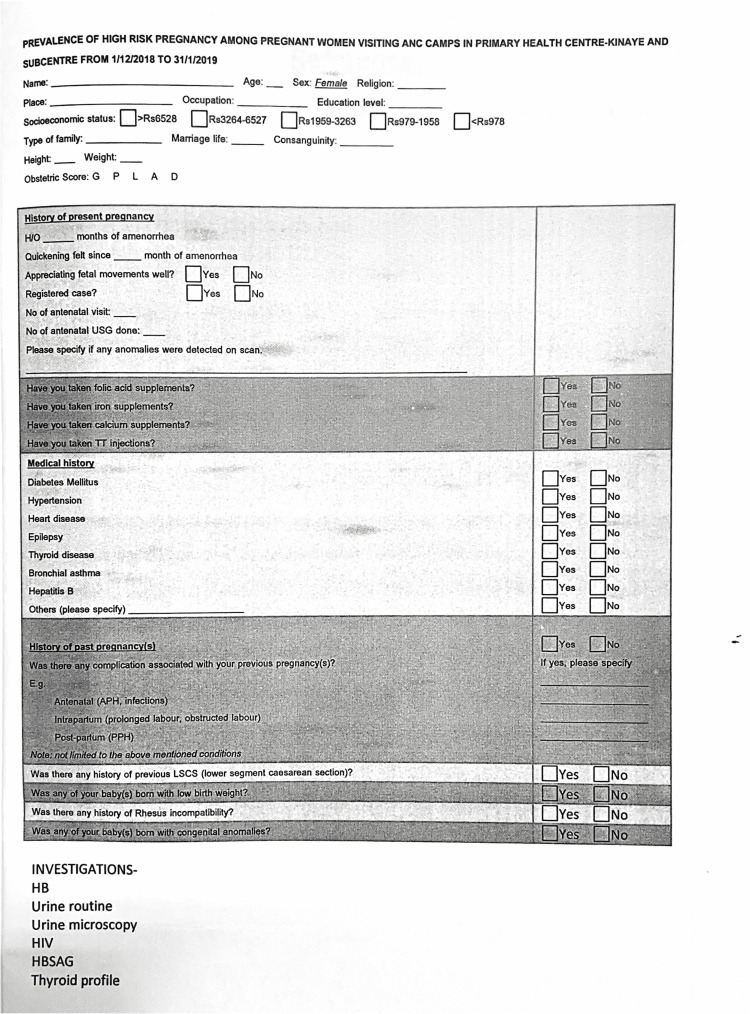
Introduction Identifying pregnancy-related complications and high-risk pregnancies early on and effectively managing care for these pregnant women through a holistic approach guided by the main objectives of antenatal care (ANC) and efficient, good-quality health care through ANC services can reduce the risk of pregnancy-related complications, being favourable for both mother and child. This study was intended to identify the percentage of pregnant women in high-risk groups attending ANC clinics. Objective This study's aim was to understand the prevalence of high-risk pregnancies in women attending ANC camps in Kinaye and Vantamuri villages in Belagavi, India. Methods A community-based cross-sectional study was carried out in a primary healthcare (PHC) setting that included all pregnant women attending antenatal camps and residing in the same areas. With a total study sample size of 200, consisting of pregnant women attending ANC camps in Kinaye and Vantamuri PHC, the data were collected using a pre-tested, pre-designed questionnaire after obtaining written informed consent from the participating pregnant women. Results The data were analysed using a chi-square test to uncover the relationship between socio-demographics, obstetric history, medical variables, and high-risk pregnancy. The results demonstrated that 48.5% of women attending ANC clinics were in the high-risk pregnancy group. Conclusion Pregnancy outcomes are greatly affected by a woman's socio-demographic, obstetric, and medical variables. The WHO recommends a minimum of four ANC visits to safely identify and mitigate the risks and complications of high-risk pregnancy to ensure positive outcomes for both mothers and children.
引言 尽早识别与妊娠相关的并发症和高危妊娠,并通过以产前保健(ANC)的主要目标为指导的整体方法,有效地管理这些孕妇的护理,并通过ANC服务提供高效、优质的医疗保健,可以降低与妊娠相关并发症的风险,对母亲和孩子都有利。本研究旨在确定参加ANC诊所的高危组孕妇的百分比。
目的 本研究的目的是了解在印度贝拉尔加维Kinaye和Vantamuri村参加ANC营地的妇女中高危妊娠的患病率。
方法 在初级卫生保健(PHC)机构开展了一项基于社区的横断面研究,纳入了所有参加产前营地并居住在同一地区的孕妇。研究总样本量为200,由参加Kinaye和Vantamuri初级卫生保健中心ANC营地的孕妇组成,在获得参与孕妇的书面知情同意后,使用预先测试、预先设计的问卷收集数据。
结果 使用卡方检验分析数据,以揭示社会人口统计学、产科病史、医学变量与高危妊娠之间的关系。结果表明,参加ANC诊所的妇女中有48.5%属于高危妊娠组。
结论 妇女的社会人口统计学、产科和医学变量对妊娠结局有很大影响。世界卫生组织建议至少进行四次ANC检查,以安全地识别和减轻高危妊娠的风险和并发症,确保母亲和孩子都有良好的结局。