Lamane Houda, Moussadek Rachid, Baghdad Bouamar, Mouhir Latifa, Briak Hamza, Laghlimi Meriem, Zouahri Abdelmjid
Laboratory of Process Engineering and Environment, University of Hassan II, Mohammedia, Morocco.
Research Unit on Environment and Conservation of Natural Resources, National Institute for Agricultural Research, Rabat, Morocco.
Heliyon. 2022 Aug 15;8(8):e10209. doi: 10.1016/j.heliyon.2022.e10209. eCollection 2022 Aug.
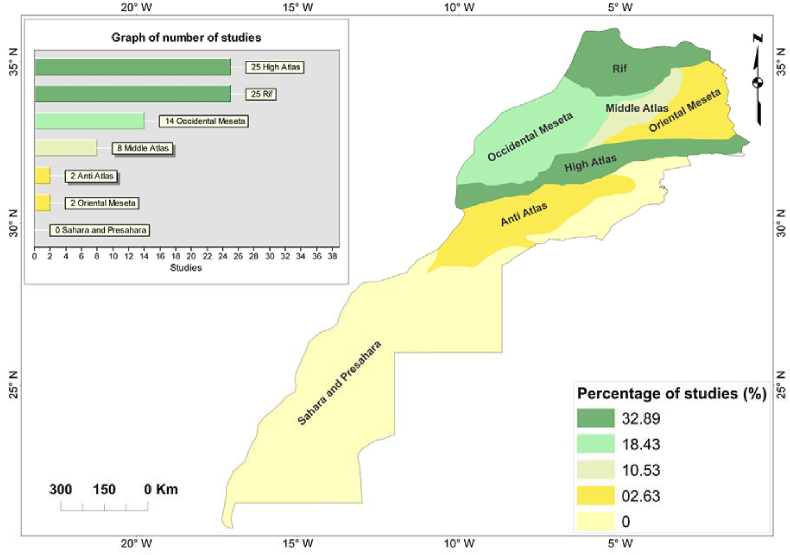
During the last century, a great deal of effort has been directed toward determining soil erosion rates using various methods under a wide range of climatic conditions, soil types, land uses, topography, and among others. Therefore, to better understand soil erosion studies in Morocco, a country with diverse physiography and climatic variations we undertook an analysis of national data of several soil erosion modeling and fingerprinting. The approach used for this research is a review of scientific articles, conference papers and thesis on soil erosion, focusing more on categorization of the different soil erosion models and other methods applied. The results reveal very interesting information as follows: (i) the distribution and frequency level of modeling and fingerprinting applications; the focus was on the north of the country: (Rif 32.89%, High Atlas 32.89%, Occidental Meseta 18.43% and Middle Atlas 10.53%), (ii) The (R) USLE models remain the most widely used models (51,32%) in Morocco, (iii) The support practice factor was severely lacking across the country, (iv) the highest erosion rate is concentrated in the Atlas and Rif mountains; and (v) a positive relationship between erosion rate and geological features, slope, climate, land use and cover, plus other environmental characteristics, as well as measurement and modeling conditions, and a negative relationship with the study areas size and scale. Even though the overall results show a high degree of variability, which cannot be explained by this combination of factors, but is at a minimum partly related to the experimental conditions. This overview research and database are designed to assist in the future assessment of soil erosion and to help define priorities for soil erosion research by providing a state of art for future focused and comprehensive analyses to address this issue of soil erosion in Morocco.
在上个世纪,人们付出了巨大努力,运用各种方法在广泛的气候条件、土壤类型、土地利用、地形等条件下测定土壤侵蚀速率。因此,为了更好地了解摩洛哥这个地形多样、气候变化丰富的国家的土壤侵蚀研究情况,我们对该国若干土壤侵蚀建模和指纹识别的国家数据进行了分析。本研究采用的方法是对有关土壤侵蚀的科学文章、会议论文和论文进行综述,更多地关注不同土壤侵蚀模型和其他应用方法的分类。结果揭示了非常有趣的信息如下:(i)建模和指纹识别应用的分布和频率水平;重点在该国北部地区(里夫地区占32.89%,高阿特拉斯地区占32.89%,西梅塞塔地区占18.43%,中阿特拉斯地区占10.53%),(ii)(R)通用土壤流失方程模型仍是摩洛哥使用最广泛的模型(51.32%),(iii)全国范围内严重缺乏支撑实践因子,(iv)最高侵蚀速率集中在阿特拉斯山脉和里夫山脉;以及(v)侵蚀速率与地质特征、坡度、气候、土地利用和覆盖以及其他环境特征以及测量和建模条件之间呈正相关,与研究区域的大小和规模呈负相关。尽管总体结果显示出高度的变异性,无法用这些因素的组合来解释,但至少部分与实验条件有关。这项概述性研究和数据库旨在通过提供未来针对性和全面分析的最新技术水平,协助未来对土壤侵蚀的评估,并帮助确定土壤侵蚀研究的优先事项,以解决摩洛哥的土壤侵蚀问题。