Transitional Artificial Intelligence Research Group, School of Mathematics and Statistics, UNSW, Sydney, Australia.
Department of Electronics & Electrical Engineering, Indian Institute of Technology Guwahati, Guwahati, Assam, India.
PLoS One. 2022 Sep 1;17(9):e0273476. doi: 10.1371/journal.pone.0273476. eCollection 2022.
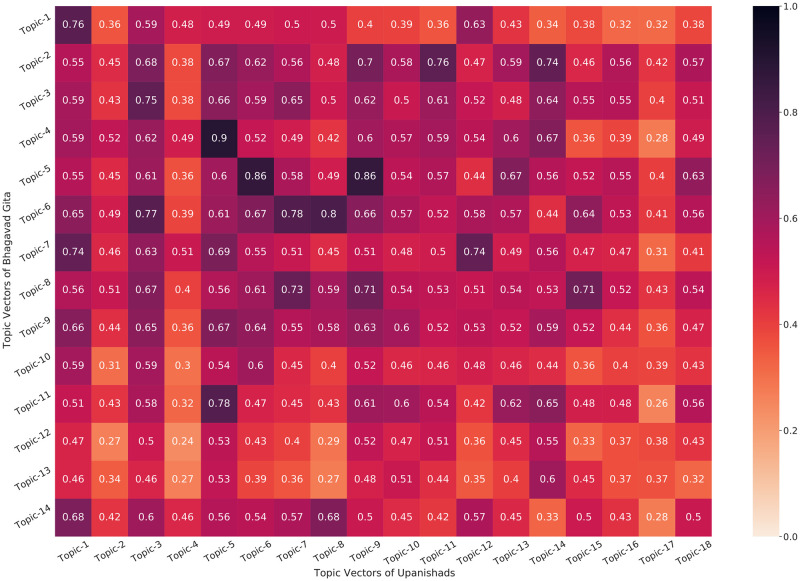
The Upanishads are known as one of the oldest philosophical texts in the world that form the foundation of Hindu philosophy. The Bhagavad Gita is the core text of Hindu philosophy and is known as a text that summarises the key philosophies of the Upanishads with a major focus on the philosophy of karma. These texts have been translated into many languages and there exist studies about themes and topics that are prominent; however, there is not much done using language models which are powered by deep learning. In this paper, we use advanced language models such as BERT to provide topic modelling of the Upanishads and the Bhagavad Gita. We then map those topics of the Bhagavad Gita and the Upanishads since it is well known that Bhagavad Gita summarizes the key messages in the Upanishads. We also analyse the distinct and overlapping topics amongst the texts and visualise the link of selected texts of the Upanishads with the Bhagavad Gita. Our results show very high similarity between the topics of these two texts with the mean cosine similarity of 73%. We find that out of the fourteen topics extracted from the Bhagavad Gita, nine of them have a cosine similarity of more than 70% with the topics of the Upanishads. We also find that topics generated by the BERT-based models show very high coherence when compared to the conventional models. Our best-performing model gives a coherence score of 73% on the Bhagavad Gita and 69% on the Upanishads. The visualization of the low-dimensional embeddings of these texts shows very clear overlapping themes among their topics adding another level of validation to our results.
《奥义书》被认为是世界上最古老的哲学文本之一,是印度教哲学的基础。《薄伽梵歌》是印度教哲学的核心文本,被认为是一本总结《奥义书》主要哲学思想的文本,主要关注业力哲学。这些文本已经被翻译成多种语言,并且有关于主题和突出主题的研究;然而,使用基于深度学习的语言模型进行的研究并不多。在本文中,我们使用先进的语言模型,如 BERT,对《奥义书》和《薄伽梵歌》进行主题建模。然后,我们对《薄伽梵歌》和《奥义书》的主题进行映射,因为众所周知,《薄伽梵歌》总结了《奥义书》的关键信息。我们还分析了文本之间的独特和重叠主题,并可视化了《奥义书》中选定文本与《薄伽梵歌》的链接。我们的结果表明,这两个文本的主题非常相似,余弦相似度平均值为 73%。我们发现,从《薄伽梵歌》中提取的十四个主题中,有九个主题与《奥义书》的主题具有 70%以上的余弦相似度。我们还发现,基于 BERT 的模型生成的主题与传统模型相比具有非常高的连贯性。我们表现最好的模型在《薄伽梵歌》上的连贯性得分为 73%,在《奥义书》上的连贯性得分为 69%。这些文本的低维嵌入的可视化显示,它们的主题之间存在非常明显的重叠主题,这为我们的结果增加了另一个验证层次。