Ieger-Raittz Rosangela, De Pierri Camilla Reginatto, Perico Camila Pereira, Costa Flavia de Fatima, Bana Elisa Garbin, Vicenzi Leonardo, Machado Diogo de Jesus Soares, Marchaukoski Jeroniza Nunes, Raittz Roberto Tadeu
Graduate Program in Physical Exercise Medicine in Health Promotion, Health Sciences Sector, Federal University of Paraná, Curitiba, Paraná, Brazil.
Laboratory of Artificial Intelligence Applied to Bioinformatics, SEPT, Federal University of Paraná, Curitiba, Paraná, Brazil.
PLoS One. 2025 May 29;20(5):e0322791. doi: 10.1371/journal.pone.0322791. eCollection 2025.
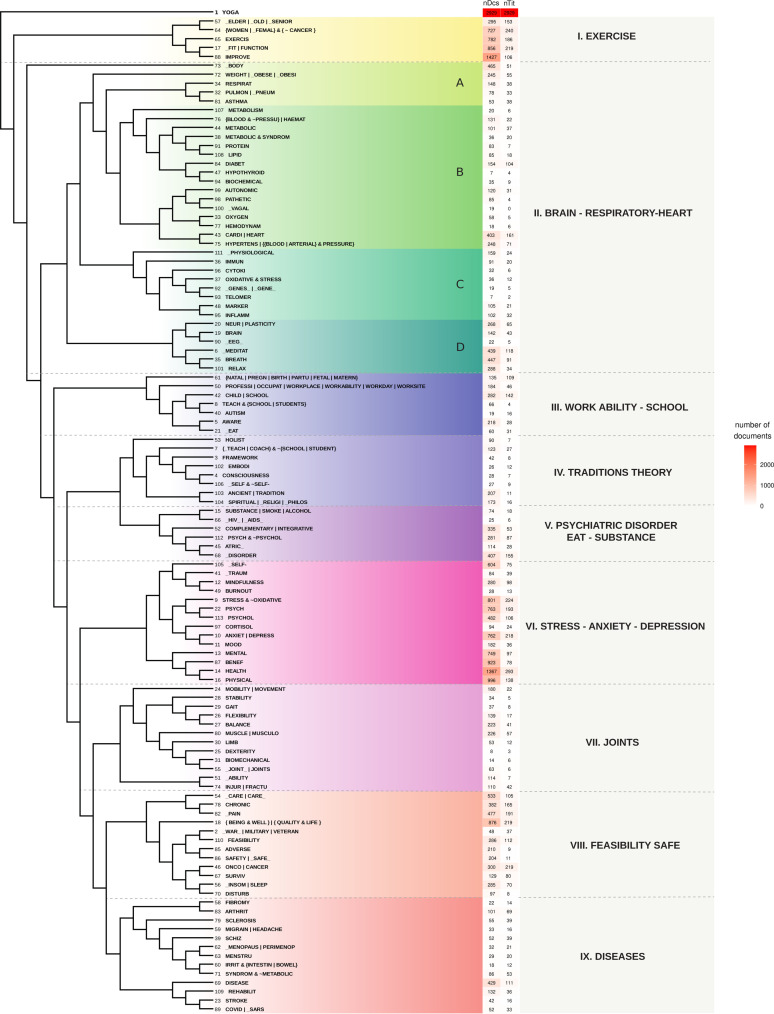
The techniques used in yoga have roots in traditions that precede modern science. Research shows that yoga enhances quality of life and well-being, positively impacting physical and mental health. As yoga gains acceptance in Western countries, scientific studies on the subject increase exponentially. However, many of these studies are considered inconsistent due to the diverse methodologies and focuses in the field, which creates challenges for researchers and hampers progress. This study aims to develop a comprehensive framework for existing literature on yoga, facilitating multidisciplinary collaboration and bringing new light to relevant aspects. Given the complexity of the subject, advanced modeling techniques are necessary. Contemporary artificial intelligence methods have advanced Bioinformatics, including text mining (TM), allowing us to employ vector representations of texts to derive semantic insights and organize literature effectively. Based on TM resources, we provided a better general understanding of yoga and highlighted the relationships between yoga practice and various domains, including biochemical parameters and neuroscience. It also reveals that practitioners can learn to engage with their bodies and environments actively, enhancing their quality of life. However, there is a lack of research exploring the mechanisms behind this learning and its potential for further enhancement. Vector TM has made it possible to bolster and improve human analysis. The set of resources developed allowed us to determine the mapping of the literature, the analysis of which revealed 4 dimensions (exercise, physiology, theory and therapeutic) divided into 9 cohesive groups, representing the trends in the literature. The resulting platforms are available to Yoga researchers to evaluate our findings and make their forays into the existing literature.
瑜伽所使用的技巧源于现代科学之前的传统。研究表明,瑜伽能提升生活质量和幸福感,对身心健康产生积极影响。随着瑜伽在西方国家被越来越多的人接受,关于这一主题的科学研究呈指数级增长。然而,由于该领域方法多样且重点各异,许多此类研究被认为缺乏一致性,这给研究人员带来了挑战并阻碍了进展。本研究旨在为现有的瑜伽文献建立一个全面的框架,促进多学科合作,并为相关方面带来新的启示。鉴于该主题的复杂性,先进的建模技术是必要的。当代人工智能方法推动了生物信息学的发展,包括文本挖掘(TM),使我们能够利用文本的向量表示来获得语义洞察并有效地组织文献。基于文本挖掘资源,我们对瑜伽有了更好的总体理解,并突出了瑜伽练习与包括生化参数和神经科学在内的各个领域之间的关系。研究还表明,练习者可以学会积极地与自己的身体和环境互动,从而提高生活质量。然而,目前缺乏对这种学习背后机制及其进一步提升潜力的研究。向量文本挖掘使得加强和改进人类分析成为可能。所开发的资源集使我们能够确定文献的映射关系,对其分析揭示了4个维度(运动、生理学、理论和治疗),分为9个连贯的组,代表了文献中的趋势。所得平台可供瑜伽研究人员评估我们的研究结果,并深入研究现有文献。