Department of Physics, University of Illinois at Urbana-Champaign, Urbana, IL, 61801, USA.
Center for the Physics of Living Cells, University of Illinois at Urbana-Champaign, Urbana, IL, 61801, USA.
Nat Commun. 2022 Sep 1;13(1):5138. doi: 10.1038/s41467-022-32857-1.
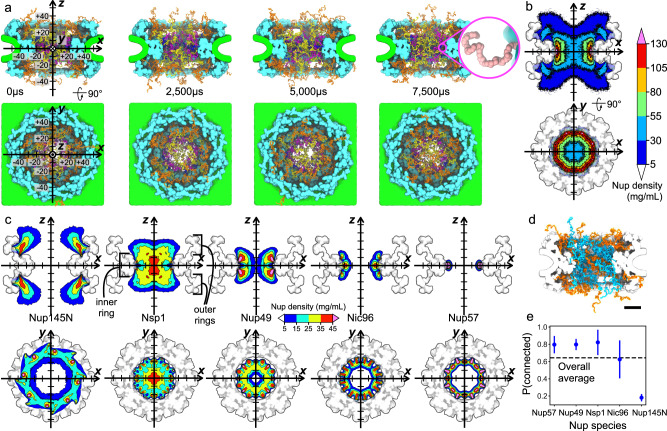
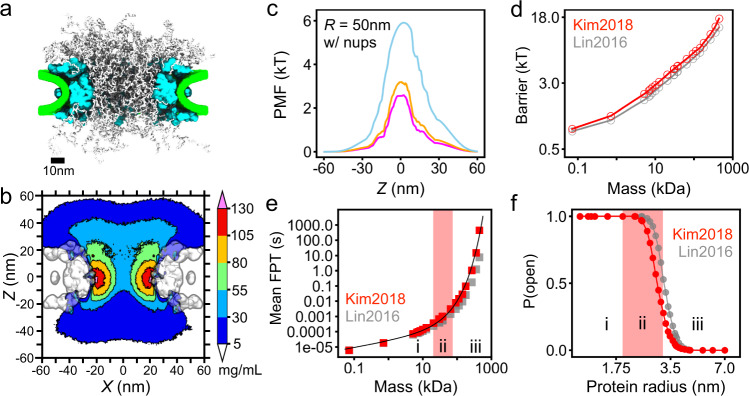
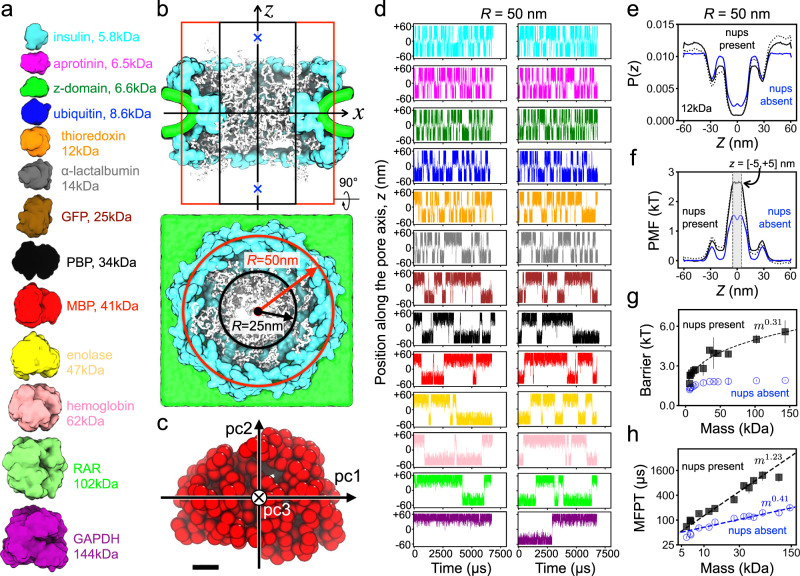
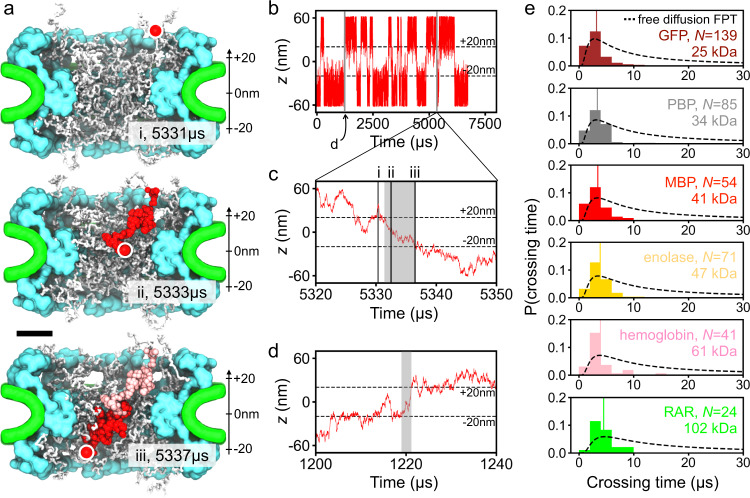
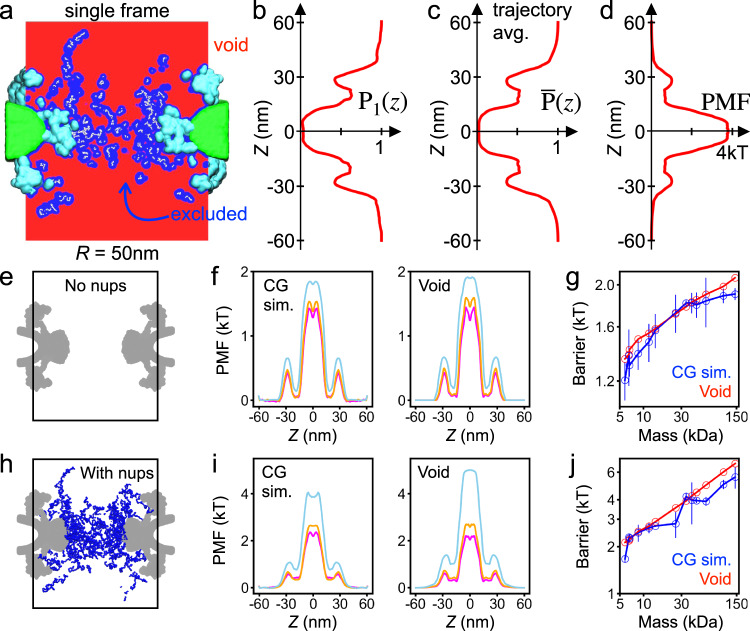
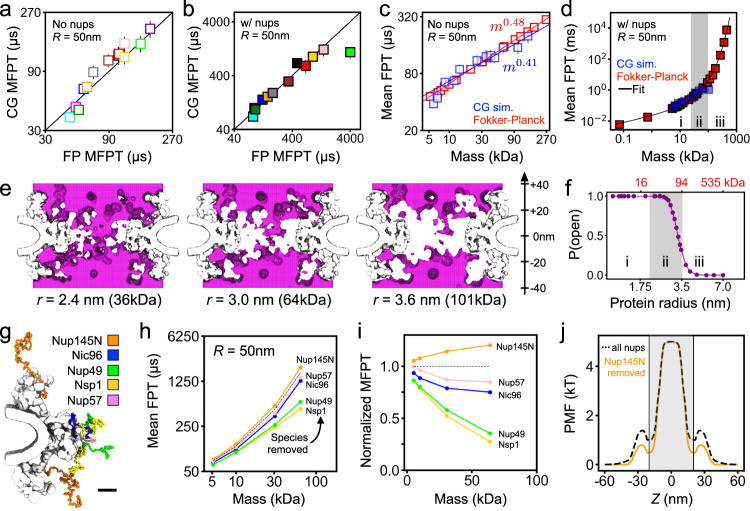
Nuclear pore complexes (NPCs) control biomolecular transport in and out of the nucleus. Disordered nucleoporins in the complex's pore form a permeation barrier, preventing unassisted transport of large biomolecules. Here, we combine coarse-grained simulations of experimentally derived NPC structures with a theoretical model to determine the microscopic mechanism of passive transport. Brute-force simulations of protein transport reveal telegraph-like behavior, where prolonged diffusion on one side of the NPC is interrupted by rapid crossings to the other. We rationalize this behavior using a theoretical model that reproduces the energetics and kinetics of permeation solely from statistics of transient voids within the disordered mesh. As the protein size increases, the mesh transforms from a soft to a hard barrier, enabling orders-of-magnitude reduction in permeation rate for proteins beyond the percolation size threshold. Our model enables exploration of alternative NPC architectures and sets the stage for uncovering molecular mechanisms of facilitated nuclear transport.
核孔复合体 (NPC) 控制着核内外生物分子的运输。复合物孔中的紊乱核孔蛋白形成了渗透屏障,阻止了大生物分子的无辅助运输。在这里,我们将实验得出的 NPC 结构的粗粒化模拟与理论模型相结合,以确定被动运输的微观机制。对蛋白质运输的暴力模拟揭示了类似电报的行为,其中 NPC 一侧的长时间扩散被快速穿越到另一侧所打断。我们使用一个理论模型来合理化这种行为,该模型仅从无序网格中瞬态空隙的统计数据中再现渗透的能量学和动力学。随着蛋白质尺寸的增加,网格从软屏障转变为硬屏障,使得超过渗透尺寸阈值的蛋白质的渗透速率降低了几个数量级。我们的模型能够探索替代的 NPC 结构,并为揭示促进核运输的分子机制奠定基础。