Department and Graduate Institute of Pharmacology, National Taiwan University College of Medicine, No. 1, Sec. 1, Ren-Ai Rd, 1150R, Taipei, 100, Taiwan.
Division of Cardiology, Department of Internal Medicine and Cardiovascular Center, National Taiwan University Hospital, Taipei, Taiwan.
J Biomed Sci. 2022 Sep 2;29(1):63. doi: 10.1186/s12929-022-00850-x.
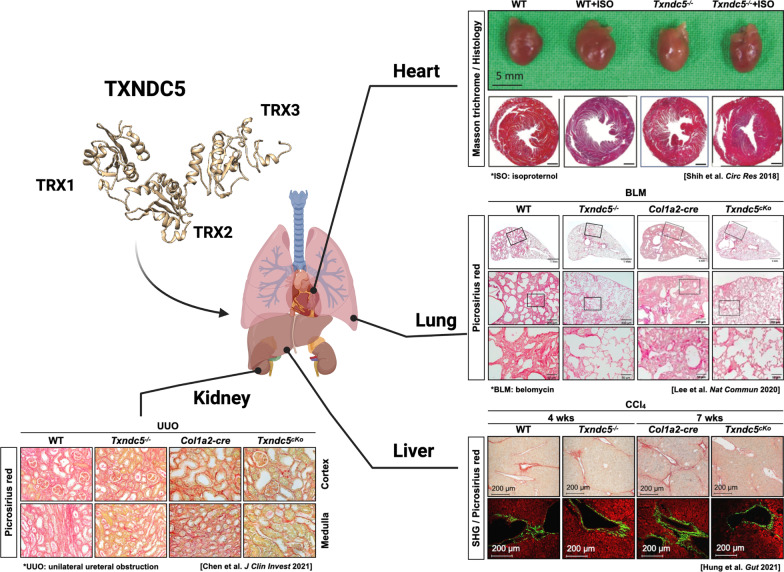
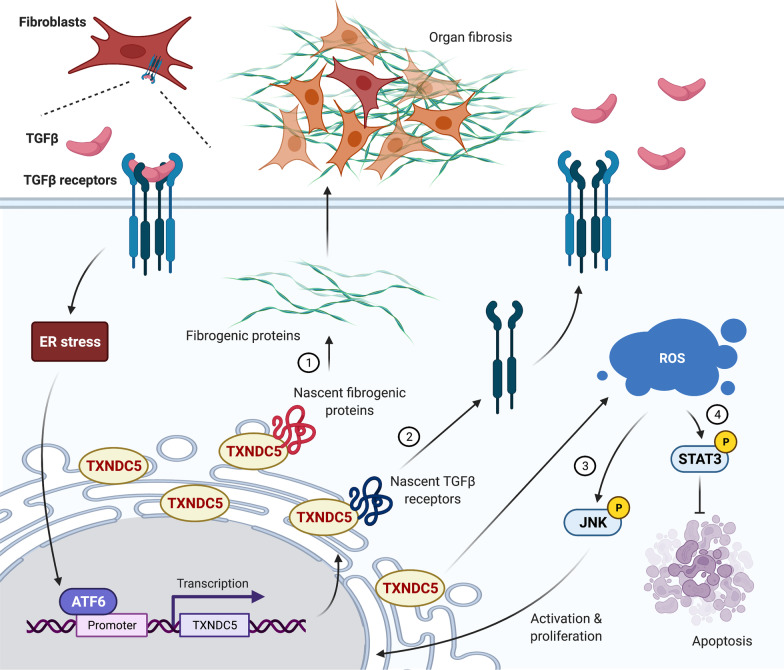
Fibrosis-related disorders account for an enormous burden of disease-associated morbidity and mortality worldwide. Fibrosis is defined by excessive extracellular matrix deposition at fibrotic foci in the organ tissue following injury, resulting in abnormal architecture, impaired function and ultimately, organ failure. To date, there lacks effective pharmacological therapy to target fibrosis per se, highlighting the urgent need to identify novel drug targets against organ fibrosis. Recently, we have discovered the critical role of a fibroblasts-enriched endoplasmic reticulum protein disulfide isomerase (PDI), thioredoxin domain containing 5 (TXNDC5), in cardiac, pulmonary, renal and liver fibrosis, showing TXNDC5 is required for the activation of fibrogenic transforming growth factor-β signaling cascades depending on its catalytic activity as a PDI. Moreover, deletion of TXNDC5 in fibroblasts ameliorates organ fibrosis and preserves organ function by inhibiting myofibroblasts activation, proliferation and extracellular matrix production. In this review, we detailed the molecular and cellular mechanisms by which TXNDC5 promotes fibrogenesis in various tissue types and summarized potential therapeutic strategies targeting TXNDC5 to treat organ fibrosis.
纤维化相关疾病在全球范围内造成了巨大的疾病负担和死亡率。纤维化是指在器官组织损伤后,纤维化病灶中细胞外基质过度沉积,导致组织结构异常、功能受损,最终导致器官衰竭。迄今为止,尚无有效的针对纤维化本身的药理学治疗方法,这凸显了迫切需要针对器官纤维化确定新的药物靶点。最近,我们发现富含成纤维细胞的内质网蛋白二硫键异构酶(PDI)、硫氧还蛋白域包含 5(TXNDC5)在心脏、肺、肾和肝纤维化中的关键作用,表明 TXNDC5 依赖其作为 PDI 的催化活性,对纤维生成转化生长因子-β信号级联的激活是必需的。此外,成纤维细胞中 TXNDC5 的缺失通过抑制肌成纤维细胞的激活、增殖和细胞外基质的产生,改善了器官纤维化并维持了器官功能。在这篇综述中,我们详细描述了 TXNDC5 在各种组织类型中促进纤维化发生的分子和细胞机制,并总结了针对 TXNDC5 治疗器官纤维化的潜在治疗策略。