TLC Infertility & Donor Services, 1920 Hillhurst Ave, Los Angeles, CA, 90027, USA.
Stanford Fertility and Reproductive Health Services, 1195 W Fremont Ave, Sunnyvale, CA, 94087, USA.
Reprod Biol Endocrinol. 2022 Sep 1;20(1):131. doi: 10.1186/s12958-022-01004-2.
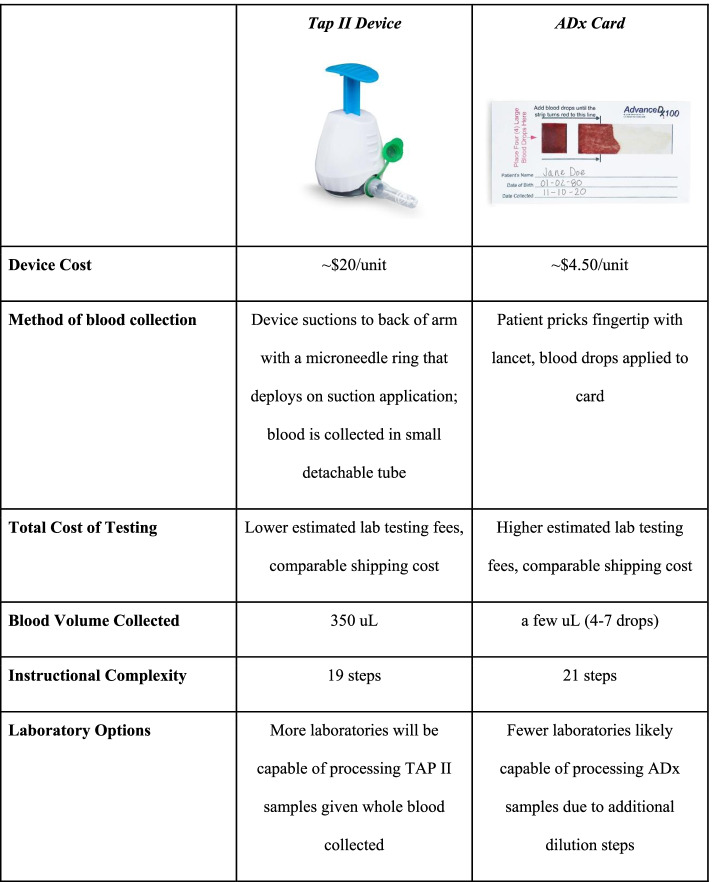
For optimal fertility testing, serum anti-Müllerian hormone levels are used in combination with other testing to provide reliable ovarian reserve evaluations. The use of the ADx 100 card is widely commercially available for at-home reproductive hormone testing, but data demonstrating that its results are reproducible outside of a clinical setting are limited, as well as comparisons of its performance with other newer blood collection techniques. This study aimed to evaluate the concordance of serum AMH levels found via standard venipuncture and self-administered blood collection using the TAP II device (TAP) and ADx card in women of reproductive age.
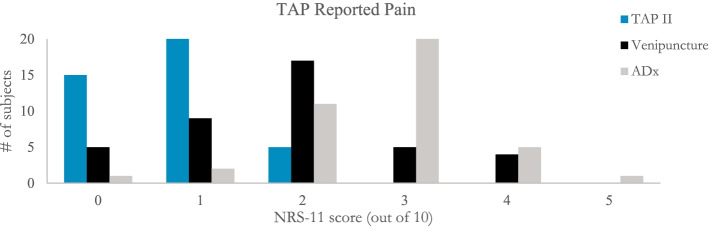
This was a prospective, head-to-head-to-head within-person crossover comparison trial that included 41 women of reproductive age (20-39 years). It was hypothesized that the TAP device would be superior to the ADx card both in terms of agreement with venipuncture reference standard and patient experience. Each subject had their blood drawn using the three modalities (TAP, ADx, and venipuncture). We evaluated the concordance of AMH assays from samples obtained via the TAP device and ADx card with the gold standard being venipuncture. Two-sided 95% CIs were generated for each method to compare relative performance across all three modes. Patient preference for the TAP device versus the ADx card was based on self-reported pain and Net Promoter Score (NPS).
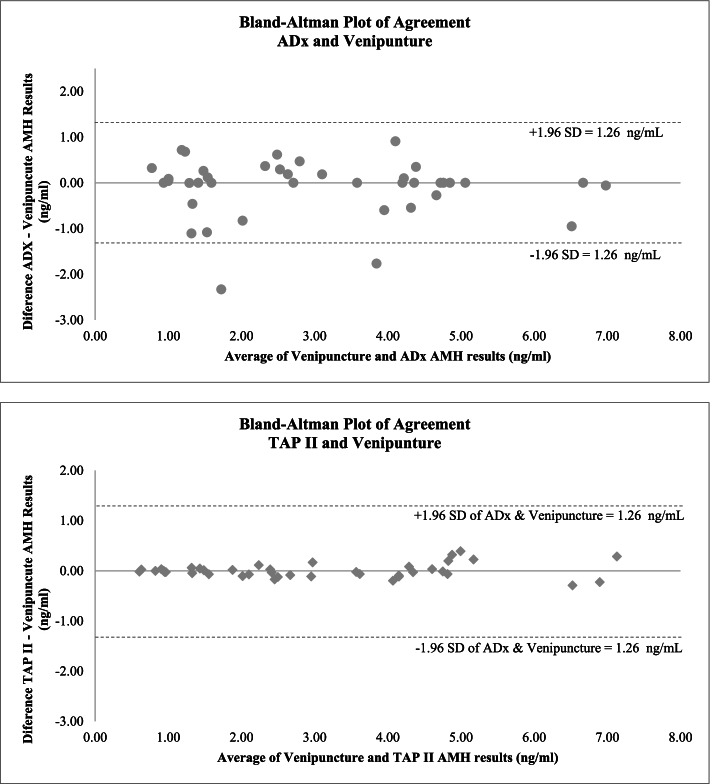
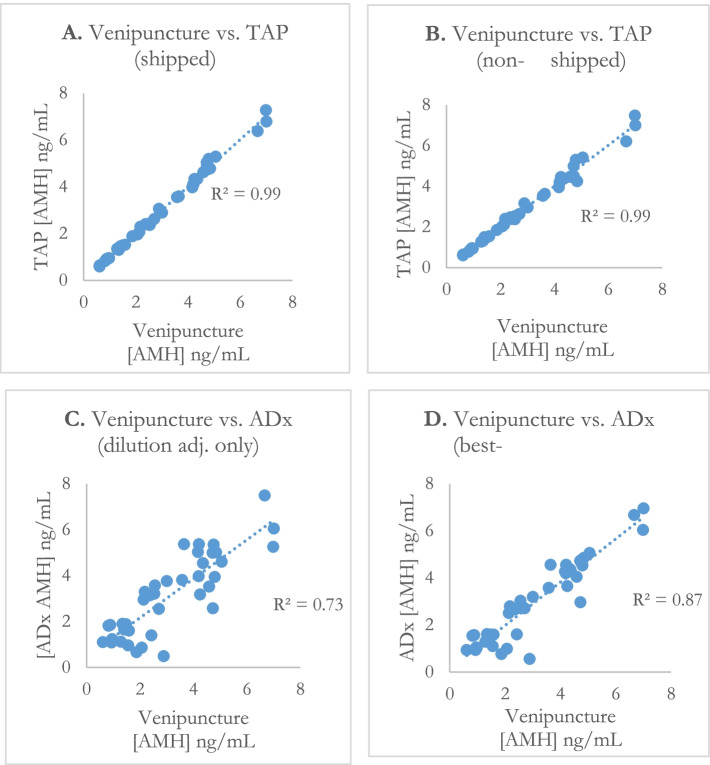
The TAP device was superior to the ADx card on all outcome measures. TAP R-squared with venipuncture was 0.99 (95% CI 0.99, > 0.99), significantly higher than the ADx card, which had an R-squared of 0.87 (95% CI 0.80, 0.94) under most favorable treatment. TAP sensitivity and specificity were both 100% (no clinical disagreement with venipuncture), versus 100 and 88%, respectively, for the ADx card. Average pain reported by users of the TAP device was significantly lower than the ADx card (0.75 versus 2.73, p < 0.01) and the NPS was significantly higher than the ADx card (+ 72 versus - 48, p < 0.01).
The TAP was non-inferior to venipuncture and superior to the ADx card with respect to correlation and false positives. Moreover, the TAP was superior to both alternatives on patient experience.
NCT04784325 (Mar 5, 2021).
为了获得最佳的生育力检测结果,血清抗苗勒管激素(AMH)水平与其他检测方法结合使用,为可靠的卵巢储备评估提供依据。ADx 100 卡广泛应用于家庭生殖激素检测,但数据表明其在临床环境之外的结果具有可重复性,并且其性能与其他较新的血液采集技术相比也存在差异。本研究旨在评估通过标准静脉穿刺和使用 TAP II 设备(TAP)和 ADx 卡进行的自我采血进行血清 AMH 水平检测的一致性,以评估其在生育期女性中的应用。
这是一项前瞻性、头对头、个体内交叉比较试验,纳入 41 名生育期女性(20-39 岁)。假设 TAP 设备在与静脉穿刺参考标准的一致性和患者体验方面均优于 ADx 卡。每位受试者均采用三种方法(TAP、ADx 和静脉穿刺)采集血液样本。我们评估了 TAP 设备和 ADx 卡获得的 AMH 检测结果与金标准静脉穿刺的一致性。生成每种方法的双侧 95%置信区间,以比较所有三种模式的相对性能。患者对 TAP 设备与 ADx 卡的偏好基于自我报告的疼痛和净推荐值(NPS)。
在所有结果测量中,TAP 设备均优于 ADx 卡。TAP 与静脉穿刺的 R 平方值为 0.99(95%置信区间 0.99,>0.99),明显高于 ADx 卡(最有利治疗条件下 R 平方值为 0.87,95%置信区间 0.80,0.94)。TAP 的灵敏度和特异性均为 100%(与静脉穿刺无临床差异),而 ADx 卡的灵敏度和特异性分别为 100%和 88%。使用 TAP 设备的患者报告的平均疼痛明显低于 ADx 卡(0.75 与 2.73,p<0.01),NPS 明显高于 ADx 卡(+72 与-48,p<0.01)。
TAP 与静脉穿刺相比非劣效,与 ADx 卡相比相关性和假阳性更高。此外,TAP 在患者体验方面也优于其他两种方法。
NCT04784325(2021 年 3 月 5 日)。