
数据驱动的实施映射方法选择实施策略:以风险调整的膀胱癌监测为例。
Data-driven approach to implementation mapping for the selection of implementation strategies: a case example for risk-aligned bladder cancer surveillance.
机构信息
White River Junction VA Medical Center, White River Junction, VT, USA.
Section of Urology, Dartmouth Hitchcock Medical Center, Lebanon, NH, USA.
出版信息
Implement Sci. 2022 Sep 1;17(1):58. doi: 10.1186/s13012-022-01231-6.
BACKGROUND
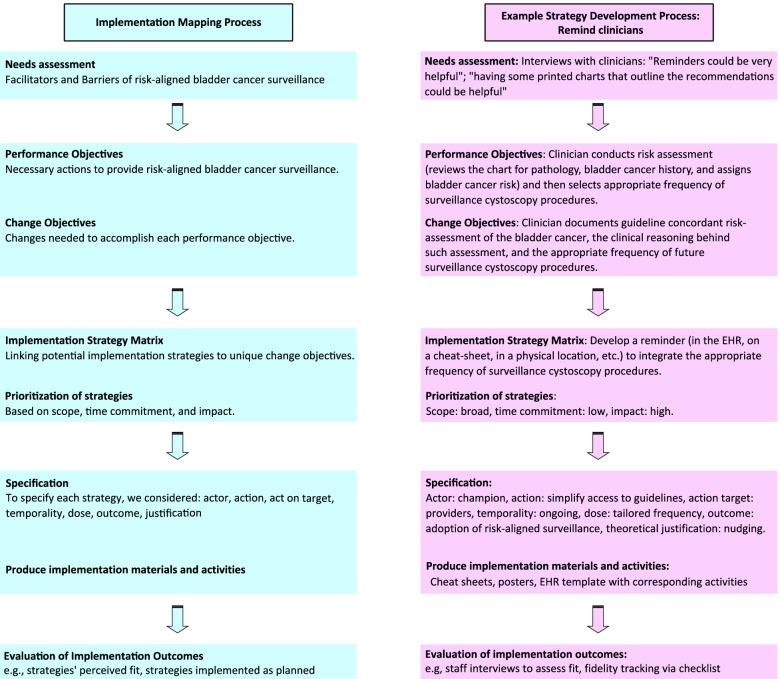
Implementation Mapping is an organized method to select implementation strategies. However, there are 73 Expert Recommendations for Implementing Change (ERIC) strategies. Thus, it is difficult for implementation scientists to map all potential strategies to the determinants of their chosen implementation science framework. Prior work using Implementation Mapping employed advisory panels to select implementation strategies. This article presents a data-driven approach to implementation mapping, in which we systematically evaluated all 73 ERIC strategies using the Tailored Implementation for Chronic Diseases (TICD) framework. We illustrate our approach using implementation of risk-aligned bladder cancer surveillance as a case example.
METHODS
We developed objectives based on previously collected qualitative data organized by TICD determinants, i.e., what needs to be changed to achieve more risk-aligned surveillance. Next, we evaluated all 73 ERIC strategies, excluding those that were not applicable to our clinical setting. The remaining strategies were mapped to the objectives using data visualization techniques to make sense of the large matrices. Finally, we selected strategies with high impact, based on (1) broad scope, defined as a strategy addressing more than the median number of objectives, (2) requiring low or moderate time commitment from clinical teams, and (3) evidence of effectiveness from the literature.
RESULTS
We identified 63 unique objectives. Of the 73 ERIC strategies, 45 were excluded because they were not applicable to our clinical setting (e.g., not feasible within the confines of the setting, not appropriate for the context). Thus, 28 ERIC strategies were mapped to the 63 objectives. Strategies addressed 0 to 26 objectives (median 10.5). Of the 28 ERIC strategies, 10 required low and 8 moderate time commitments from clinical teams. We selected 9 strategies based on high impact, each with a clearly documented rationale for selection.
CONCLUSIONS
We enhanced Implementation Mapping via a data-driven approach to the selection of implementation strategies. Our approach provides a practical method for other implementation scientists to use when selecting implementation strategies and has the advantage of favoring data-driven strategy selection over expert opinion.
背景
实施映射是一种有组织的方法,用于选择实施策略。然而,有 73 种用于实施变革的专家建议(ERIC)策略。因此,实施科学家很难将所有潜在策略映射到他们选择的实施科学框架的决定因素上。以前使用实施映射的工作使用顾问小组来选择实施策略。本文提出了一种数据驱动的实施映射方法,其中我们使用定制的慢性病实施(TICD)框架系统地评估了所有 73 种 ERIC 策略。我们以实施风险调整的膀胱癌监测为例来说明我们的方法。
方法
我们根据 TICD 决定因素组织的先前收集的定性数据制定目标,即需要改变什么才能实现更具风险调整的监测。接下来,我们评估了所有 73 种 ERIC 策略,不包括那些不适用于我们临床环境的策略。使用数据可视化技术将剩余策略映射到目标上,以理解大型矩阵。最后,我们根据(1)广泛的范围,即一种策略解决的目标多于中位数数量,(2)临床团队所需的时间投入低或适中,以及(3)来自文献的有效性证据,选择具有高影响力的策略。
结果
我们确定了 63 个独特的目标。在 73 种 ERIC 策略中,有 45 种因不适用于我们的临床环境而被排除(例如,在环境限制内不可行,不适合背景)。因此,28 种 ERIC 策略被映射到 63 个目标。策略解决了 0 到 26 个目标(中位数为 10.5)。在 28 种 ERIC 策略中,有 10 种需要临床团队投入低时间,有 8 种需要中等时间。我们根据高影响力选择了 9 种策略,每种策略都有明确记录的选择理由。
结论
我们通过数据驱动的方法增强了实施映射,以选择实施策略。我们的方法为其他实施科学家提供了一种实用的方法,用于选择实施策略,并且具有有利于数据驱动的策略选择而不是专家意见的优势。


 Zotero 插件