Chinese PLA Medical School, Beijing 100853, China.
Department of General Surgery, The First Medical Center, Chinese PLA General Hospital, Beijing 100853, China.
Breast J. 2022 Aug 22;2022:2500594. doi: 10.1155/2022/2500594. eCollection 2022.
Metaplastic breast carcinoma is a rare special type of breast cancer, which has distinguished clinical characteristics. We aimed to evaluate the clinicopathological features of metaplastic breast carcinoma compared with nonspecific invasive breast carcinoma and study the prognosis of metaplastic breast carcinoma.
We reviewed metaplastic breast carcinoma cases ( = 37) from January 2000 to December 2021 and nonspecific invasive breast carcinoma cases ( = 433) from January 2019 to December 2020 extracted from our institution retrospectively. The following variables were recorded, including the patients' general information, complications, T stage, expression of estrogen receptor, progesterone receptor, human epidermal growth factor receptor 2, Ki-67, molecular subtyping, lymph node status, skin or chest wall involvement, vessel carcinoma embolus, therapy modality (surgical treatments, chemotherapy, and radiotherapy), and survival.
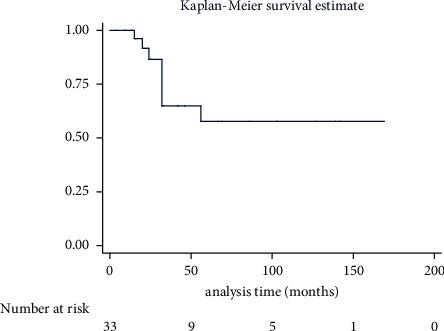
Patients with metaplastic breast carcinoma had more advanced disease than patients with nonspecific invasive breast carcinoma (T stage: =0.0011). A greater proportion of metaplastic breast carcinoma presented with triple-negative breast cancer than nonspecific invasive breast carcinoma (79.41% vs. 12.47%, ≤ 0.001). Our study showed that the skin or chest wall invasion was more frequent in metaplastic breast carcinoma patients (11.76% vs. 1.62%, =0.005). The 5-year survival rate for metaplastic breast carcinoma patients was 57.66% (95% CI: 0.3195∼0.7667). No local recurrence was observed while distant metastasis occurred in 33.33% of patients with metaplastic breast carcinoma. Death due to disease occurred in 24.24% of patients with metaplastic breast carcinoma.
The majority of metaplastic breast carcinoma patients had more advanced disease and triple-negative disease than nonspecific invasive breast carcinoma patients. Also, metaplastic breast carcinoma patients had frequent skin or chest wall invasion and a high rate of distant metastasis and mortality.
化生性乳腺癌是一种罕见的特殊类型乳腺癌,具有独特的临床特征。我们旨在评估化生性乳腺癌与非特异性浸润性乳腺癌的临床病理特征,并研究化生性乳腺癌的预后。
我们回顾性地从我们机构中提取了 2000 年 1 月至 2021 年 12 月的化生性乳腺癌病例(n=37)和 2019 年 1 月至 2020 年 12 月的非特异性浸润性乳腺癌病例(n=433)。记录了以下变量,包括患者的一般信息、并发症、T 分期、雌激素受体、孕激素受体、人表皮生长因子受体 2、Ki-67、分子亚型、淋巴结状态、皮肤或胸壁受累、脉管癌栓、治疗方式(手术治疗、化疗、放疗)和生存情况。
与非特异性浸润性乳腺癌患者相比,化生性乳腺癌患者的疾病更为晚期(T 分期:=0.0011)。化生性乳腺癌患者中三阴性乳腺癌的比例高于非特异性浸润性乳腺癌(79.41%比 12.47%,≤0.001)。我们的研究表明,化生性乳腺癌患者皮肤或胸壁侵犯更为常见(11.76%比 1.62%,=0.005)。化生性乳腺癌患者的 5 年生存率为 57.66%(95%可信区间:0.3195~0.7667)。未观察到局部复发,而化生性乳腺癌患者中有 33.33%发生远处转移。化生性乳腺癌患者中有 24.24%死于疾病。
大多数化生性乳腺癌患者的疾病比非特异性浸润性乳腺癌更为晚期且为三阴性疾病。此外,化生性乳腺癌患者皮肤或胸壁侵犯频繁,远处转移和死亡率高。