Department of Breast Surgery, The Third Affiliated Hospital of Harbin Medical University, 150 Haping Road, Harbin 150081, China.
World J Surg Oncol. 2013 Jun 6;11:129. doi: 10.1186/1477-7819-11-129.
Metaplastic breast carcinoma is a rare aggressive malignant neoplasm. The purposes of this study are to review the pathologic features and clinical outcomes of metaplastic breast carcinoma compared to invasive ductal carcinoma and to evaluate the prognosis of metaplastic breast carcinoma.
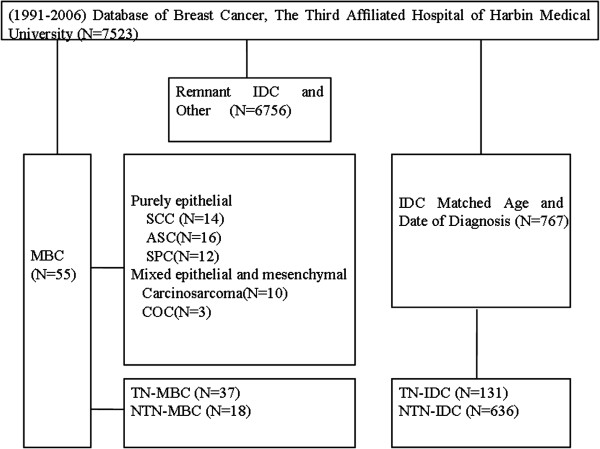
The cases of 55 patients with metaplastic breast carcinoma presenting between 1991 and 2006 were analyzed and compared to the cases of 767 age-matched patients with invasive ductal carcinoma from the same time period.
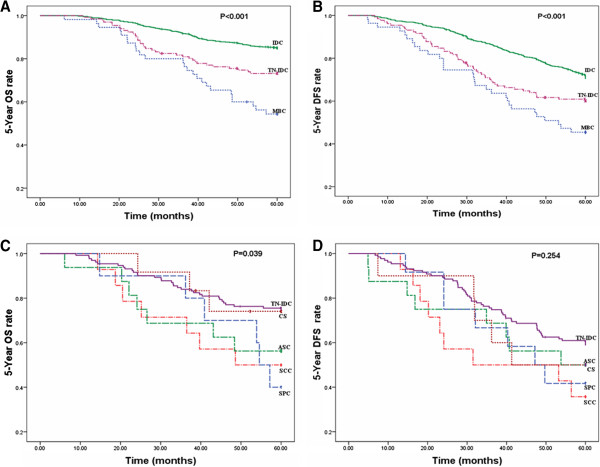
The group of patients with metaplastic breast carcinoma presented with a larger tumor size, lower lymph node involvement, higher percentage of triple-negative (estrogen receptor-, progesterone receptor- and human epidermal growth factor receptor-2-negative) cases, and Ki-67 over-expression compared with the group of patients with invasive ductal carcinoma and triple-negative invasive ductal carcinomas. Patients in the metaplastic breast carcinoma group tended to have more local (often chest wall) recurrences (P = 0.038) and distant (often lung) metastases (P = 0.001) than those in the invasive ductal carcinomas group. The prognosis of metaplastic breast carcinoma was poorer than that of invasive ductal carcinoma and triple-negative invasive ductal carcinomas; the 5-year overall survival rate was 54.5% in metaplastic breast carcinoma versus 85.1% in invasive ductal carcinoma, and 73.3% in triple-negative invasive ductal carcinomas (P <0.001). The 5-year disease-free survival rate was 45.5% in metaplastic breast carcinoma versus 71.2% in invasive ductal carcinoma, and 60.3% in triple-negative invasive ductal carcinomas (P <0.001). Multivariate analysis revealed tumor size larger than 5.0 cm, lymph node involvement and Ki-67≥14% were significantly related to 5-year overall survival (P = 0.010; P = 0.010; P = 0.035) and 5-year disease-free survival (P = 0.020; P = 0.018; P = 0.049).
Metaplastic breast carcinoma shows a poorer prognosis than both invasive ductal carcinoma and triple-negative invasive ductal carcinomas. Tumor size larger than 5.0 cm, lymph node involvement and Ki-67 ≥14% indicate a poor prognosis in patients with metaplastic breast carcinoma.
化生性乳腺癌是一种罕见的侵袭性恶性肿瘤。本研究旨在回顾化生性乳腺癌与浸润性导管癌的病理特征和临床结局,并评估化生性乳腺癌的预后。
分析了 1991 年至 2006 年间 55 例化生性乳腺癌患者的病例,并与同期 767 例年龄匹配的浸润性导管癌患者的病例进行比较。
与浸润性导管癌和三阴性浸润性导管癌相比,化生性乳腺癌组患者的肿瘤体积较大,淋巴结受累较少,三阴性(雌激素受体、孕激素受体和人表皮生长因子受体-2 阴性)病例比例较高,Ki-67 过度表达。与浸润性导管癌组相比,化生性乳腺癌组患者更倾向于局部(常为胸壁)复发(P = 0.038)和远处(常为肺部)转移(P = 0.001)。化生性乳腺癌的预后比浸润性导管癌和三阴性浸润性导管癌差;5 年总生存率分别为 54.5%和 85.1%,三阴性浸润性导管癌为 73.3%(P <0.001)。5 年无病生存率分别为 45.5%、71.2%和 60.3%,三阴性浸润性导管癌为 60.3%(P <0.001)。多变量分析显示,肿瘤大小>5.0 cm、淋巴结受累和 Ki-67≥14%与 5 年总生存率(P = 0.010;P = 0.010;P = 0.035)和 5 年无病生存率(P = 0.020;P = 0.018;P = 0.049)显著相关。
化生性乳腺癌的预后比浸润性导管癌和三阴性浸润性导管癌差。肿瘤大小>5.0 cm、淋巴结受累和 Ki-67≥14%提示化生性乳腺癌患者预后不良。