Huynh Jasmine, Cho May Thet, Kim Edward Jae-Hoon, Ren Min, Ramji Zahra, Vogel Arndt
University of California Davis Comprehensive Center, Sacramento, CA, USA.
University of California Irvine Health, Orange, CA, USA.
Ther Adv Med Oncol. 2022 Aug 24;14:17588359221116608. doi: 10.1177/17588359221116608. eCollection 2022.
Lenvatinib is an approved first-line treatment for unresectable hepatocellular carcinoma (uHCC). We evaluated the safety and efficacy of lenvatinib sorafenib in patients with uHCC who deteriorated to Child-Pugh class B (CP-B) on treatment.
We retrospectively evaluated patients from REFLECT who deteriorated to CP-B those who remained Child-Pugh class A (CP-A) within 8 weeks after randomization. Best overall response and objective response rate (ORR) per modified Response Evaluation Criteria In Solid Tumors (mRECIST) were assessed from baseline. Progression-free survival (PFS) per mRECIST and overall survival (OS) were assessed beginning at week 8.
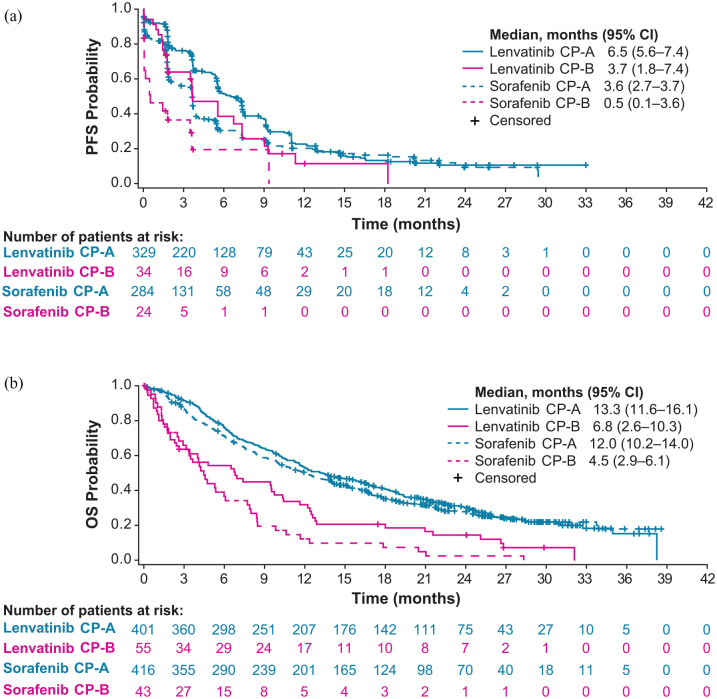
Patients with CP-B CP-A classification receiving lenvatinib had ORRs of 28.3 and 42.9%, respectively; patients with CP-B CP-A classification receiving sorafenib had ORRs of 8.5 and 12.9%, respectively. Median PFS and OS (landmark analyses beginning at week 8) in patients receiving lenvatinib were 3.7 months [95% confidence interval (CI): 1.8-7.4] and 6.8 months (95% CI: 2.6-10.3) in the CP-B subgroup 6.5 months (95% CI: 5.6-7.4) and 13.3 months (95% CI: 11.6-16.1) in the CP-A subgroup, respectively. Median PFS and OS in patients receiving sorafenib were 0.5 months (95% CI: 0.1-3.6) and 4.5 months (95% CI: 2.9-6.1) in the CP-B subgroup 3.6 months (95% CI: 2.7-3.7) and 12.0 months (95% CI: 10.2-14.0) in the CP-A subgroup, respectively. The most common treatment-emergent adverse events in the lenvatinib cohort were hypertension (both subgroups) and decreased appetite (CP-B subgroup).
Results suggest that patients with uHCC whose liver function deteriorates to CP-B after initiation of therapy may continue to receive lenvatinib.
ClinicalTrials.gov, NCT01761266, https://clinicaltrials.gov/ct2/show/NCT01761266.
仑伐替尼是一种已获批用于不可切除肝细胞癌(uHCC)的一线治疗药物。我们评估了仑伐替尼与索拉非尼在治疗过程中肝功能恶化至Child-Pugh B级(CP-B)的uHCC患者中的安全性和疗效。
我们回顾性评估了来自REFLECT研究中在随机分组后8周内肝功能恶化至CP-B级的患者以及仍为Child-Pugh A级(CP-A)的患者。根据改良的实体瘤疗效评价标准(mRECIST)评估从基线开始的最佳总体缓解和客观缓解率(ORR)。从第8周开始评估根据mRECIST标准的无进展生存期(PFS)和总生存期(OS)。
CP-B级和CP-A级接受仑伐替尼治疗的患者的ORR分别为28.3%和42.9%;CP-B级和CP-A级接受索拉非尼治疗的患者的ORR分别为8.5%和12.9%。接受仑伐替尼治疗的患者中,CP-B亚组的中位PFS和OS(从第8周开始的标志性分析)分别为3.7个月[95%置信区间(CI):1.8 - 7.4]和6.8个月(95% CI:2.6 - 10.3),CP-A亚组分别为6.5个月(95% CI:5.6 - 7.4)和13.3个月(95% CI:11.6 - 16.1)。接受索拉非尼治疗的患者中,CP-B亚组的中位PFS和OS分别为0.5个月(95% CI:0.1 - 3.6)和4.5个月(95% CI:2.9 - 6.1),CP-A亚组分别为3.6个月(95% CI:2.7 - 3.7)和12.0个月(95% CI:10.2 - 14.0)。仑伐替尼队列中最常见的治疗中出现的不良事件是高血压(两个亚组)和食欲减退(CP-B亚组)。
结果表明,治疗开始后肝功能恶化至CP-B级的uHCC患者可能继续接受仑伐替尼治疗。
ClinicalTrials.gov,NCT01761266,https://clinicaltrials.gov/ct2/show/NCT01761266 。