Machino Masaaki, Nakashima Hiroaki, Ito Keigo, Tsushima Mikito, Ando Kei, Kobayashi Kazuyoshi, Imagama Shiro
Department of Orthopedic Surgery, Nagoya University Graduate School of Medicine, Nagoya, Japan.
Department of Orthopedic Surgery, Chubu Rosai Hospital, Japan Organization of Occupational Health and Safety, Nagoya, Japan.
Spine Surg Relat Res. 2021 Dec 14;6(4):379-387. doi: 10.22603/ssrr.2021-0187. eCollection 2022.
Intervertebral disk degeneration is a universal and natural process. However, no reports have summarized anatomical age-related intervertebral disk height and disk degenerative changes in the thoracolumbar spine or examined sex-specific differences. This study aimed to establish age-related changes and gender-specific differences of intervertebral disk height and disk degeneration of the thoracolumbar spine in a large cohort of relatively healthy subjects and also to evaluate the relationship between the degree of thoracolumbar disk height and disk degeneration.
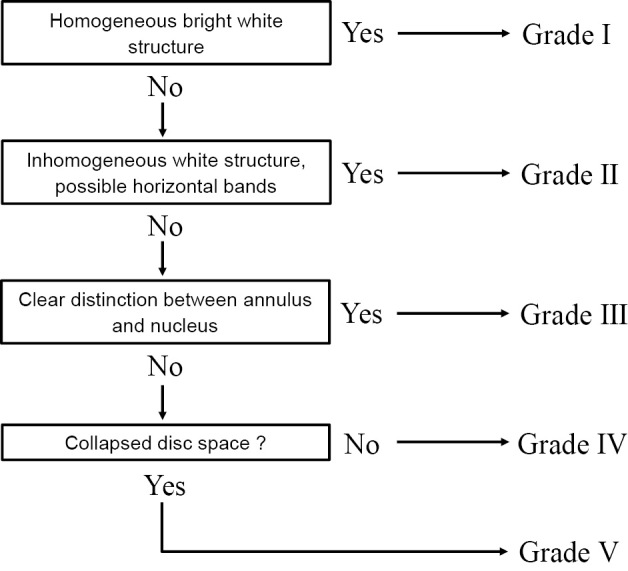
Six hundred and twenty-seven relatively healthy subjects (307 males and 320 females; average age, 49.6±16.5 years) were enrolled. We included at least 50 males and 50 females in each decade of life between the 20s and the 70s. We measured intervertebral disk height from T10/T11 to L5/S1, vertebral body height from T10 to S1 on lateral neutral radiographs. Lumbar disk degeneration was defined according to the Pfirrmann classification in sagittal plane magnetic resonance imaging.
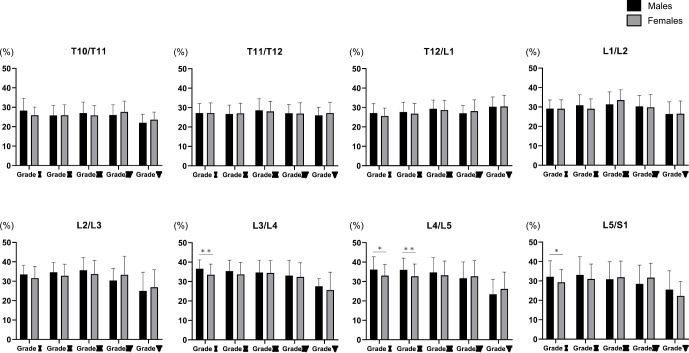
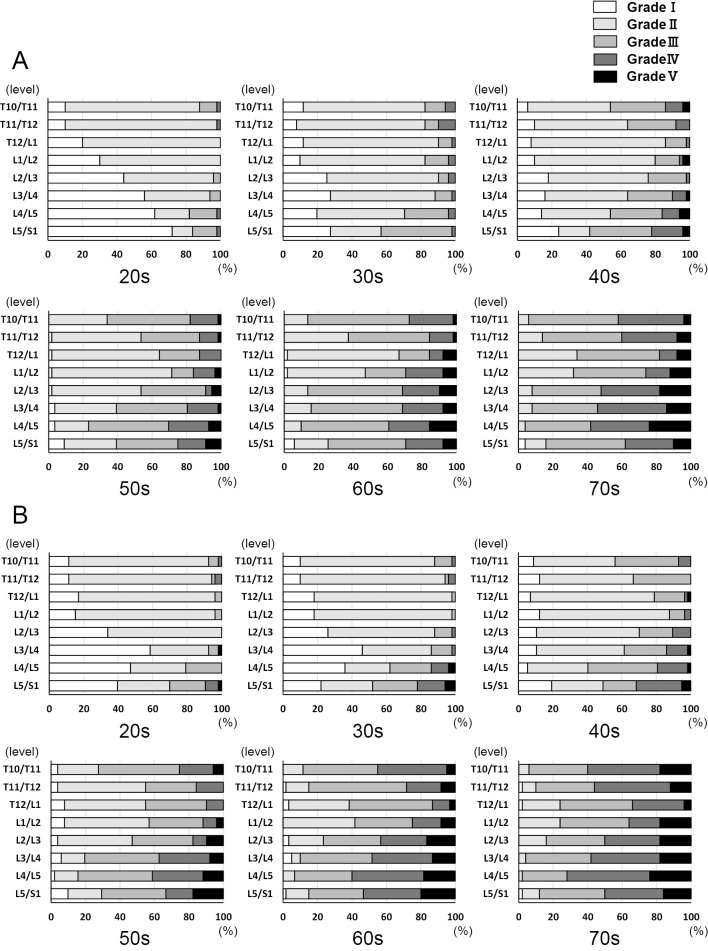
Age-related decreases in intervertebral disk height were most prominent at L4/L5 in middle-aged and elderly individuals of both sexes. The grade of disk degeneration significantly increased with age in both genders at every level. Mild disk degeneration was observed even in the 20s. The disk degeneration occurred around the L4/L5 level. Although grade V disk degeneration was not identified for males in the 20s and the 30s, it appeared after the 40s and then increased further with age. The intervertebral disk height at the lower lumbar disks decreased with a progression in the disk degeneration grade in both genders.
This large-scale cross-sectional analysis of the thoracolumbar spine in relatively healthy subjects demonstrated that lumbar disk height narrowing progresses with age and is correlated with the progression of disk degeneration.
椎间盘退变是一个普遍且自然的过程。然而,尚无报告总结胸腰椎与年龄相关的椎间盘高度及椎间盘退变变化,或研究性别差异。本研究旨在确定一大群相对健康受试者胸腰椎椎间盘高度及椎间盘退变的年龄相关变化和性别差异,并评估胸腰椎椎间盘高度与退变程度之间的关系。
纳入627名相对健康的受试者(男性307名,女性320名;平均年龄49.6±16.5岁)。我们在20多岁至70多岁的每个十年年龄段中,各纳入至少50名男性和50名女性。在中立位侧位X线片上测量从T10/T11至L5/S1的椎间盘高度,以及从T10至S1的椎体高度。根据矢状面磁共振成像的Pfirrmann分级定义腰椎间盘退变。
在中年及老年男女中,L4/L5节段的椎间盘高度随年龄下降最为显著。在各个节段,椎间盘退变程度均随年龄显著增加。即使在20多岁时也观察到轻度椎间盘退变。椎间盘退变发生在L4/L5节段周围。虽然20多岁和30多岁的男性未发现V级椎间盘退变,但40多岁后出现,且随后随年龄进一步增加。男女两性下腰椎椎间盘高度均随椎间盘退变程度进展而降低。
这项对相对健康受试者胸腰椎的大规模横断面分析表明,腰椎间盘高度变窄随年龄进展,且与椎间盘退变进展相关。