Department of Immunology, Fukushima Medical University, Fukushima, Japan.
Radioisotope Research Center, Fukushima Medical University, Fukushima, Japan.
Front Immunol. 2022 Aug 16;13:907023. doi: 10.3389/fimmu.2022.907023. eCollection 2022.
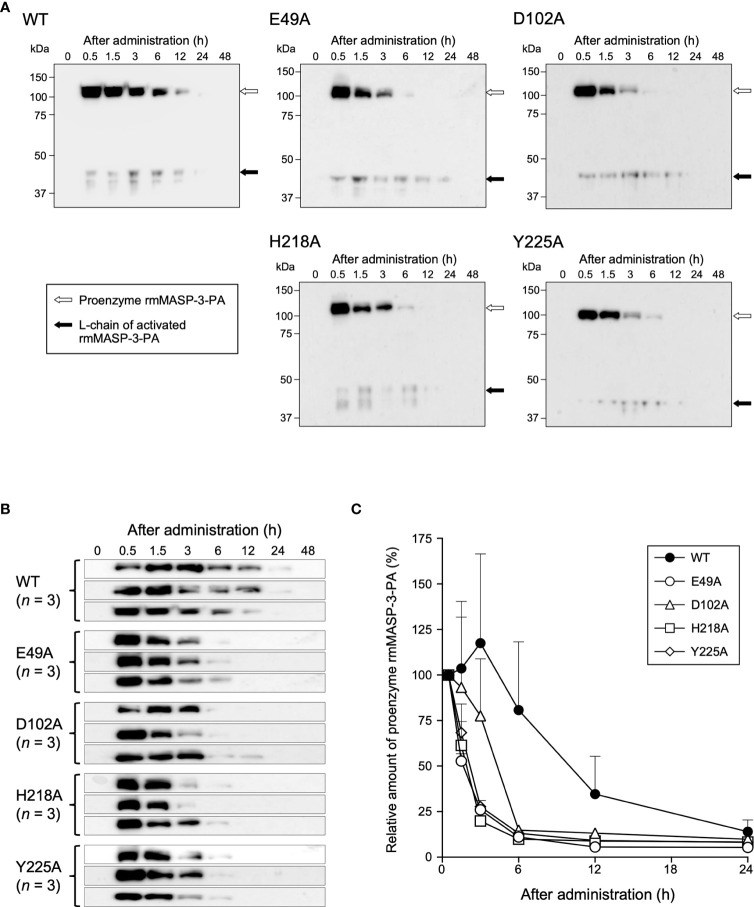
The complement system plays an important role in host defense and is activated three different activation pathways. We have previously reported that mannose-binding lectin-associated serine protease (MASP)-3, unlike its splicing variant MASP-1, circulates in an active form and is essential for the activation of the alternative pathway (AP) the activation of complement factor D (FD). On the other hand, like MASP-1 and MASP-2 of the lectin pathway (LP), MASP-3 forms a complex with the pattern recognition molecules (PRMs) of the LP (LP-PRMs). Both MASP-1 and MASP-2 can be activated efficiently when the LP-PRMs complexed with them bind to their ligands. On the other hand, it remains unclear how MASP-3 is activated, or whether complex formation of MASP-3 with LP-PRMs is involved in activation of MASP-3 or its efficiency in the circulation. To address these issues, we generated wild-type (WT) and four mutant recombinant mouse MASP-3 proteins fused with PA (human podoplanin dodecapeptide)-tag (rmMASP-3-PAs), the latter of which have single amino acid substitution for alanine in the CUB1 or CUB2 domain responsible for binding to LP-PRMs. The mutant rmMASP-3-PAs showed significantly reduced complex formation with LP-PRMs when compared with WT rmMASP-3-PA. In the kinetic analysis of MASP-3 activation, both WT and mutant rmMASP-3-PAs were cleaved into the active forms as early as 30 minutes in the circulation of mice, and no significant difference in the efficiency of MASP-3 cleavage was observed throughout an observation period of 48 hours after intravenous administration. All sera collected 3 hours after administration of each rmMASP-3-PA showed full restoration of the active FD and AP activity in MASP-3-deficient mouse sera at the same levels as WT mouse sera. Unexpectedly, all mutant rmMASP-3-PAs showed faster clearance from the circulation than the WT rmMASP-3-PA. To our knowledge, the current study is the first to show kinetics of MASP-3 demonstrating rapid activation and clearance in the circulation. In conclusion, our results demonstrated that the complex formation of MASP-3 with LP-PRMs is not required for activation of MASP-3 or its efficiency, but may contribute to the long-term retention of MASP-3 in the circulation.
补体系统在宿主防御中发挥重要作用,可通过三种不同的激活途径被激活。我们之前曾报道过,不同于其剪接变体 MASP-1,甘露糖结合凝集素相关丝氨酸蛋白酶(MASP)-3 以活性形式循环,并对替代途径(AP)的激活和补体因子 D(FD)的激活至关重要。另一方面,与凝集素途径(LP)的 MASP-1 和 MASP-2 一样,MASP-3 与 LP 的模式识别分子(PRMs)形成复合物(LP-PRMs)。当与它们结合的 LP-PRMs 复合物与配体结合时,MASP-1 和 MASP-2 均可被有效激活。另一方面,MASP-3 如何被激活,或者 MASP-3 与 LP-PRMs 的复合物形成是否参与 MASP-3 的激活或其在循环中的效率,目前仍不清楚。为了解决这些问题,我们生成了野生型(WT)和四个与 PA(人 podoplanin 十二肽)-标签(rmMASP-3-PAs)融合的重组小鼠 MASP-3 蛋白突变体,后者的 CUB1 或 CUB2 结构域中的单个氨基酸被丙氨酸取代,该结构域负责与 LP-PRMs 结合。与 WT rmMASP-3-PA 相比,突变的 rmMASP-3-PAs 与 LP-PRMs 的复合物形成明显减少。在 MASP-3 激活的动力学分析中,WT 和突变的 rmMASP-3-PAs 早在注射后 30 分钟就在小鼠的循环中被切割成活性形式,并且在静脉注射后 48 小时的观察期内,MASP-3 切割的效率没有明显差异。在每种 rmMASP-3-PA 给药后 3 小时收集的所有血清均在与 WT 小鼠血清相同的水平上完全恢复了 MASP-3 缺陷型小鼠血清中的活性 FD 和 AP 活性。出乎意料的是,所有突变的 rmMASP-3-PAs 从循环中的清除速度均快于 WT rmMASP-3-PA。据我们所知,本研究首次展示了 MASP-3 的动力学,表明其在循环中快速激活和清除。总之,我们的结果表明,MASP-3 与 LP-PRMs 的复合物形成对于 MASP-3 的激活或其效率不是必需的,但可能有助于 MASP-3 在循环中的长期保留。