
补体系统凝集素途径的激活、调控、疾病关联及与其他(蛋白水解)系统的相互作用。
The Lectin Pathway of the Complement System-Activation, Regulation, Disease Connections and Interplay with Other (Proteolytic) Systems.
机构信息
Institute of Molecular Life Sciences, HUN-REN Research Centre for Natural Sciences, Hungarian Research Network, 1117 Budapest, Hungary.
Cell Biology and Cell Therapy Group, Research Laboratory, Department of Internal Medicine and Hematology, Semmelweis University, 1085 Budapest, Hungary.
出版信息
Int J Mol Sci. 2024 Jan 26;25(3):1566. doi: 10.3390/ijms25031566.
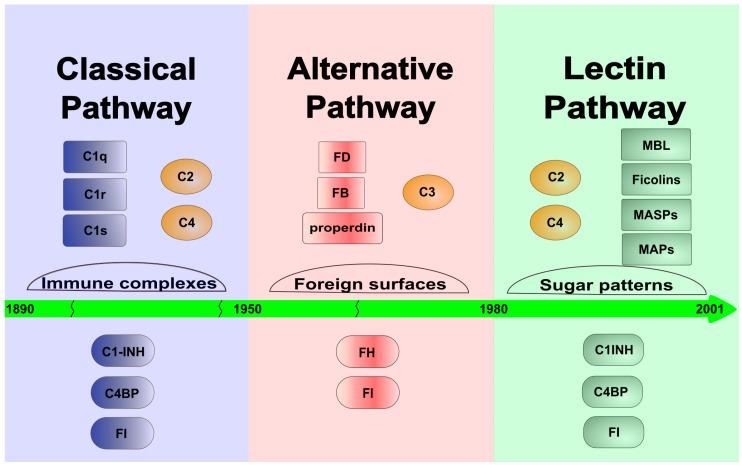
The complement system is the other major proteolytic cascade in the blood of vertebrates besides the coagulation-fibrinolytic system. Among the three main activation routes of complement, the lectin pathway (LP) has been discovered the latest, and it is still the subject of intense research. Mannose-binding lectin (MBL), other collectins, and ficolins are collectively termed as the pattern recognition molecules (PRMs) of the LP, and they are responsible for targeting LP activation to molecular patterns, e.g., on bacteria. MBL-associated serine proteases (MASPs) are the effectors, while MBL-associated proteins (MAps) have regulatory functions. Two serine protease components, MASP-1 and MASP-2, trigger the LP activation, while the third component, MASP-3, is involved in the function of the alternative pathway (AP) of complement. Besides their functions within the complement system, certain LP components have secondary ("moonlighting") functions, e.g., in embryonic development. They also contribute to blood coagulation, and some might have tumor suppressing roles. Uncontrolled complement activation can contribute to the progression of many diseases (e.g., stroke, kidney diseases, thrombotic complications, and COVID-19). In most cases, the lectin pathway has also been implicated. In this review, we summarize the history of the lectin pathway, introduce their components, describe its activation and regulation, its roles within the complement cascade, its connections to blood coagulation, and its direct cellular effects. Special emphasis is placed on disease connections and the non-canonical functions of LP components.
补体系统是脊椎动物血液中除凝血-纤维蛋白溶解系统之外的另一个主要蛋白水解级联。在补体的三条主要激活途径中,凝集素途径(LP)是最新发现的,它仍然是一个研究热点。甘露聚糖结合凝集素(MBL)、其他凝集素和纤维胶凝素统称为 LP 的模式识别分子(PRMs),它们负责将 LP 激活靶向分子模式,例如细菌上的分子模式。MBL 相关丝氨酸蛋白酶(MASPs)是效应物,而 MBL 相关蛋白(MAps)具有调节功能。两种丝氨酸蛋白酶成分,MASP-1 和 MASP-2,触发 LP 激活,而第三个成分,MASP-3,参与补体替代途径(AP)的功能。除了在补体系统中的功能外,某些 LP 成分具有次要(“兼职”)功能,例如在胚胎发育中。它们还参与血液凝固,并且一些可能具有肿瘤抑制作用。补体的不受控制的激活可能导致许多疾病的进展(例如中风、肾脏疾病、血栓并发症和 COVID-19)。在大多数情况下,凝集素途径也与这些疾病有关。在这篇综述中,我们总结了凝集素途径的历史,介绍了它们的成分,描述了其激活和调节、在补体级联中的作用、与血液凝固的关系以及其对细胞的直接作用。特别强调了与疾病的联系以及 LP 成分的非典型功能。



 Zotero 插件