Wang Yun, Wang Yurui, Ren Jialiang, Jia Linyi, Ma Luyao, Yin Xiaoping, Yang Fei, Gao Bu-Lang
Affiliated Hospital of Hebei University/Hebei University (Clinical Medical College), Baoding, China.
Tangshan Gongren Hospital, Tangshan, China.
Front Oncol. 2022 Aug 16;12:966743. doi: 10.3389/fonc.2022.966743. eCollection 2022.
This study was to investigate the diagnostic efficacy of radiomics models based on the enhanced CT images in differentiating the malignant risk of gastrointestinal stromal tumors (GIST) in comparison with the clinical indicators model and traditional CT diagnostic criteria.
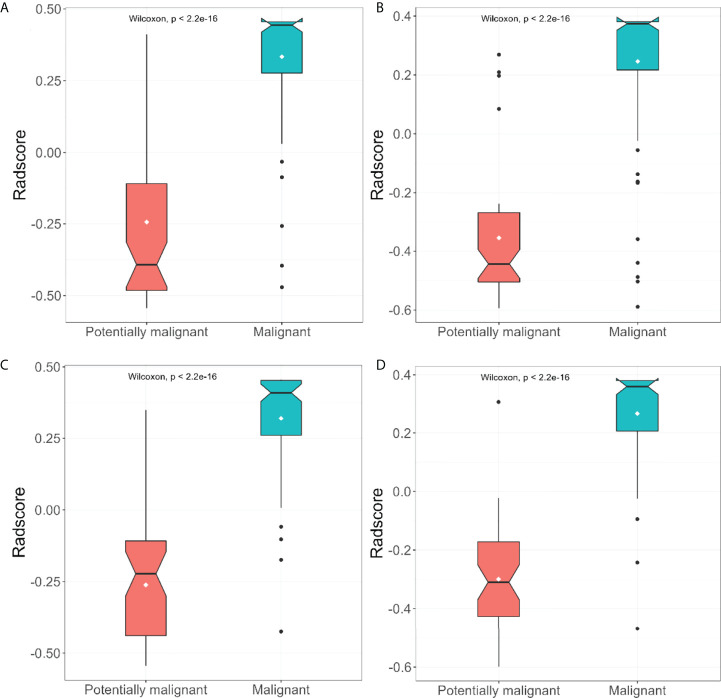
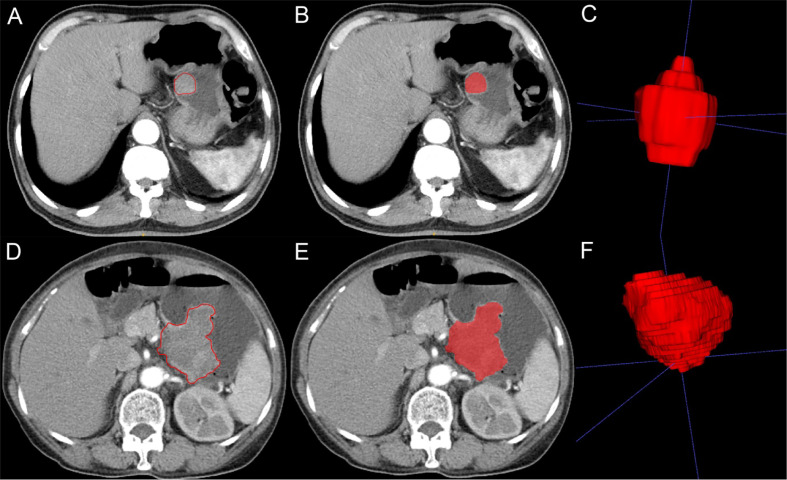
A total of 342 patients with GISTs confirmed histopathologically were enrolled from five medical centers. Data of patients wrom two centers comprised the training group (n=196), and data from the remaining three centers constituted the validation group (n=146). After CT image segmentation and feature extraction and selection, the arterial phase model and venous phase model were established. The maximum diameter of the tumor and internal necrosis were used to establish a clinical indicators model. The traditional CT diagnostic criteria were established for the classification of malignant potential of tumor. The performance of the four models was assessed using the receiver operating characteristics curve.
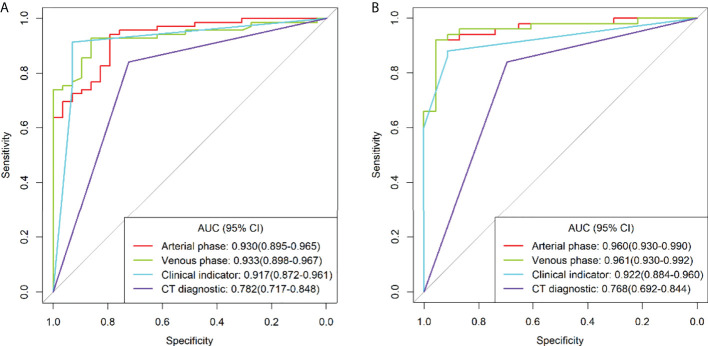
In the training group, the area under the curves(AUCs) of the arterial phase model, venous phase model, clinical indicators model, and traditional CT diagnostic criteria were 0.930 [95% confidence interval (CI): 0.895-0.965), 0.933 (95%CI 0.898-0.967), 0.917 (95%CI 0.872-0.961) and 0.782 (95%CI 0.717-0.848), respectively. In the validation group, the AUCs of the models were 0.960 (95%CI 0.930-0.990), 0.961 (95% CI 0.930-0.992), 0.922 (95%CI 0.884-0.960) and 0.768 (95%CI 0.692-0.844), respectively. No significant difference was detected in the AUC between the arterial phase model, venous phase model, and clinical indicators model by the DeLong test, whereas a significant difference was observed between the traditional CT diagnostic criteria and the other three models.
The radiomics model using the morphological features of GISTs play a significant role in tumor risk stratification and can provide a reference for clinical diagnosis and treatment plan.
本研究旨在探讨基于增强CT图像的放射组学模型在鉴别胃肠道间质瘤(GIST)恶性风险方面的诊断效能,并与临床指标模型和传统CT诊断标准进行比较。
从五个医疗中心纳入342例经组织病理学确诊的GIST患者。来自两个中心的患者数据组成训练组(n = 196),其余三个中心的数据构成验证组(n = 146)。经过CT图像分割、特征提取与选择后,建立动脉期模型和静脉期模型。利用肿瘤最大直径和内部坏死情况建立临床指标模型。建立传统CT诊断标准用于肿瘤恶性潜能分类。采用受试者操作特征曲线评估四种模型的性能。
在训练组中,动脉期模型、静脉期模型、临床指标模型和传统CT诊断标准的曲线下面积(AUC)分别为0.930 [95%置信区间(CI):0.895 - 0.965]、0.933(95%CI 0.898 - 0.967)、0.917(95%CI 0.872 - 0.961)和0.782(95%CI 0.717 - 0.848)。在验证组中,各模型的AUC分别为0.960(95%CI 0.930 - 0.990)、0.961(95%CI 0.930 - 0.992)、0.922(95%CI 0.884 - 0.960)和0.768(95%CI 0.692 - 0.844)。通过DeLong检验,动脉期模型、静脉期模型和临床指标模型的AUC之间未检测到显著差异,而传统CT诊断标准与其他三种模型之间存在显著差异。
利用GIST形态学特征的放射组学模型在肿瘤风险分层中发挥重要作用,可为临床诊断和治疗方案提供参考。