• 文献检索
  • 文档翻译
  • 深度研究
  • 学术资讯
  • Suppr Zotero 插件Zotero 插件
  • 邀请有礼
  • 套餐&价格
  • 历史记录
应用&插件
Suppr Zotero 插件Zotero 插件浏览器插件Mac 客户端Windows 客户端微信小程序
定价
高级版会员购买积分包购买API积分包
服务
文献检索文档翻译深度研究API 文档MCP 服务
关于我们
关于 Suppr公司介绍联系我们用户协议隐私条款
关注我们

Suppr 超能文献

核心技术专利:CN118964589B侵权必究
粤ICP备2023148730 号-1Suppr @ 2026

文献检索

告别复杂PubMed语法,用中文像聊天一样搜索,搜遍4000万医学文献。AI智能推荐,让科研检索更轻松。

立即免费搜索

文件翻译

保留排版,准确专业,支持PDF/Word/PPT等文件格式,支持 12+语言互译。

免费翻译文档

深度研究

AI帮你快速写综述,25分钟生成高质量综述,智能提取关键信息,辅助科研写作。

立即免费体验

数字健康干预对老年人的影响:真实世界用户数据的回顾性分析

The Effects of a Digital Well-being Intervention on Older Adults: Retrospective Analysis of Real-world User Data.

作者信息

Boucher Eliane, Honomichl Ryan, Ward Haley, Powell Tyler, Stoeckl Sarah Elizabeth, Parks Acacia

机构信息

Twill, New York, NY, United States.

出版信息

JMIR Aging. 2022 Sep 2;5(3):e39851. doi: 10.2196/39851.

DOI:10.2196/39851
PMID:36053569
原文链接:https://pmc.ncbi.nlm.nih.gov/articles/PMC9482073/
Abstract

BACKGROUND

Digital interventions have been shown to be effective for a variety of mental health disorders and problems. However, few studies have examined the effects of digital interventions in older adults; therefore, little is known about how older adults engage with or benefit from these interventions. Given that adoption rates for technology among people aged ≥65 years remain substantially lower than in the general population and that approximately 20% of older adults are affected by mental health disorders, research exploring whether older adults will use and benefit from digital interventions is needed.

OBJECTIVE

This study aimed to examine the extent to which older adults engaged with a digital well-being intervention (Happify) and whether engaging with this program led to improvements in both subjective well-being and anxiety symptoms.

METHODS

In this retrospective analysis, we analyzed data from 375 real-world Happify users aged ≥65 years who signed up for the platform between January 1, 2019, and December 23, 2021. Changes in well-being and anxiety symptoms across 42 to 182 days were assessed using responses to the in-app assessment, which users were prompted to take every 2 weeks, and were compared among users who engaged with the program at the recommended level (ie, 2 or more activities per week) or below the recommended level.

RESULTS

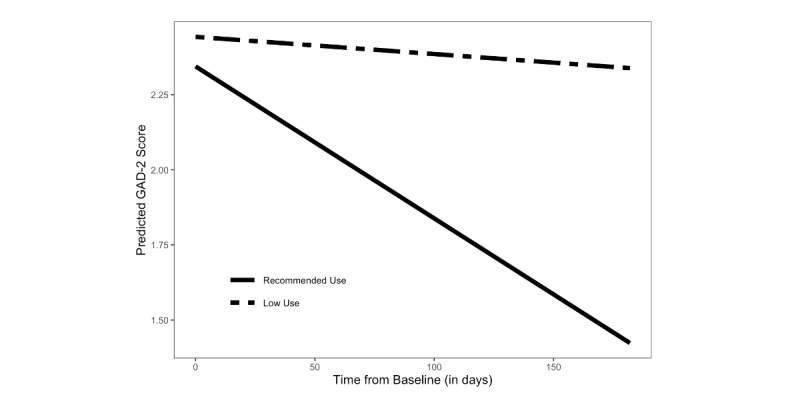
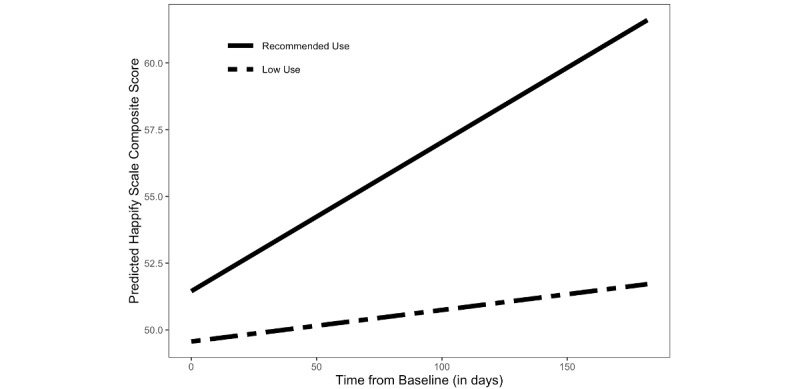
In all, 30% (113/375) of the sample engaged with the platform at the recommended level (ie, completed an average of 2 or more activities per week), and overall, users completed an average of 43.35 (SD 87.80) activities, ranging from 1 to 786, between their first and last assessment. Users were also active on the platform for an average of 19.36 (SD 27.16) days, ranging from 1 to 152 days. Moreover, older adults who engaged at the recommended level experienced significantly greater improvements in subjective well-being (P=.002) and anxiety symptoms (P<.001) relative to those who completed fewer activities.

CONCLUSIONS

These data provide preliminary evidence that older adults engage with and benefit from digital well-being interventions. We believe that these findings highlight the importance of considering older adult populations in digital health research. More research is needed to understand potential barriers to using digital interventions among older adults and whether digital interventions should be modified to account for this population's particular needs (eg, ensuring that the intervention is accessible using a variety of devices). However, these results are an important step in demonstrating the feasibility of such interventions in a population that is assumed to be less inclined toward digital approaches.

摘要

背景

数字干预已被证明对多种心理健康障碍和问题有效。然而,很少有研究考察数字干预对老年人的影响;因此,对于老年人如何参与这些干预或从中受益知之甚少。鉴于65岁及以上人群的技术采用率仍远低于普通人群,且约20%的老年人受心理健康障碍影响,需要开展研究探索老年人是否会使用数字干预并从中受益。

目的

本研究旨在考察老年人参与数字健康干预(Happify)的程度,以及参与该项目是否能改善主观幸福感和焦虑症状。

方法

在这项回顾性分析中,我们分析了2019年1月1日至2021年12月23日期间注册该平台的375名65岁及以上Happify真实用户的数据。使用应用内评估的回复来评估42至182天内幸福感和焦虑症状的变化,该评估提示用户每2周进行一次,并在按推荐水平(即每周2次或更多活动)参与项目的用户与低于推荐水平的用户之间进行比较。

结果

总体而言,30%(113/375)的样本按推荐水平参与了该平台(即平均每周完成2次或更多活动),在首次评估和末次评估之间,用户总共平均完成了43.35次(标准差87.80)活动,范围从1次到786次。用户在平台上的活跃天数平均为19.36天(标准差27.16),范围从1天到152天。此外,与完成活动较少的老年人相比,按推荐水平参与的老年人在主观幸福感(P = 0.002)和焦虑症状(P < 0.001)方面有显著更大的改善。

结论

这些数据提供了初步证据,表明老年人参与数字健康干预并从中受益。我们认为这些发现凸显了在数字健康研究中考虑老年人群体的重要性。需要更多研究来了解老年人使用数字干预的潜在障碍,以及是否应调整数字干预以满足该人群的特殊需求(例如,确保干预可通过多种设备访问)。然而,这些结果是朝着证明此类干预在假定对数字方法不太感兴趣的人群中的可行性迈出的重要一步。
https://cdn.ncbi.nlm.nih.gov/pmc/blobs/371d/9482073/62400ad0bc9e/aging_v5i3e39851_fig4.jpg
https://cdn.ncbi.nlm.nih.gov/pmc/blobs/371d/9482073/258080449df2/aging_v5i3e39851_fig1.jpg
https://cdn.ncbi.nlm.nih.gov/pmc/blobs/371d/9482073/c5045c6edc14/aging_v5i3e39851_fig2.jpg
https://cdn.ncbi.nlm.nih.gov/pmc/blobs/371d/9482073/2e1b810e689b/aging_v5i3e39851_fig3.jpg
https://cdn.ncbi.nlm.nih.gov/pmc/blobs/371d/9482073/62400ad0bc9e/aging_v5i3e39851_fig4.jpg
https://cdn.ncbi.nlm.nih.gov/pmc/blobs/371d/9482073/258080449df2/aging_v5i3e39851_fig1.jpg
https://cdn.ncbi.nlm.nih.gov/pmc/blobs/371d/9482073/c5045c6edc14/aging_v5i3e39851_fig2.jpg
https://cdn.ncbi.nlm.nih.gov/pmc/blobs/371d/9482073/2e1b810e689b/aging_v5i3e39851_fig3.jpg
https://cdn.ncbi.nlm.nih.gov/pmc/blobs/371d/9482073/62400ad0bc9e/aging_v5i3e39851_fig4.jpg

相似文献

1
The Effects of a Digital Well-being Intervention on Older Adults: Retrospective Analysis of Real-world User Data.数字健康干预对老年人的影响:真实世界用户数据的回顾性分析
JMIR Aging. 2022 Sep 2;5(3):e39851. doi: 10.2196/39851.
2
The Effects of a Digital Mental Health Intervention in Adults With Cardiovascular Disease Risk Factors: Analysis of Real-World User Data.数字心理健康干预对有心血管疾病风险因素的成年人的影响:真实世界用户数据分析
JMIR Cardio. 2021 Nov 19;5(2):e32351. doi: 10.2196/32351.
3
The Effects of a Digital Well-Being Intervention on Patients With Chronic Conditions: Observational Study.数字健康干预对慢性病患者的影响:观察性研究。
J Med Internet Res. 2020 Jan 10;22(1):e16211. doi: 10.2196/16211.
4
Evaluation of a pilot implementation of a digital cognitive behavioral therapy platform for isolated older adults in county mental health services.对县心理健康服务中针对独居老年人的数字认知行为疗法平台试点实施情况的评估。
Implement Res Pract. 2024 Oct 15;5:26334895241288571. doi: 10.1177/26334895241288571. eCollection 2024 Jan-Dec.
5
Folic acid supplementation and malaria susceptibility and severity among people taking antifolate antimalarial drugs in endemic areas.在流行地区,服用抗叶酸抗疟药物的人群中,叶酸补充剂与疟疾易感性和严重程度的关系。
Cochrane Database Syst Rev. 2022 Feb 1;2(2022):CD014217. doi: 10.1002/14651858.CD014217.
6
Evaluation of a Commercial Mobile Health App for Depression and Anxiety (AbleTo Digital+): Retrospective Cohort Study.一款用于治疗抑郁和焦虑的商业移动健康应用程序(AbleTo Digital+)的评估:回顾性队列研究。
JMIR Form Res. 2021 Sep 21;5(9):e27570. doi: 10.2196/27570.
7
Mobile App Use for Insomnia Self-Management in Urban Community-Dwelling Older Korean Adults: Retrospective Intervention Study.移动应用程序在城市社区居住的老年韩国成年人失眠自我管理中的使用:回顾性干预研究。
JMIR Mhealth Uhealth. 2020 Aug 24;8(8):e17755. doi: 10.2196/17755.
8
Insights Into the Use of a Digital Healthy Aging Coach (AGATHA) for Older Adults From Malaysia: App Engagement, Usability, and Impact Study.马来西亚老年人使用数字健康老龄化教练(AGATHA)的见解:应用参与度、可用性和影响研究。
JMIR Form Res. 2024 May 21;8:e54101. doi: 10.2196/54101.
9
An Empathy-Driven, Conversational Artificial Intelligence Agent (Wysa) for Digital Mental Well-Being: Real-World Data Evaluation Mixed-Methods Study.用于数字心理健康的共情驱动对话式人工智能代理(Wysa):现实世界数据评估混合方法研究
JMIR Mhealth Uhealth. 2018 Nov 23;6(11):e12106. doi: 10.2196/12106.
10
The Effect of a Digital Mental Health Program on Anxiety and Depression Symptoms: Retrospective Analysis of Clinical Severity.数字心理健康项目对焦虑和抑郁症状的影响:临床严重程度的回顾性分析
JMIR Form Res. 2023 Oct 3;7:e36596. doi: 10.2196/36596.

引用本文的文献

1
Perceptions and Effectiveness of a Fully Automated Brief Behavioral Insomnia Therapy, Delivered by a Virtual Companion, in Older and Young Adults.由虚拟伴侣提供的全自动简短行为性失眠疗法在老年人和年轻人中的认知与效果
Innov Aging. 2024 Sep 24;9(2):igae086. doi: 10.1093/geroni/igae086. eCollection 2025.
2
Digital Multidomain Lifestyle Intervention for Community-Dwelling Older Adults: A Mixed Methods Evaluation.针对社区居住老年人的数字多领域生活方式干预:一项混合方法评估
Int J Public Health. 2025 Mar 14;70:1608014. doi: 10.3389/ijph.2025.1608014. eCollection 2025.
3
Combining Artificial Intelligence and Human Support in Mental Health: Digital Intervention With Comparable Effectiveness to Human-Delivered Care.

本文引用的文献

1
An overview of and recommendations for more accessible digital mental health services.更易获取的数字心理健康服务概述与建议。
Nat Rev Psychol. 2022 Feb;1(2):87-100. doi: 10.1038/s44159-021-00003-1. Epub 2022 Jan 26.
2
Mobile phone-based interventions for mental health: A systematic meta-review of 14 meta-analyses of randomized controlled trials.基于手机的心理健康干预措施:对14项随机对照试验的荟萃分析进行的系统元综述。
PLOS Digit Health. 2022;1(1). doi: 10.1371/journal.pdig.0000002. Epub 2022 Jan 18.
3
The Effects of a Digital Mental Health Intervention in Adults With Cardiovascular Disease Risk Factors: Analysis of Real-World User Data.
心理健康领域中人工智能与人力支持相结合:数字干预与人工提供的护理效果相当
J Med Internet Res. 2025 May 13;27:e69351. doi: 10.2196/69351.
4
ADL+: A Digital Toolkit for Multidomain Cognitive, Physical, and Nutritional Interventions to Prevent Cognitive Decline in Community-Dwelling Older Adults.ADL+:用于多领域认知、身体和营养干预以预防社区居住老年人认知衰退的数字工具包。
Int J Environ Res Public Health. 2024 Dec 31;22(1):42. doi: 10.3390/ijerph22010042.
5
Equity in Digital Mental Health Interventions in the United States: Where to Next?美国数字心理健康干预中的公平性:下一步在哪里?
J Med Internet Res. 2024 Sep 24;26:e59939. doi: 10.2196/59939.
6
Internet Use as a Moderator of the Relationship Between Personal Resources and Stress in Older Adults: Cross-Sectional Study.互联网使用在老年人个人资源与压力关系中的调节作用:一项横断面研究。
JMIR Aging. 2024 Jul 19;7:e52555. doi: 10.2196/52555.
7
Age Differences in Electronic Mental Health Literacy: Qualitative Study.电子心理健康素养的年龄差异:定性研究。
J Med Internet Res. 2024 Jul 16;26:e59131. doi: 10.2196/59131.
8
Accountable Care Organizations, Mental Health, and Aging in the New Era of Digital Health.数字健康新时代的 accountable care 组织、心理健康与老龄化
Public Policy Aging Rep. 2024 Apr 26;34(2):54-58. doi: 10.1093/ppar/prae003. eCollection 2024.
9
The Effects of a Single-Session Virtual Rumination Intervention to Enhance Cognitive Functioning in Veterans With Subjective Cognitive Symptoms: Multimethod Pilot Study.单次虚拟反刍干预对改善有主观认知症状退伍军人认知功能的影响:多方法试点研究
JMIR Form Res. 2024 Apr 12;8:e48525. doi: 10.2196/48525.
10
Effects of a Digital Mental Health Intervention on Perceived Stress and Rumination in Adolescents Aged 13 to 17 Years: Randomized Controlled Trial.数字心理健康干预对 13 至 17 岁青少年感知压力和反刍思维的影响:随机对照试验。
J Med Internet Res. 2024 Mar 29;26:e54282. doi: 10.2196/54282.
数字心理健康干预对有心血管疾病风险因素的成年人的影响:真实世界用户数据分析
JMIR Cardio. 2021 Nov 19;5(2):e32351. doi: 10.2196/32351.
4
The Influence of Gender and Age on the Outcomes of and Adherence to a Digital Interdisciplinary Mental Health Promotion Intervention in an Australasian Nonclinical Setting: Cohort Study.性别和年龄对澳大利亚非临床环境中数字跨学科心理健康促进干预的结果及依从性的影响:队列研究
JMIR Ment Health. 2021 Nov 11;8(11):e29866. doi: 10.2196/29866.
5
Older Adults Engage With Personalized Digital Coaching Programs at Rates That Exceed Those of Younger Adults.老年人参与个性化数字辅导项目的比例超过年轻人。
Front Digit Health. 2021 Aug 6;3:642818. doi: 10.3389/fdgth.2021.642818. eCollection 2021.
6
Evaluation of the Effectiveness of Digital Technology Interventions to Reduce Loneliness in Older Adults: Systematic Review and Meta-analysis.评估数字技术干预措施对减少老年人孤独感的有效性:系统评价和荟萃分析。
J Med Internet Res. 2021 Jun 4;23(6):e24712. doi: 10.2196/24712.
7
COVID-19, Social Isolation, and Mental Health Among Older Adults: A Digital Catch-22.COVID-19、老年人的社会隔离和心理健康:数字困境。
J Med Internet Res. 2021 May 6;23(5):e21864. doi: 10.2196/21864.
8
Discrimination reported by older adults living with mental health conditions: types, contexts and association with healthcare barriers.老年人心理健康状况报告的歧视:类型、背景及与医疗保健障碍的关联。
Soc Psychiatry Psychiatr Epidemiol. 2021 Jun;56(6):1003-1014. doi: 10.1007/s00127-020-01914-9. Epub 2020 Jul 21.
9
Barriers to older adults' uptake of mobile-based mental health interventions.老年人采用基于移动设备的心理健康干预措施的障碍。
Digit Health. 2020 Feb 11;6:2055207620905422. doi: 10.1177/2055207620905422. eCollection 2020 Jan-Dec.
10
The Effects of a Digital Well-Being Intervention on Patients With Chronic Conditions: Observational Study.数字健康干预对慢性病患者的影响:观察性研究。
J Med Internet Res. 2020 Jan 10;22(1):e16211. doi: 10.2196/16211.