Population Health Sciences Institute, Newcastle University, Newcastle upon Tyne, UK.
Great North Children's Hospital, Newcastle Upon Tyne Hospitals NHS Foundation Trust, Newcastle Upon Tyne, UK.
BMJ Paediatr Open. 2022 Apr;6(1). doi: 10.1136/bmjpo-2022-001425.
Young children with neurodisability commonly experience eating, drinking and swallowing difficulties (EDSD). Little is documented about which interventions and outcomes are most appropriate for such children. We aimed to seek consensus between parents of children with neurodisability and health professionals on the appropriate interventions and outcomes to inform future clinical developments and research studies.
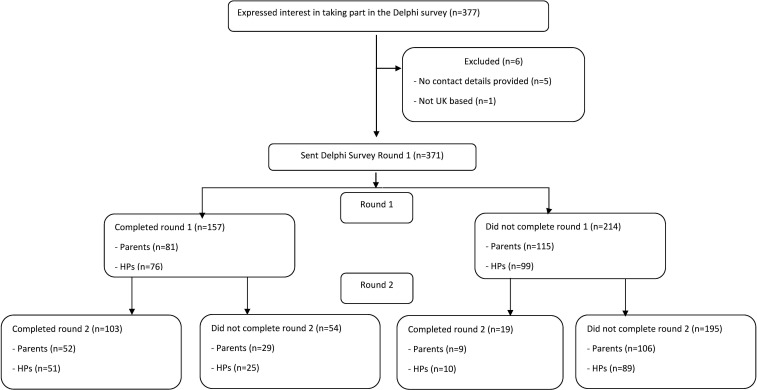
Two populations were sampled: parents of children aged up to 12 years with neurodisability who experienced EDSD; health professionals working with children and young people (aged 0-18 years) with neurodisability with experience of EDSD. Participants had taken part in a previous national survey and were invited to take part in a Delphi survey and/or consultation workshops. Two rounds of this Delphi survey sought agreement on the appropriate interventions and outcomes for use with children with neurodisability and EDSD. Two stakeholder consultation workshops were iterative, with the findings of the first discussed at the second, and conclusions reached.
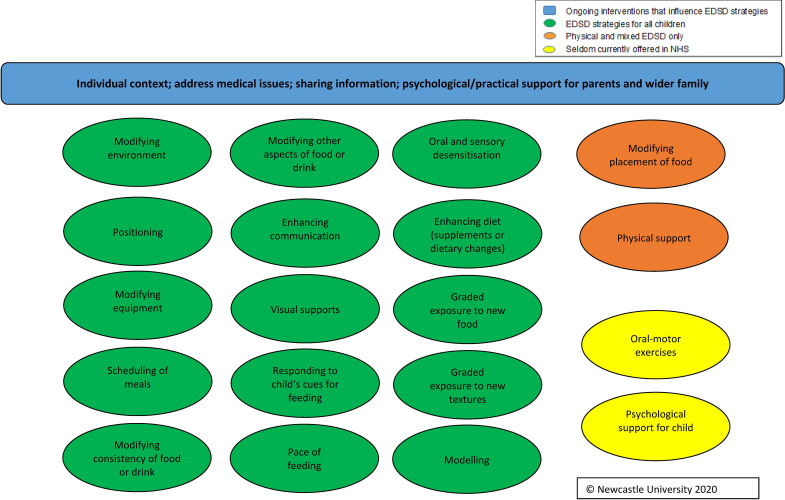
A total of 105 parents and 105 health professionals took part. Parents and health professionals viewed 19 interventions and 10 outcomes as essential. Interventions related to improvement in the physical aspects of a child's EDSD, behavioural changes of the child or parent, and changes in the child or family's well-being. Both parents and health professionals supported a 'toolkit' of interventions that they could use together in shared decision making to prioritise and implement timely interventions appropriate to the child.
This study identified interventions viewed as essential to consider for improving EDSD in children with neurodisability. It also identified several key outcomes that are valued by parents and health professionals. The Focus on Early Eating, Drinking and Swallowing (FEEDS) Toolkit of interventions to improve EDSD in children with neurodisability has been developed and now requires evaluation regarding its use and effectiveness.
患有神经发育障碍的幼儿常出现饮食、饮水和吞咽困难(EDSD)。对于此类儿童,哪些干预措施和结果最合适,相关记录甚少。我们旨在就适当的干预措施和结果达成家长与神经发育障碍儿童的健康专业人员之间的共识,为未来的临床发展和研究提供信息。
抽取了两个群体的样本:患有神经发育障碍且年龄在 12 岁以下、存在 EDSD 的儿童的父母;具有 EDSD 儿童和青少年(0-18 岁)工作经验的健康专业人员。参与者之前参加过一项全国性调查,并受邀参加了一项 Delphi 调查和/或咨询研讨会。该 Delphi 调查进行了两轮,旨在就神经发育障碍和 EDSD 儿童的适当干预措施和结果达成一致意见。两次利益相关者咨询研讨会是迭代的,第一轮的结果在第二轮中进行了讨论,并得出了结论。
共有 105 名家长和 105 名健康专业人员参加了研究。家长和健康专业人员认为 19 项干预措施和 10 项结果是必不可少的。干预措施涉及改善儿童 EDSD 的身体方面、儿童或家长的行为变化以及儿童或家庭的幸福感变化。家长和健康专业人员都支持使用“工具包”干预措施,他们可以共同做出决策,确定优先级并及时实施适合儿童的干预措施。
本研究确定了改善神经发育障碍儿童 EDSD 时需要考虑的关键干预措施。它还确定了家长和健康专业人员重视的几个关键结果。为改善神经发育障碍儿童的 EDSD 而开发的“早期进食、饮水和吞咽关注(FEEDS)”干预措施工具包,现在需要对其使用和效果进行评估。