Department of Medical Oncology and Hematology, University Hospital of Zurich, Zurich, Switzerland.
Cancer Genomics Research, Foundation Medicine, Inc, Cambridge, Massachusetts, USA.
Int J Cancer. 2022 Dec 15;151(12):2161-2171. doi: 10.1002/ijc.34257. Epub 2022 Aug 30.
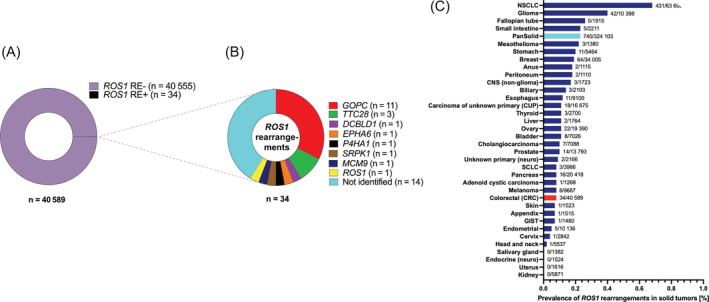
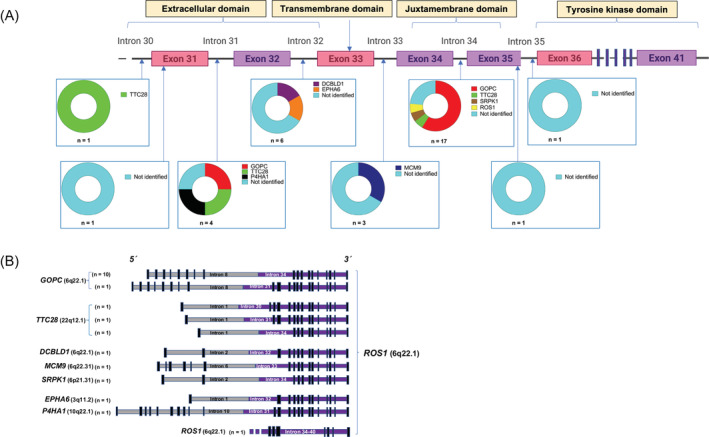
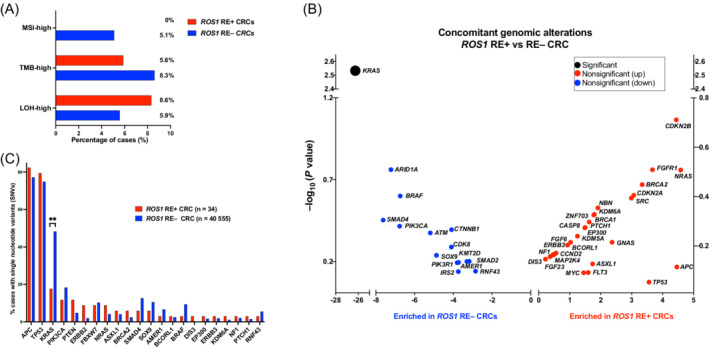
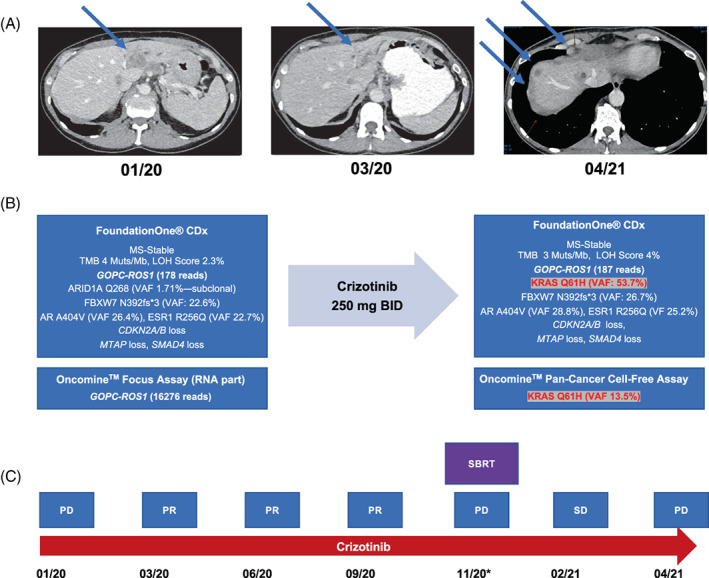
c-Ros oncogene 1, receptor tyrosine kinase (ROS1) genomic rearrangements have been reported previously in rare cases of colorectal cancer (CRC), yet little is known about the frequency, molecular characteristics, and therapeutic vulnerabilities of ROS1-driven CRC. We analyzed a clinical dataset of 40 589 patients with CRC for ROS1 genomic rearrangements and their associated genomic characteristics (Foundation Medicine, Inc [FMI]). We moreover report the disease course and treatment response of an index patient with ROS1-rearranged metastatic CRC. ROS1 genomic rearrangements were identified in 34 (0.08%) CRC samples. GOPC-ROS1 was the most common ROS1 fusion identified (11 samples), followed by TTC28-ROS1 (3 samples). Four novel 5' gene partners of ROS1 were identified (MCM9, SRPK1, EPHA6, P4HA1). Contrary to previous reports on fusion-positive CRC, ROS1-rearrangements were found exclusively in microsatellite stable (MSS) CRCs. KRAS mutations were significantly less abundant in ROS1-rearranged vs ROS1 wild type cases. The index patient presented with chemotherapy-refractory metastatic right-sided colon cancer harboring GOPC-ROS1. Molecularly targeted treatment with crizotinib induced a rapid and sustained partial response. After 15 months on crizotinib disseminated tumor progression occurred and KRAS Q61H emerged in tissue and liquid biopsies. ROS1 rearrangements define a small, yet therapeutically actionable molecular subgroup of MSS CRC. In summary, the high prevalence of GOPC-ROS1 and noncanonical ROS1 fusions pose diagnostic challenges. We advocate NGS-based comprehensive molecular profiling of MSS CRCs that are wild type for RAS and BRAF and patient enrollment in precision trials.
ROS1 致癌基因 1,受体酪氨酸激酶(ROS1)基因重排先前已在罕见的结直肠癌(CRC)病例中报道,然而,对于 ROS1 驱动的 CRC 的频率、分子特征和治疗弱点知之甚少。我们分析了 40589 例 CRC 患者的临床数据集,以检测 ROS1 基因重排及其相关的基因组特征(Foundation Medicine,Inc. [FMI])。此外,我们还报告了一名 ROS1 重排转移性 CRC 指数患者的疾病过程和治疗反应。在 34 例(0.08%)CRC 样本中鉴定出 ROS1 基因重排。GOPC-ROS1 是鉴定出的最常见的 ROS1 融合(11 个样本),其次是 TTC28-ROS1(3 个样本)。鉴定出了 4 个 ROS1 的新 5'基因伙伴(MCM9、SRPK1、EPHA6、P4HA1)。与先前关于融合阳性 CRC 的报告相反,ROS1 重排仅在微卫星稳定(MSS)CRC 中发现。ROS1 重排与 ROS1 野生型病例相比,KRAS 突变明显较少。该指数患者表现为化疗难治性转移性右侧结肠直肠癌,携带 GOPC-ROS1。用克唑替尼进行分子靶向治疗诱导了快速和持续的部分缓解。在克唑替尼治疗 15 个月后,发生了弥散性肿瘤进展,并且在组织和液体活检中出现了 KRAS Q61H。ROS1 重排定义了一个小的、但具有治疗作用的 MSS CRC 分子亚群。总之,GOPC-ROS1 和非典型 ROS1 融合的高发生率带来了诊断挑战。我们主张对 MSS CRC 进行基于 NGS 的全面分子分析,这些 CRC 对 RAS 和 BRAF 为野生型,并将患者纳入精准试验中。