Faculdade de Ciências, Plant Biology Department, Biosystems & Integrative Sciences Institute (BioISI), Universidade de Lisboa, Lisbon, Portugal.
Energy Technologies and Renewable Sources Department, National Agency for New Technologies, Energy and Sustainable Economic Development (ENEA), Trisaia Research Centre, Rotondella, Matera, Italy.
Physiol Plant. 2022 Sep;174(5):e13771. doi: 10.1111/ppl.13771.
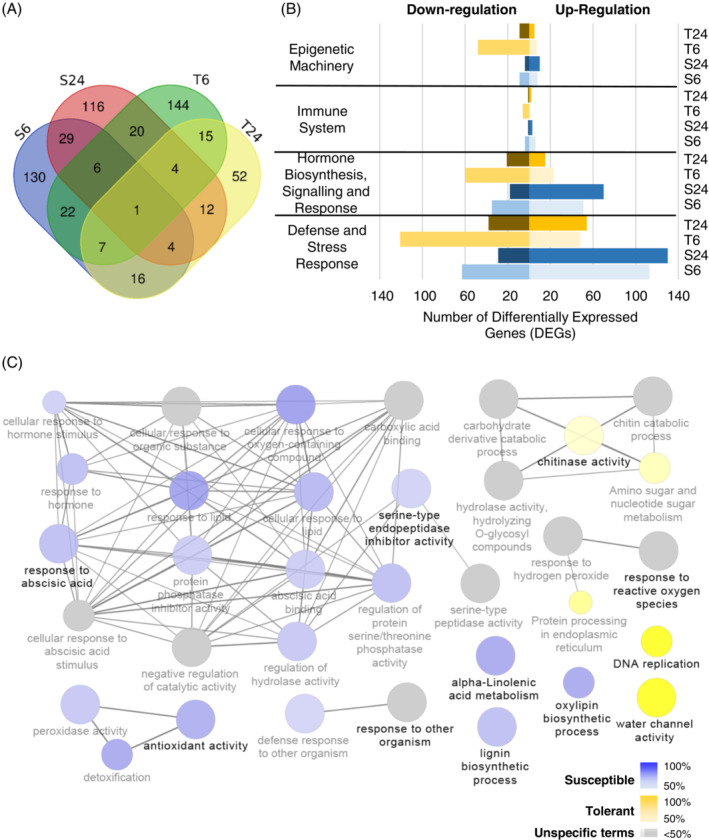
Downy mildew, caused by the biotrophic oomycete Plasmopara viticola, is one of the most economically significant grapevine diseases worldwide. Current strategies to cope with this threat rely on the massive use of chemical compounds during each cultivation season. The economic costs and negative environmental impact associated with these applications increased the urge to search for sustainable strategies of disease control. Improved knowledge of plant mechanisms to counteract pathogen infection may allow the development of alternative strategies for plant protection. Epigenetic regulation, in particular DNA methylation, is emerging as a key factor in the context of plant-pathogen interactions associated with the expression modulation of defence genes. To improve our understanding of the genetic and epigenetic mechanisms underpinning grapevine response to P. viticola, we studied the modulation of both 5-mC methylation and gene expression at 6 and 24 h post-infection (hpi). Leaves of two table grape genotypes (Vitis vinifera), selected by breeding activities for their contrasting level of susceptibility to the pathogen, were analysed. Following pathogen infection, we found variations in the 5-mC methylation level and the gene expression profile. The results indicate a genotype-specific response to pathogen infection. The tolerant genotype (N23/018) at 6 hpi exhibits a lower methylation level compared to the susceptible one (N20/020), and it shows an early modulation (at 6 hpi) of defence and epigenetic-related genes during P. viticola infection. These data suggest that the timing of response is an important mechanism to efficiently counteract the pathogen attack.
由专性寄生卵菌霜霉病菌引起的霜霉病是全球范围内对葡萄危害最严重的病害之一。目前应对这一威胁的策略依赖于在每个栽培季节大量使用化学化合物。这些应用带来的经济成本和负面环境影响增加了人们对寻找可持续疾病控制策略的迫切需求。对植物抵御病原体感染机制的深入了解可能为植物保护开发替代策略提供条件。表观遗传调控,特别是 DNA 甲基化,在与防御基因表达调控相关的植物-病原体相互作用的背景下,正成为一个关键因素。为了提高我们对葡萄对霜霉病菌反应的遗传和表观遗传机制的理解,我们研究了感染后 6 小时和 24 小时(hpi)的 5-mC 甲基化和基因表达的调节。选择了两个鲜食葡萄基因型(Vitis vinifera)进行研究,这些基因型是通过育种活动选择的,它们对病原体的易感性存在差异。在病原体感染后,我们发现 5-mC 甲基化水平和基因表达谱发生了变化。结果表明,对病原体感染存在基因型特异性反应。在 6 hpi 时,耐病基因型(N23/018)的甲基化水平低于易感基因型(N20/020),并且在感染霜霉病菌时,它表现出防御和与表观遗传相关基因的早期调节(在 6 hpi 时)。这些数据表明,反应的时机是有效抵御病原体攻击的重要机制。