Martin A. Fisher School of Physics, Brandeis University, Waltham, Massachusetts02453, United States.
Department of Physics, Babeş-Bolyai University, 400084Cluj-Napoca, Romania.
ACS Nano. 2022 Sep 27;16(9):13845-13859. doi: 10.1021/acsnano.2c02119. Epub 2022 Sep 2.
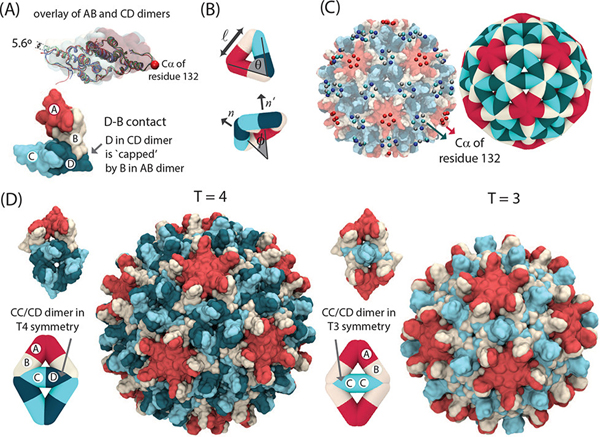
Hepatitis B virus (HBV) is an endemic, chronic virus that leads to 800000 deaths per year. Central to the HBV lifecycle, the viral core has a protein capsid assembled from many copies of a single protein. The capsid protein adopts different (quasi-equivalent) conformations to form icosahedral capsids containing 180 or 240 proteins: = 3 or = 4, respectively, in Caspar-Klug nomenclature. HBV capsid assembly has become an important target for recently developed antivirals; nonetheless, the assembly pathways and mechanisms that control HBV dimorphism remain unclear. We describe computer simulations of the HBV assembly, using a coarse-grained model that has parameters learned from all-atom molecular dynamics simulations of a complete HBV capsid and yet is computationally tractable. Dynamical simulations with the resulting model reproduce experimental observations of HBV assembly pathways and products. By constructing Markov state models and employing transition path theory, we identify pathways leading to = 3, = 4, and other experimentally observed capsid morphologies. The analysis shows that capsid polymorphism is promoted by the low HBV capsid bending modulus, where the key factors controlling polymorphism are the conformational energy landscape and protein-protein binding affinities.
乙型肝炎病毒 (HBV) 是一种地方性、慢性病毒,每年导致 80 万人死亡。HBV 生命周期的核心是病毒核心,它由单个蛋白的许多拷贝组成蛋白衣壳。衣壳蛋白采用不同的(准等价)构象形成二十面体衣壳,分别包含 180 或 240 个蛋白:根据 Caspar-Klug 命名法,分别为 = 3 或 = 4。HBV 衣壳组装已成为最近开发的抗病毒药物的重要靶点;然而,控制 HBV 二态性的组装途径和机制仍不清楚。我们使用从完整 HBV 衣壳的全原子分子动力学模拟中学习到参数的粗粒度模型,对 HBV 组装进行计算机模拟,并且该模型具有计算可行性。使用所得模型进行动力学模拟可重现 HBV 组装途径和产物的实验观察结果。通过构建 Markov 状态模型并采用转移路径理论,我们确定了导致 = 3、 = 4 和其他实验观察到的衣壳形态的途径。分析表明,衣壳多态性是由低 HBV 衣壳弯曲模量促进的,控制多态性的关键因素是构象能景观和蛋白-蛋白结合亲和力。