Faculty of Medicine, University of Belgrade, Serbia; Blood Transfusion Institute of Serbia, Hemostasis Department, Belgrade, Serbia.
Faculty of Medicine Novi Sad, University of Novi Sad, Serbia.
Thromb Res. 2022 Oct;218:151-156. doi: 10.1016/j.thromres.2022.08.020. Epub 2022 Aug 20.
Coagulation dysfunction represents a serious complication in patients during the COVID-19 infection, while fulminant thrombotic complications emerge as critical issues in individuals with severe COVID-19. In addition to a severe clinical presentation, comorbidities and age significantly contribute to the development of thrombotic complications in this disease. However, there is very little data on association of congenital thrombophilia and thrombotic events in the setting of COVID-19. Our study aimed to evaluate the risk of COVID-19 associated thrombosis in patients with congenital thrombophilia.
This prospective, case-control study included patients with confirmed COVID-19 infection, followed 6 months post-confirmation. The final outcome was a symptomatic thrombotic event. In total, 90 COVID-19 patients, 30 with known congenital thrombophilia and 60 patients without thrombophilia within the period July 2020-November 2021, were included in the study. Evaluation of hemostatic parameters including FVIII activity and D-dimer was performed for all patients at 1 month, 3 months and 6 months post-COVID-19 diagnosis.
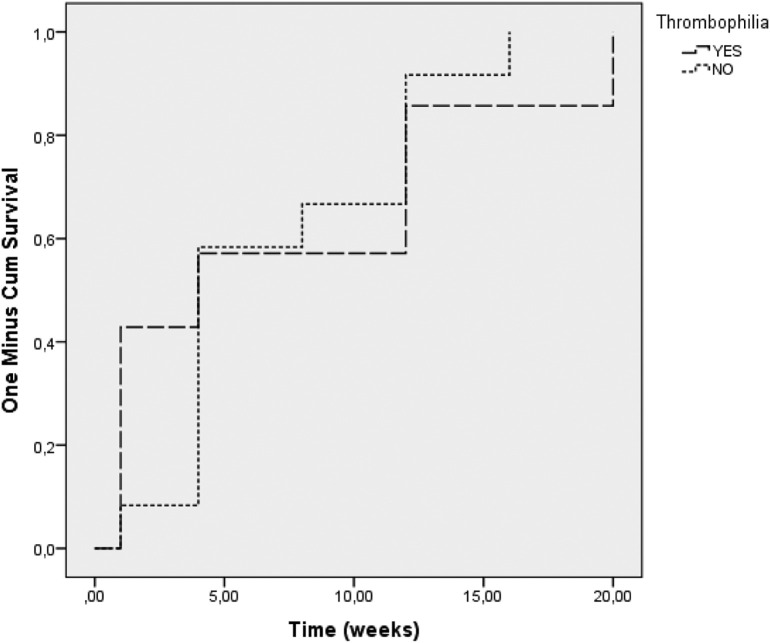
Symptomatic thrombotic events were observed in 7 out of 30 (23 %) COVID-19 patients with thrombophilia, and 12 out of 60 (20 %) without thrombophilia, P = 0.715. In addition, the two patient groups had comparable localization of thrombotic events, time to thrombotic event, effect of antithrombotic treatment and changes in FVIII activity, while D-dimer level were significantly increased in patients without thrombophilia.
Our findings suggest that patients with congenital thrombophilia, irrespective of their age, a mild clinical picture and absence of comorbidities, should receive anticoagulant prophylaxis, adjusted based on the specific genetic defect.
在 COVID-19 感染期间,凝血功能障碍是患者的严重并发症,而暴发性血栓并发症则成为重症 COVID-19 患者的关键问题。除了严重的临床表现外,合并症和年龄也显著增加了该疾病中血栓并发症的发生风险。然而,关于 COVID-19 背景下先天性血栓形成倾向与血栓事件之间的关联,目前的数据很少。我们的研究旨在评估患有先天性血栓形成倾向的 COVID-19 患者发生 COVID-19 相关血栓的风险。
本前瞻性病例对照研究纳入了确诊 COVID-19 感染的患者,并在确诊后随访 6 个月。最终结果是有症状的血栓事件。2020 年 7 月至 2021 年 11 月期间,共纳入 90 例 COVID-19 患者,其中 30 例已知有先天性血栓形成倾向,60 例无血栓形成倾向。所有患者在 COVID-19 确诊后 1 个月、3 个月和 6 个月时进行凝血参数评估,包括 FVIII 活性和 D-二聚体。
30 例有血栓形成倾向的 COVID-19 患者中有 7 例(23%)发生了有症状的血栓事件,60 例无血栓形成倾向的患者中有 12 例(20%)发生了有症状的血栓事件,P=0.715。此外,两组患者的血栓事件定位、发生血栓事件的时间、抗血栓治疗的效果以及 FVIII 活性的变化均相似,而无血栓形成倾向的患者的 D-二聚体水平显著升高。
我们的研究结果表明,不论年龄大小、临床症状较轻且无合并症的先天性血栓形成倾向患者,均应根据特定的遗传缺陷接受抗凝预防治疗。