Earle A. Chiles Research Institute, Robert W. Franz Cancer Center, Providence Portland Medical Center, 4805 NE Glisan St, North Pavilion, Suite 2N108, Portland, OR, 97213, USA.
Jounce Therapeutics, Inc., 780 Memorial Drive, Cambridge, MA, 02139, USA.
Sci Rep. 2022 Sep 2;12(1):14954. doi: 10.1038/s41598-022-19256-8.
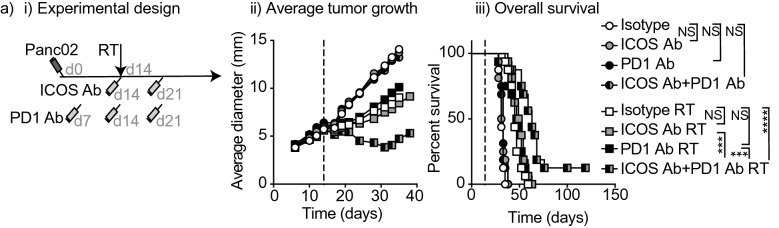
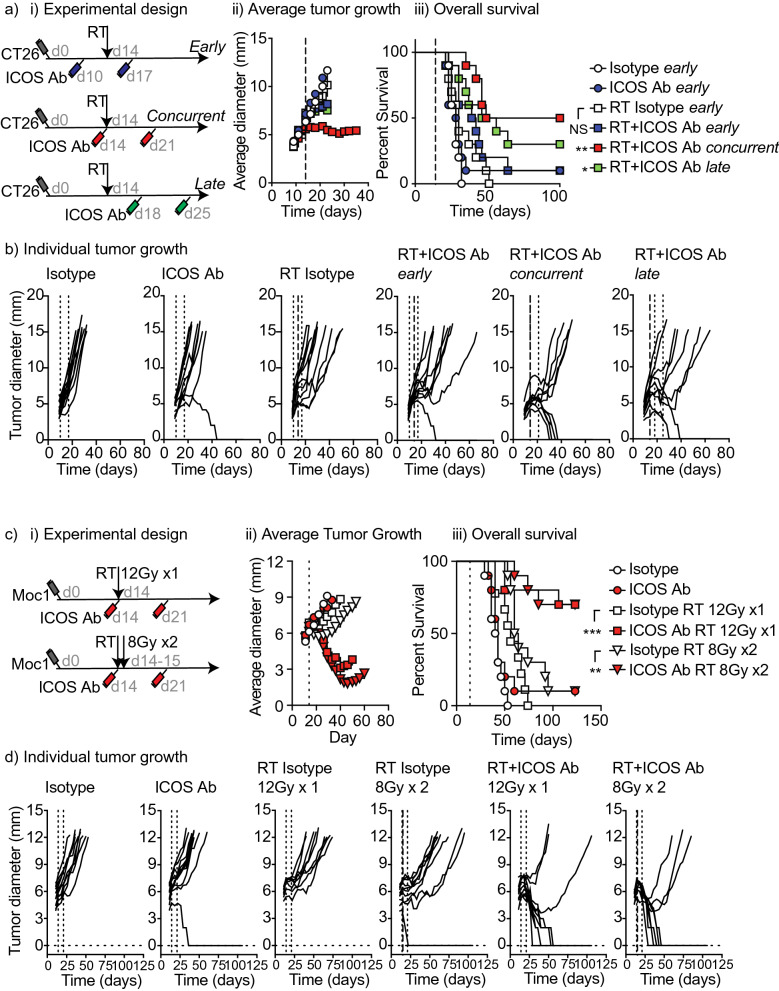
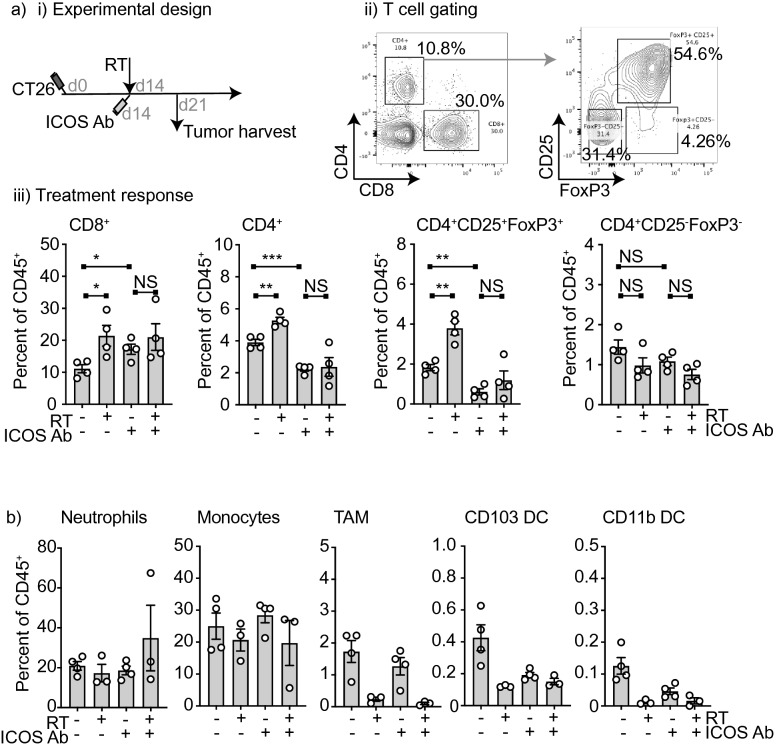
Multiple preclinical studies have shown improved outcomes when radiation therapy is combined with immune modulating antibodies. However, to date, many of these promising results have failed to translate to successful clinical studies. This led us to explore additional checkpoint and co-stimulatory pathways that may be regulated by radiation therapy. Here, we demonstrate that radiation increases the expression of inducible T cell co-stimulator (ICOS) on both CD4 and CD8 T cells in the blood following treatment. Moreover, when we combined a novel ICOS agonist antibody with radiation we observed durable cures across multiple tumor models and mouse strains. Depletion studies revealed that CD8 T cells were ultimately required for treatment efficacy, but CD4 T cells and NK cells also partially contributed to tumor control. Phenotypic analysis showed that the combination therapy diminished the increased infiltration of regulatory T cells into the tumor that typically occurs following radiation alone. Finally, we demonstrate in a poorly immunogenic pancreatic tumor model which is resistant to combined radiation and anti-PD1 checkpoint blockade that the addition of this novel ICOS agonist antibody to the treatment regimen results in tumor control. These findings identify ICOS as part of a T cell pathway that is modulated by radiation and targeting this pathway with a novel ICOS antibody results in durable tumor control in preclinical models.
多项临床前研究表明,当放射疗法与免疫调节抗体联合使用时,可改善治疗效果。然而,迄今为止,许多有前途的研究结果未能转化为成功的临床研究。这促使我们探索额外的检查点和共刺激途径,这些途径可能受放射治疗调节。在这里,我们证明治疗后,血液中的 CD4 和 CD8 T 细胞上的诱导性 T 细胞共刺激因子(ICOS)表达增加。此外,当我们将新型 ICOS 激动剂抗体与放射疗法联合使用时,我们观察到多种肿瘤模型和小鼠品系中均有持久的治愈效果。耗竭研究表明,CD8 T 细胞是治疗效果所必需的,但 CD4 T 细胞和 NK 细胞也部分有助于肿瘤控制。表型分析表明,联合治疗可减少单独放射治疗后通常发生的肿瘤中调节性 T 细胞浸润的增加。最后,我们在一种对放射和抗 PD1 检查点阻断联合治疗具有抗性的低免疫原性胰腺肿瘤模型中证明,将这种新型 ICOS 激动剂抗体添加到治疗方案中可控制肿瘤。这些发现确定 ICOS 是受放射调节的 T 细胞途径的一部分,并且用新型 ICOS 抗体靶向该途径可在临床前模型中实现持久的肿瘤控制。