Center for Clinical and Translational Research, The Abigail Wexner Research Institute at Nationwide Children's Hospital, Columbus, OH, 43205, USA.
Department of Biomedical Sciences, Rocky Vista University College of Osteopathic Medicine, Parker, CO, 80134, USA.
Sci Rep. 2022 Sep 2;12(1):14984. doi: 10.1038/s41598-022-18698-4.
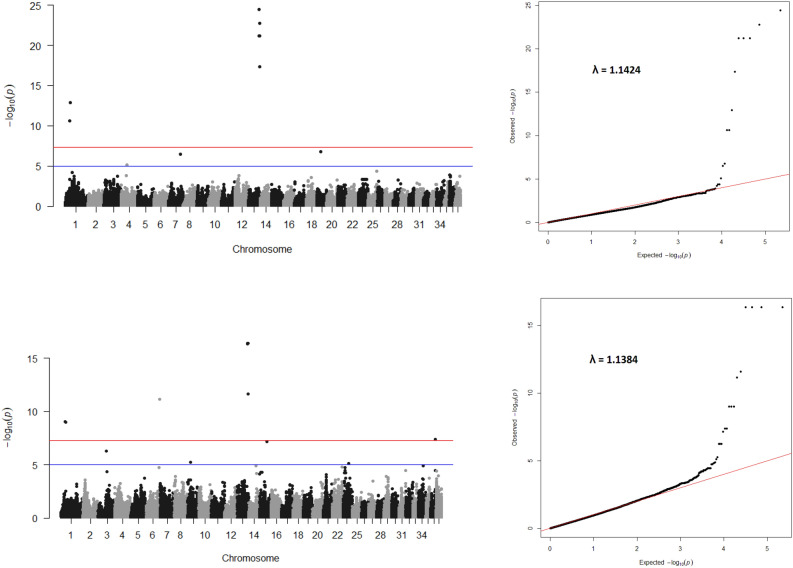
Research on working dogs is growing rapidly due to increasing global demand. Here we report genome scanning of the risk of puppies being eliminated for behavioral reasons prior to entering the training phase of the US Transportation Security Administration's (TSA) canine olfactory detection breeding and training program through 2013. Elimination of dogs for behavioral rather than medical reasons was based on evaluations at three, six, nine and twelve months after birth. Throughout that period, the fostered dogs underwent standardized behavioral tests at TSA facilities, and, for a subset of tests, dogs were tested in four different environments. Using methods developed for family studies, we performed a case-control genome wide association study (GWAS) of elimination due to behavioral observation and testing results in a cohort of 528 Labrador Retrievers (2002-2013). We accounted for relatedness by including the pedigree as a covariate and maximized power by including individuals with phenotype, but not genotype, data (approximately half of this cohort). We determined genome wide significance based on Bonferroni adjustment of two quasi-likelihood score tests optimized for either small or nearly-fully penetrant effect sizes. Six loci were significant and five suggestive, with approximately equal numbers of loci for the two tests and frequencies of loci with single versus multiple mapped markers. Several loci implicate a single gene, including CHD2, NRG3 and PDE1A which have strong relevance to behavior in humans and other species. We briefly discuss how expanded studies of canine breeding programs could advance understanding of learning and performance in the mammalian life course. Although human interactions and other environmental conditions will remain critical, our findings suggest genomic breeding selection could help improve working dog populations.
由于全球需求的增加,工作犬的研究正在迅速发展。在这里,我们报告了通过 2013 年对美国运输安全管理局(TSA)犬类嗅觉检测繁殖和培训计划进入培训阶段之前因行为原因被淘汰的幼犬风险的基因组扫描研究。淘汰犬只的原因是行为问题,而不是医疗原因,这是基于出生后三个月、六个月、九个月和十二个月的评估。在整个期间,寄养犬只在 TSA 设施接受了标准化的行为测试,并且对于一部分测试,犬只在四个不同的环境中进行了测试。我们使用针对家族研究开发的方法,对 528 只拉布拉多猎犬(2002-2013 年)的行为观察和测试结果进行了病例对照全基因组关联研究(GWAS)。我们通过将系谱作为协变量包含在内来解释相关性,并通过包含具有表型但没有基因型数据的个体(大约是该队列的一半)来最大化功效。我们通过针对小或几乎完全外显效应大小的两个准似然得分测试进行 Bonferroni 调整来确定全基因组显著性。六个基因座具有统计学意义,五个基因座具有提示意义,两个测试的基因座数量大致相等,具有单个或多个映射标记的基因座的频率也大致相等。几个基因座暗示了单个基因,包括 CHD2、NRG3 和 PDE1A,它们与人以及其他物种的行为具有很强的相关性。我们简要讨论了如何扩展对犬类繁殖计划的研究,以增进对哺乳动物生命过程中学习和表现的理解。尽管人类的相互作用和其他环境条件仍然至关重要,但我们的发现表明,基因组繁殖选择可能有助于改善工作犬种群。