Edson College of Nursing and Health Innovation, Arizona State University, 500 N. 3rdSt, Phoenix, AZ, 85004, USA.
Department of Psychology, Georgia State University, Atlanta, GA, USA.
BMC Public Health. 2022 Sep 2;22(1):1666. doi: 10.1186/s12889-022-14093-w.
Intimate partner aggression (IPA) is a prevalent public health concern that is associated with multiple negative consequences. Rates of IPA in the U.S. have increased since the onset of the Coronavirus Disease 2019 (COVID-19) pandemic, likely due to stress associated with the pandemic. Socioeconomic deprivation is associated with COVID-19 outcomes as well as IPA. However, whether socioeconomic deprivation interacts with COVID-19 stress in predicting IPA remains unclear.
Using a sample of 510 individuals recruited via Qualtrics Research Services in April 2020, the present study tested whether socioeconomic deprivation moderates the association between COVID-19 stress and IPA perpetration and victimization. Participants completed a questionnaire battery that included measures of COVID-19 stressors and physical and psychological IPA perpetration and victimization. In addition, participants reported their residential zip codes, which were subsequently matched with scores on the Social Deprivation Index, a composite measure of seven demographic variables from the 5-year American Community Survey.
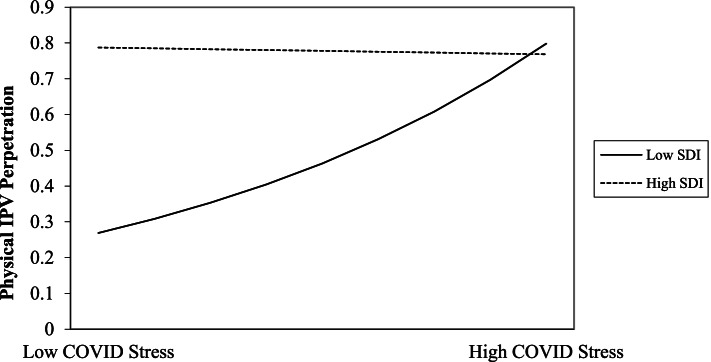
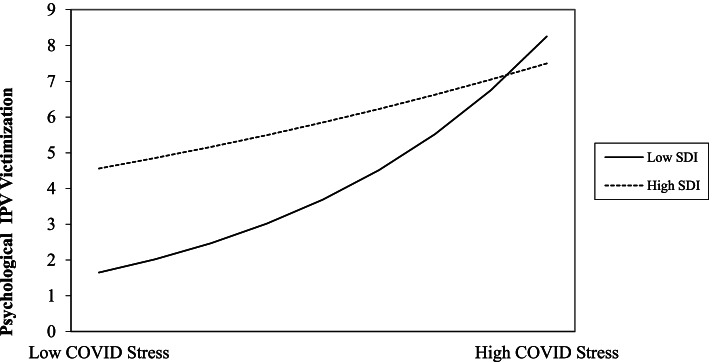
Sequential generalized linear models in Mplus Version 8.7 showed that the effects of COVID-19 stress on physical IPA perpetration and psychological IPA victimization can be best understood through its interactive effects with socioeconomic deprivation. Higher COVID-19 stress was associated with higher levels of physical IPA perpetration and psychological IPA victimization when socioeconomic deprivation was low but not when socioeconomic deprivation was high. Importantly, however, overall rates of IPA were higher among individuals with higher socioeconomic deprivation than among individuals with lower socioeconomic deprivation, regardless of the amount of COVID-19 stress they experienced.
The present analyses implicate COVID-19 stress as a critical correlate of IPA and show that the association between this stress and physical IPA perpetration and psychological IPA victimization may be particularly salient among individuals who live in areas of lower socioeconomic deprivation. Furthermore, our results clearly pinpoint the detrimental effects of socioeconomic deprivation more broadly, showing that individuals who live in more deprived areas tend to have high levels of IPA regardless of their level of COVID-19 stress. These findings call for public health policies at the community and societal level that target not only COVID-related stress but also the impacts of socioeconomic inequality.
亲密伴侣暴力(IPA)是一个普遍存在的公共卫生问题,与多种负面后果相关。自 2019 年冠状病毒病(COVID-19)大流行开始以来,美国的 IPA 发生率有所增加,这可能是由于与大流行相关的压力所致。社会经济贫困与 COVID-19 结局以及 IPA 相关。然而,社会经济贫困是否与 COVID-19 压力相互作用,从而预测 IPA 仍不清楚。
本研究使用 2020 年 4 月通过 Qualtrics 研究服务招募的 510 名个体的样本,测试了社会经济贫困是否调节了 COVID-19 压力与 IPA 实施和受害之间的关系。参与者完成了一份问卷,其中包括 COVID-19 压力源以及身体和心理 IPA 实施和受害的测量。此外,参与者报告了他们的居住邮政编码,随后将这些邮政编码与社会剥夺指数的分数相匹配,社会剥夺指数是来自 5 年美国社区调查的七个人口统计学变量的综合衡量标准。
在 Mplus Version 8.7 中的序贯广义线性模型显示,COVID-19 压力对身体 IPA 实施和心理 IPA 受害的影响可以通过其与社会经济贫困的交互作用来最好地理解。当社会经济贫困程度较低时,较高的 COVID-19 压力与较高水平的身体 IPA 实施和心理 IPA 受害相关,但当社会经济贫困程度较高时则不相关。然而,重要的是,无论个体经历的 COVID-19 压力水平如何,社会经济贫困程度较高的个体的 IPA 发生率总体上均高于社会经济贫困程度较低的个体。
本分析表明 COVID-19 压力是 IPA 的一个重要相关因素,并表明这种压力与身体 IPA 实施和心理 IPA 受害之间的关联在社会经济贫困程度较低的个体中可能更为突出。此外,我们的结果清楚地指出了社会经济贫困的有害影响,表明生活在较贫困地区的个体无论 COVID-19 压力水平如何,IPA 水平都较高。这些发现呼吁在社区和社会层面制定公共卫生政策,不仅针对与 COVID 相关的压力,还针对社会经济不平等的影响。