State Key Laboratory of Proteomics, National Center for Protein Sciences(Beijing), Beijing Proteome Research Center, Beijing Institute of Lifeomics, Beijing, 102206, China.
Anti-Radiation Medical Laboratory, Beijing Institute of Radiation Medicine, Beijing, 100039, China.
Stem Cell Res Ther. 2022 Sep 2;13(1):436. doi: 10.1186/s13287-022-03131-4.
Neural stem cells (NSCs)-derived extracellular vesicles (EVs) possess great potential in treating severe neurological and cerebrovascular diseases, as they carry the modulatory and regenerative ingredients of NSCs. Induced pluripotent stem cells (iPSCs)-derived NSCs culture represents a sustainable source of therapeutic EVs. However, there exist two major challenges in obtaining a scalable culture of NSCs for high-efficiency EVs production: (1) the heterogeneity of iPSC-derived NSCs culture impairs the production of high-quality EVs and (2) the intrinsic propensity of neuronal or astroglial differentiation of NSCs during prolonged culturing reduces the number of NSCs for preparing EVs. A NSCs strain that is amenable to stable self-renewal and proliferation is thus greatly needed for scalable and long-term culture.
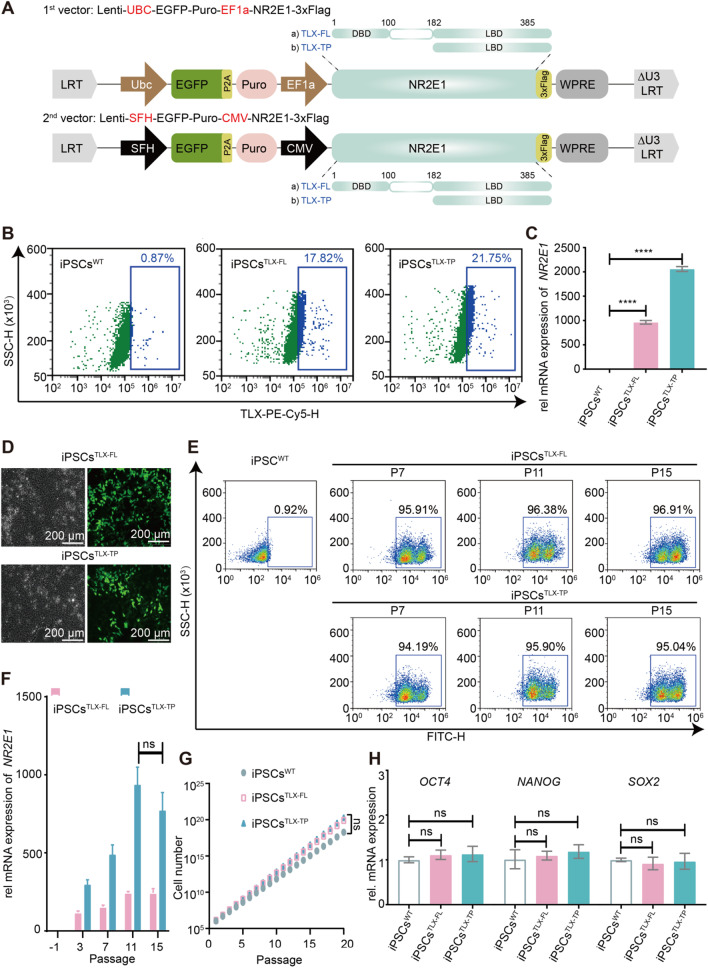
Various constructs of the genes encoding the orphan nuclear receptor NR2E1 (TLX) were stably transfected in iPSCs, which were subsequently cultured in a variety of differentiation media for generation of iNSCs. Transcriptomic and biomarker profile of iNSCs were investigated. In particular, the positivity ratios of Sox2/Nestin and Musashi/Vimentin were used to gauge the homogeneity of the iNSCs culture. The iNSCs expressing a truncated version of TLX (TLX-TP) was expanded for up to 45 passages, after which its neuronal differentiation potential and EV activity were evaluated.
Stable expression of TLX-TP could confer the iPSCs with rapid and self-driven differentiation into NSCs through stable passaging up to 225 days. The long-term culture of NSCs maintained the highly homogenous expression of NSC-specific biomarkers and potential of neuronal differentiation. EVs harvested from the TLX-expressing NSCs cultures exhibited anti-inflammatory and neuroprotective activities.
iPSC-derived NSCs stably expressing TLX-TP is a promising cell line for scalable production of EVs, which should be further exploited for therapeutic development in neurological treatment.
神经干细胞(NSCs)衍生的细胞外囊泡(EVs)在治疗严重神经和脑血管疾病方面具有巨大潜力,因为它们携带 NSCs 的调节和再生成分。诱导多能干细胞(iPSCs)衍生的 NSCs 培养代表了治疗性 EVs 的可持续来源。然而,获得可扩展的 NSCs 培养以高效生产 EVs 存在两个主要挑战:(1)iPSC 衍生的 NSCs 培养的异质性会损害高质量 EVs 的产生;(2)NSCs 在长时间培养过程中固有地向神经元或星形胶质细胞分化会减少用于制备 EVs 的 NSCs 数量。因此,非常需要一种易于稳定自我更新和增殖的 NSCs 株,以实现可扩展和长期培养。
将编码孤儿核受体 NR2E1(TLX)的基因的各种构建体稳定转染到 iPSCs 中,随后将其在各种分化培养基中培养以生成 iNSCs。研究了 iNSCs 的转录组和生物标志物谱。特别是,Sox2/Nestin 和 Musashi/Vimentin 的阳性率用于衡量 iNSCs 培养的均一性。表达 TLX 截断形式(TLX-TP)的 iNSCs 被扩增至 45 代以上,然后评估其神经元分化潜能和 EV 活性。
TLX-TP 的稳定表达可以通过稳定传代至 225 天,使 iPSCs 快速且自发地分化为 NSCs。长期培养的 NSCs 保持了高度均一的 NSC 特异性标志物表达和神经元分化潜能。从表达 TLX 的 NSCs 培养物中收获的 EV 表现出抗炎和神经保护活性。
稳定表达 TLX-TP 的 iPSC 衍生 NSCs 是一种有前途的 EV 可扩展生产细胞系,应进一步用于神经治疗的治疗性开发。