Cellular Reprogramming and Production Unit, Andalusian Network for the Design and Translation of Advanced Therapies, 41092 Sevilla, Spain.
Department of Pharmacy and Pharmaceutical Technology, School of Pharmacy, University of Sevilla, 41012 Sevilla, Spain.
Cells. 2021 Sep 9;10(9):2377. doi: 10.3390/cells10092377.
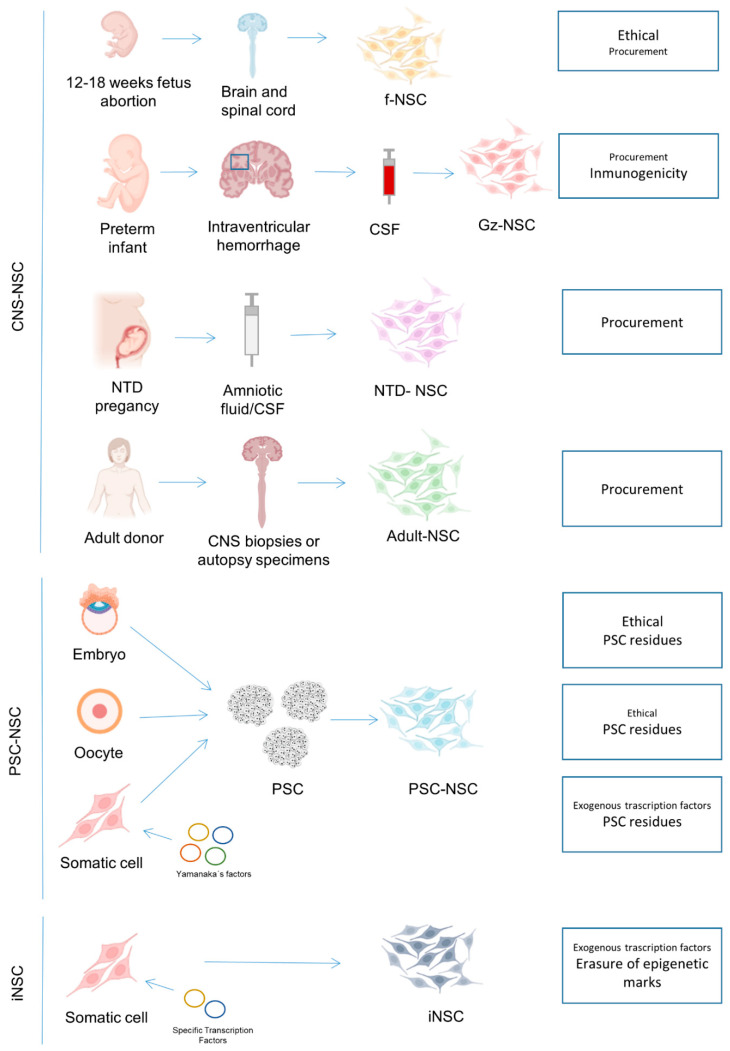
Neural stem cells represent an attractive tool for the development of regenerative therapies and are being tested in clinical trials for several neurological disorders. Human neural stem cells can be isolated from the central nervous system or can be derived in vitro from pluripotent stem cells. Embryonic sources are ethically controversial and other sources are less well characterized and/or inefficient. Recently, isolation of NSC from the cerebrospinal fluid of patients with spina bifida and with intracerebroventricular hemorrhage has been reported. Direct reprogramming may become another alternative if genetic and phenotypic stability of the reprogrammed cells is ensured. Here, we discuss the advantages and disadvantages of available sources of neural stem cells for the production of cell-based therapies for clinical applications. We review available safety and efficacy clinical data and discuss scalability and quality control considerations for manufacturing clinical grade cell products for successful clinical application.
神经干细胞是一种有吸引力的再生治疗工具,目前正在针对多种神经疾病进行临床试验。人神经干细胞可从中枢神经系统中分离得到,也可从多能干细胞体外诱导分化而来。胚胎来源的神经干细胞存在伦理争议,其他来源的神经干细胞尚未得到很好的鉴定和/或效率较低。最近,有报道称可以从患有脊柱裂和脑室内出血的患者的脑脊液中分离出神经干细胞。如果能确保重编程细胞的遗传和表型稳定性,直接重编程可能成为另一种选择。本文讨论了用于临床应用的基于细胞治疗的神经干细胞的各种来源的优缺点。我们综述了现有的安全性和有效性临床数据,并讨论了为成功的临床应用而制造临床级细胞产品的可扩展性和质量控制注意事项。