Institute for the Study of Inborn Errors of Metabolism, Faculty of Science, Pontificia Universidad Javeriana, Cra. 7 No. 43-82 Building 54, Room 305A, 110231, Bogotá D.C., Colombia.
Department of Biomedical Engineering, Universidad de los Andes, 111711, Bogotá, Colombia.
Sci Rep. 2022 Sep 3;12(1):15045. doi: 10.1038/s41598-022-19407-x.
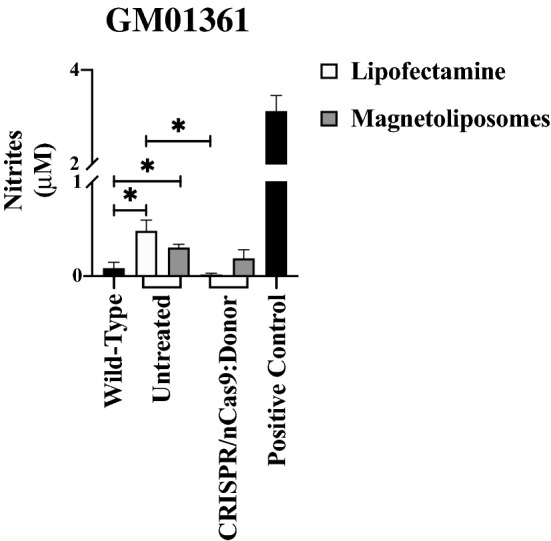
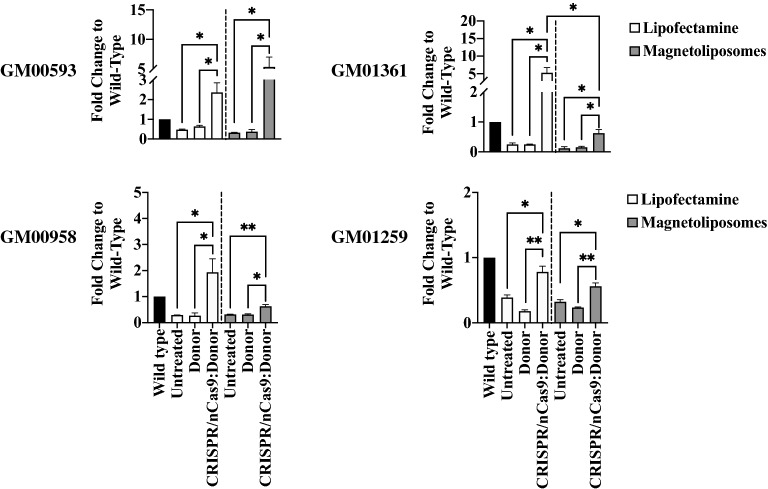
Mucopolysaccharidosis IV A (MPS IVA) is a lysosomal disorder caused by mutations in the GALNS gene. Consequently, the glycosaminoglycans (GAGs) keratan sulfate and chondroitin 6-sulfate accumulate in the lysosomal lumen. Although enzyme replacement therapy has shown essential advantages for the patients, several challenges remain to overcome, such as the limited impact on the bone lesion and recovery of oxidative profile. Recently, we validated a CRISPR/nCas9-based gene therapy with promising results in an in vitro MPS IVA model. In this study, we have expanded the use of this CRISPR/nCas9 system to several MPS IVA fibroblasts carrying different GALNS mutations. Considering the latent need to develop more safety vectors for gene therapy, we co-delivered the CRISPR/nCas9 system with a novel non-viral vector based on magnetoliposomes (MLPs). We found that the CRISPR/nCas9 treatment led to an increase in enzyme activity between 5 and 88% of wild-type levels, as well as a reduction in GAGs accumulation, lysosomal mass, and mitochondrial-dependent oxidative stress, in a mutation-dependent manner. Noteworthy, MLPs allowed to obtain similar results to those observed with the conventional transfection agent lipofectamine. Overall, these results confirmed the potential of CRISPR/nCas9 as a genome editing tool for treating MPS IVA. We also demonstrated the potential use of MLPs as a novel delivery system for CRISPR/nCas9-based therapies.
黏多糖贮积症 IVA(MPS IVA)是一种溶酶体贮积症,由 GALNS 基因突变引起。因此,糖胺聚糖(GAGs)硫酸角质素和硫酸软骨素 6 在溶酶体腔内积累。尽管酶替代疗法已显示出对患者的重要优势,但仍有一些挑战需要克服,例如对骨骼病变和氧化谱恢复的影响有限。最近,我们在体外 MPS IVA 模型中验证了一种基于 CRISPR/nCas9 的基因治疗方法,取得了有前景的结果。在这项研究中,我们扩展了这种 CRISPR/nCas9 系统的用途,以治疗几种携带不同 GALNS 突变的 MPS IVA 成纤维细胞。考虑到开发更安全的基因治疗载体的潜在需求,我们将 CRISPR/nCas9 系统与一种新型基于磁脂体(MLPs)的非病毒载体共同递送至细胞内。我们发现 CRISPR/nCas9 处理导致酶活性增加 5%至 88%,野生型水平,以及 GAGs 积累、溶酶体质量和依赖线粒体的氧化应激的减少,这取决于突变。值得注意的是,MLPs 允许获得与常规转染试剂脂质体观察到的相似结果。总之,这些结果证实了 CRISPR/nCas9 作为治疗 MPS IVA 的基因组编辑工具的潜力。我们还证明了 MLPs 作为 CRISPR/nCas9 为基础的治疗方法的新型递送系统的潜在用途。