Department of Ultrasound, Zhangzhou Affiliated Hospital of Fujian Medical University, Zhangzhou, 363000, Fujian, China.
Reproductive Medicine Center, Zhangzhou Affiliated Hospital of Fujian Medical University, No. 59 Shengli Road, Zhangzhou, 363000, Fujian, China.
BMC Med Imaging. 2022 Sep 4;22(1):158. doi: 10.1186/s12880-022-00863-w.
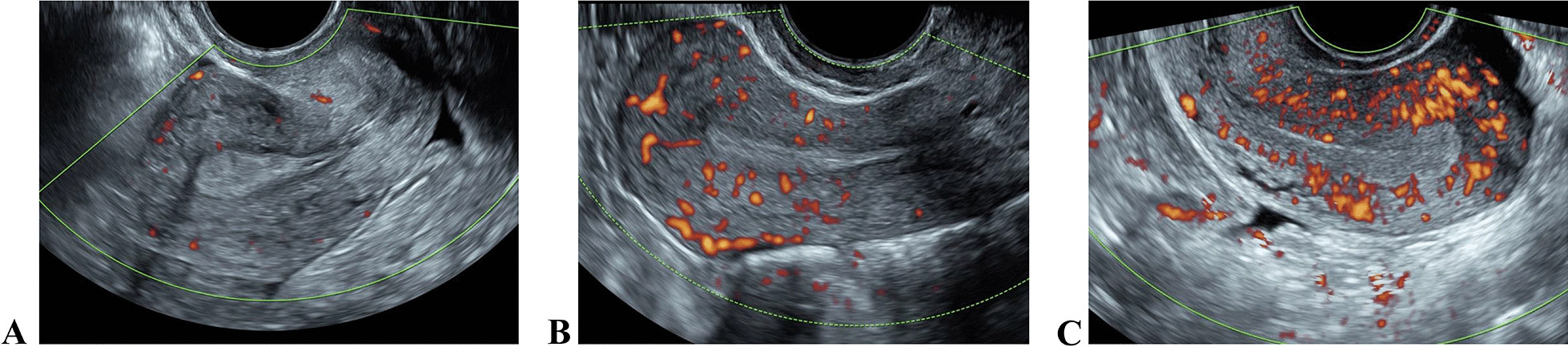
In-vitro fertilization-embryo transfer (IVF-ET) is a commonly used assisted reproductive technology. Its success depends on many factors, including endometrial receptivity. Endometrial receptivity can be evaluated by ultrasound, endometrial biopsy, and magnetic resonance imaging. Compared with the latter two methods, ultrasound has the advantages of wide availability, non-invasiveness, and low cost. Three-dimensional (3D) ultrasound imaging examines endometrial thickness, morphology, and blood vessels, which are associated with the success of embryo implantation. However, there are no reports of endometrial receptivity assessment by 3D ultrasound. Therefore, we aimed to evaluate endometrial receptivity using 3D ultrasound and construct a predictive model for first-trimester pregnancy inception following IVF-ET.
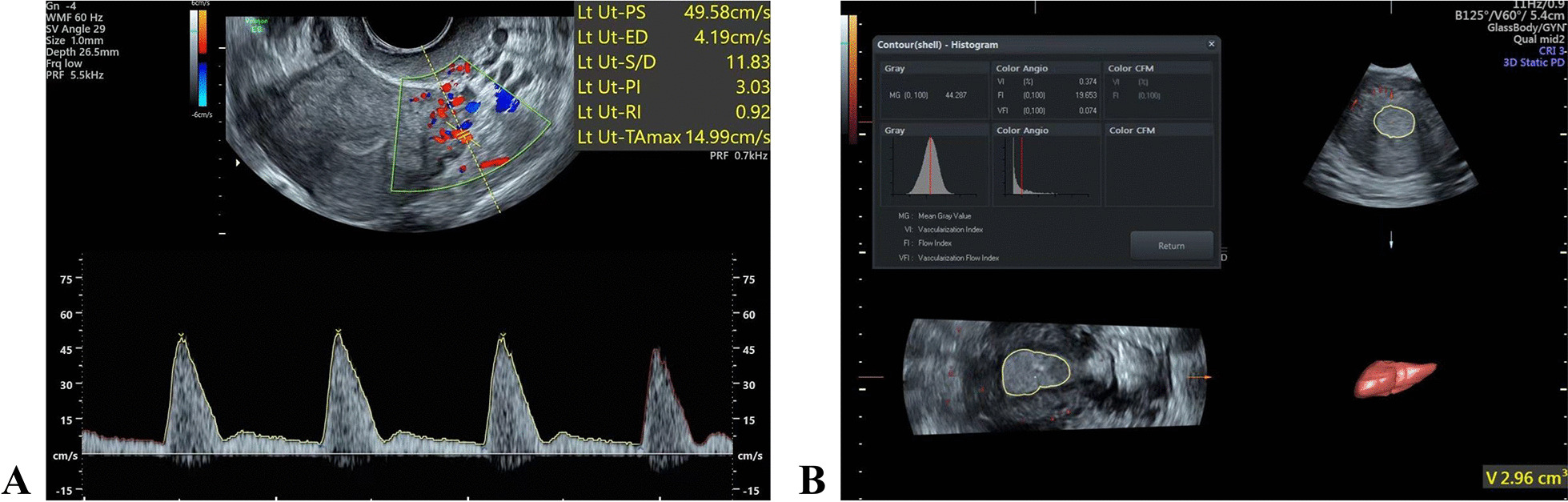
We performed a prospective observational study on infertile women who underwent IVF-ET between December 2019 and February 2021. These women had 3D ultrasound evaluations, measuring endometrial thickness, volume, pattern, morphology, peristalsis, uterine artery blood flow index, sub-endometrial blood flow index, and distribution pattern. We recorded the occurrence of first-trimester pregnancies in these women. Using Akaike information criterion (AIC) and backward stepwise regression, a first-trimester pregnancy prediction model was constructed based on the minimum AIC value and validated internally and externally.
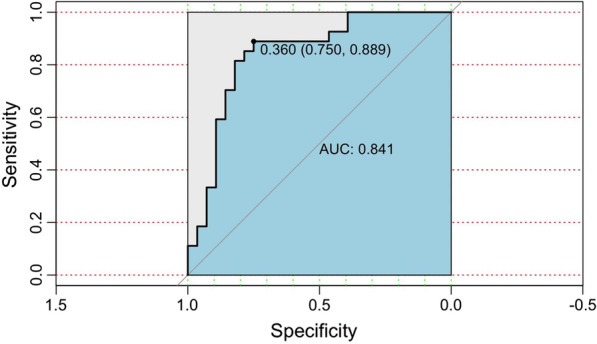
111 women were enrolled, with 103 included in the analysis. Univariate and multiple logistic regression analyses showed that endometrial thickness and vascularization flow index (VFI) were independent factors associated with the occurrence of a pregnancy. The final prediction model corresponding to the minimum AIC value (65.166) was Y = - 6.131-0.182endometrial thickness + 0.542endometrial volume + 4.374VFI + 0.132age. In the test set, modeling cohort, and external validation cohort, the model showed satisfactory differentiation, with C index of 0.841 (95%CI 0.699-0.817), 0.727 (95%CI 0.619-0.815), and 0.745 (95%CI 0.671-0.840), respectively. The Hosmer-Lemeshow goodness of fit tests reported P = 0.865, 0.139, and 0.070, respectively, indicating a high agreement with the actual IVF-ET outcome. This model reached the highest diagnostic efficiency (sensitivity 88.9%, specificity 75%, Youden index 0.639) at a diagnostic cut-off value of ≥ 0.360.
The predictive model based on endometrial receptivity evaluations by 3D ultrasound had high diagnostic efficiency and could be a simple and effective tool to predict first-trimester pregnancy inception after IVF-ET.
体外受精-胚胎移植(IVF-ET)是一种常用的辅助生殖技术。其成功取决于许多因素,包括子宫内膜容受性。子宫内膜容受性可以通过超声、子宫内膜活检和磁共振成像来评估。与后两种方法相比,超声具有广泛应用、非侵入性和低成本的优势。三维(3D)超声成像检查子宫内膜厚度、形态和血管,与胚胎着床的成功相关。然而,目前尚无关于 3D 超声评估子宫内膜容受性的报道。因此,我们旨在使用 3D 超声评估子宫内膜容受性,并构建 IVF-ET 后早期妊娠起始的预测模型。
我们对 2019 年 12 月至 2021 年 2 月期间接受 IVF-ET 的不孕妇女进行了前瞻性观察研究。这些妇女进行了 3D 超声评估,测量子宫内膜厚度、体积、形态、形态、蠕动、子宫动脉血流指数、子宫内膜下血流指数和分布模式。我们记录了这些妇女的早期妊娠发生情况。使用赤池信息量准则(AIC)和逐步向后回归,基于最小 AIC 值构建了一个早期妊娠预测模型,并进行了内部和外部验证。
共纳入 111 名妇女,其中 103 名妇女纳入分析。单因素和多因素逻辑回归分析表明,子宫内膜厚度和血管化血流指数(VFI)是与妊娠发生相关的独立因素。对应最小 AIC 值(65.166)的最终预测模型为 Y=-6.131-0.182 子宫内膜厚度+0.542 子宫内膜体积+4.374VFI+0.132 年龄。在测试集、建模队列和外部验证队列中,该模型均表现出良好的区分度,C 指数分别为 0.841(95%CI 0.699-0.817)、0.727(95%CI 0.619-0.815)和 0.745(95%CI 0.671-0.840)。Hosmer-Lemeshow 拟合优度检验报告 P 值分别为 0.865、0.139 和 0.070,分别与 IVF-ET 实际结果高度一致。该模型在诊断截止值≥0.360 时达到最高诊断效率(灵敏度 88.9%,特异性 75%,约登指数 0.639)。
基于 3D 超声评估子宫内膜容受性的预测模型具有较高的诊断效率,可作为预测 IVF-ET 后早期妊娠起始的简单有效工具。