Kim Won-Hyoung, Jung Young-Eun, Roh Daeyoung, Kim Daeho, Chae Jeong-Ho, Park Joo Eon
Department of Psychiatry, Inha University Hospital, Inha University School of Medicine, Incheon, Republic of Korea.
Department of Psychiatry, Jeju National University Hospital, Jeju National University School of Medicine, Jeju, Republic of Korea.
Psychiatry Investig. 2022 Aug;19(8):661-667. doi: 10.30773/pi.2022.0092. Epub 2022 Aug 24.
This study presents the reliability and validity of the Korean version of the post-traumatic stress disorder (PTSD) checklist for the Diagnostic and Statistical Manual for Mental Disorders-fifth edition (DSM-5) (K-PCL-5) and the short form (K-PCL-5-S).
Seventy-one subjects with PTSD, 74 subjects with mood or anxiety disorders, and 99 healthy controls were enrolled. The Korean version of the Structured Clinical Interview for DSM-5-research version was used to confirm the presence of PTSD. The Beck Depression Inventory-II (BDI-II), Beck Anxiety Inventory (BAI), Impact of Event Scale-Revised (IES-R), and Spielberger State Trait Anxiety Inventory (STAI) were used to evaluate the concurrent validity of the K-PCL-5 and K-PCL-5-S.
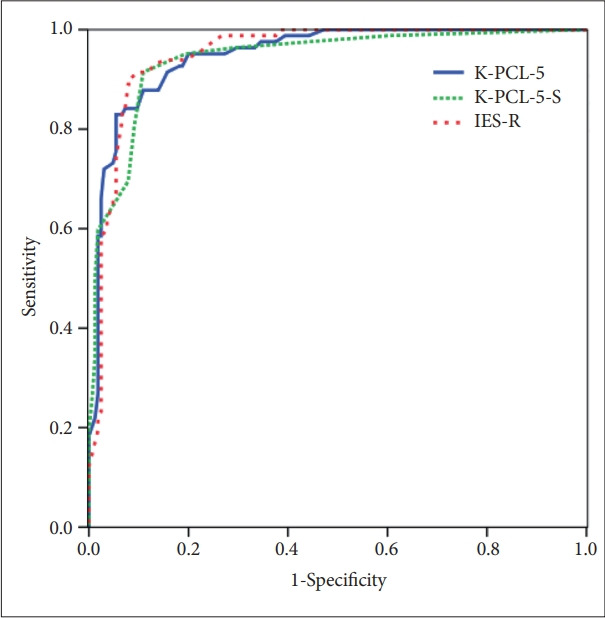
It presented good internal consistency (Cronbach's α=0.93) and test-retest reliability (r=0.90). The K-PCL-5 and K-PCL-5-S were highly correlated with the BDI-II, BAI, IES-R, STAI-S, and STAI-T. The suggested cutoff score for PTSD was 33 for the K-PCL-5 with a sensitivity of 88.51 and specificity of 89.09, and 6 for the K-PCL-5-S with a sensitivity of 91.95 and specificity of 89.09. The data were best explained with a one-factor model.
These results demonstrated the good reliability and validity of the K-PCL-5 and K-PCL-5-S, and their suitability as simple tools for PTSD assessment.
本研究呈现了《精神疾病诊断与统计手册》第五版(DSM - 5)创伤后应激障碍(PTSD)检查表韩文版(K - PCL - 5)及其简版(K - PCL - 5 - S)的信度和效度。
招募了71名创伤后应激障碍患者、74名患有情绪或焦虑障碍的患者以及99名健康对照者。使用《精神疾病诊断与统计手册》第五版研究版的韩文版结构化临床访谈来确认创伤后应激障碍的存在。采用贝克抑郁量表第二版(BDI - II)、贝克焦虑量表(BAI)、事件影响量表修订版(IES - R)以及斯皮尔伯格状态 - 特质焦虑量表(STAI)来评估K - PCL - 5和K - PCL - 5 - S的同时效度。
其呈现出良好的内部一致性(克朗巴哈系数α = 0.93)和重测信度(r = 0.90)。K - PCL - 5和K - PCL - 5 - S与BDI - II、BAI、IES - R、STAI - S和STAI - T高度相关。K - PCL - 5诊断创伤后应激障碍的建议临界值为33,敏感度为88.51,特异度为89.09;K - PCL - 5 - S的临界值为6,敏感度为91.95,特异度为89.09。单因素模型能最好地解释这些数据。
这些结果证明了K - PCL - 5和K - PCL - 5 - S具有良好的信度和效度,且适合作为创伤后应激障碍评估的简易工具。