Malmakov Nurlan, Ptacek Martin, Savvulidi Filipp Georgijevic, Stadnik Ludek
Department of Sheep and Goat Artificial Insemination and Sperm Cryoconservation, Scientific Research Institute of Sheep Breeding Branch, Mynbaev, Almaty Region 040622, Kazakhstan.
Department of Animal Science, Faculty of Agrobiology, Food and Natural Resources, Czech University of Life Sciences, Kamycka 129, 165 00 Prague, Suchdol, Czech Republic.
Saudi J Biol Sci. 2022 Oct;29(10):103416. doi: 10.1016/j.sjbs.2022.103416. Epub 2022 Aug 17.
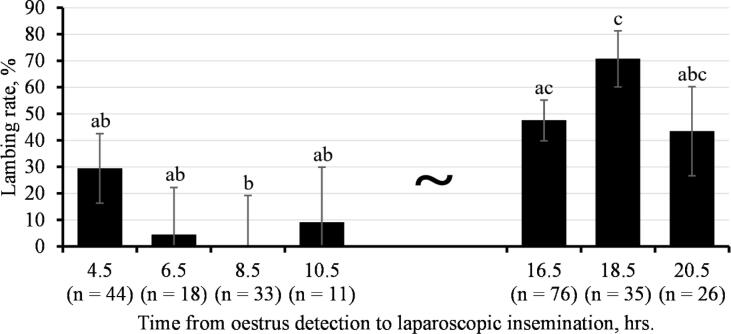
The aim of this study was to optimize the laparoscopic intrauterine insemination (LAI) methodology by testing different time intervals between the natural heat detection and ewe insemination. Three experiments were performed in the breeding conditions of Southern Kazakhstan. Ewes (n = 243) were exposed for one hour to direct contact with the teaser rams (once a day, morning or evening). Ewes expressing behavioral symptoms of heat were detected and inseminated with the use of LAI during 210-1290 min (3.5-21.5 hrs) after heat detection. Reproductive traits of lambing rate (LR) and litter size (LS) were recorded according to the births registered at 137 to 152 days post insemination. Our statistical model showed significance only for the effects of ewe age category and the time interval from heat detection to LAI on the LR attribute. The highest LR (38.8%) was detected in ewes at 2.5-3.5 years of age. Corrected least-square means of LR indicated 18.5 hrs. as an optimal time for LAI of ewes in natural heat. In the present study, the percentage value of lambing rate obtained at 18.5 h interval was 70.7%. Therefore, our study suggested an effective methodology to spread valuable genetic information in the sheep population in the regions of extensive farming where heat cycle synchronization is not usually performed. Importantly, our study is among the first ones that follow the European strategy to eliminate the occurrence of hormones in livestock production and the environment.
本研究的目的是通过测试自然发情检测与母羊授精之间的不同时间间隔,优化腹腔镜子宫内授精(LAI)方法。在哈萨克斯坦南部的繁殖条件下进行了三项实验。将母羊(n = 243)与试情公羊直接接触1小时(每天一次,早晨或晚上)。检测出表现出发情行为症状的母羊,并在发情检测后210 - 1290分钟(3.5 - 21.5小时)内使用LAI进行授精。根据授精后137至152天登记的出生情况记录产羔率(LR)和产仔数(LS)等繁殖性状。我们的统计模型显示,仅母羊年龄类别以及从发情检测到LAI的时间间隔对LR属性有显著影响。在2.5 - 3.5岁的母羊中检测到最高的LR(38.8%)。LR的校正最小二乘均值表明,18.5小时是自然发情母羊LAI的最佳时间。在本研究中,在18.5小时间隔获得的产羔率百分比值为70.7%。因此,我们的研究提出了一种有效的方法,可在通常不进行发情周期同步的粗放养殖地区的绵羊群体中传播有价值的遗传信息。重要的是,我们的研究是首批遵循欧洲消除畜牧生产和环境中激素出现的战略的研究之一。