Atif Hamna, Peck Lindsey, Connolly Mary, Endres Kodi, Musser Leah, Shalaby Mariam, Lehman Morgan, Olympia Robert P
Emergency Medicine, Christiana Care Health System, Newark, USA.
Obstetrics and Gynecology, Penn State Health Milton S. Hershey Medical Center, Hershey, USA.
Cureus. 2022 Jul 27;14(7):e27349. doi: 10.7759/cureus.27349. eCollection 2022 Jul.
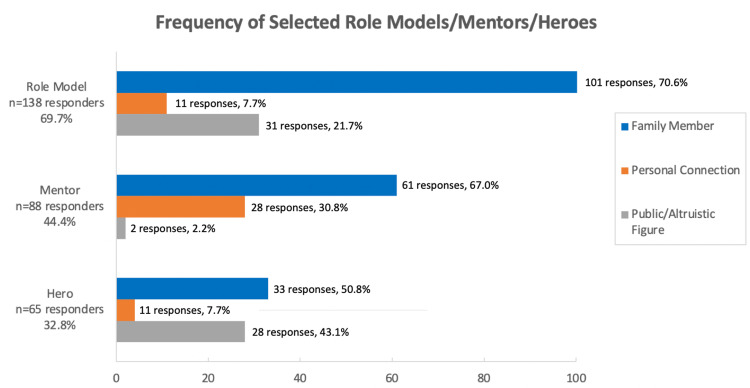
Background Identity formation is a dynamic process and key developmental task that begins in adolescence. During this time, children look to adults as role models and mentors. These adults can have a significant impact on adolescents' decisions of appropriate or inappropriate behaviors, potentially causing a positive or negative change. Little research has been performed to identify these role models and understand how they affect the development of physical and mental health of children. Objective The goal of this study is to see if there is a relationship between identified role models, mentors, and/or heroes and adolescents' interest in education, participation in risky behavior, confidence level, happiness, safety, violence-related behaviors, and physical activity. Methods In this study, 198 children aged 11-18 years were identified on the scheduling platforms at various Hershey Medical Center sites to take a 10-minute survey via RedCap. The survey identified their role model, mentor, and/or hero and followed up with outcome questions from validated tools. Results The results show that 140 participants (70.7%) identified having a role model compared to 88 (44.4%) having mentors and 61 (30.8%) having heroes, and family members were the most identified figures for each category. There were significant differences between identified categories of role models, mentors, and heroes, and interest in education, happiness, risky behavior, and safety, while no significant differences were found for violence-related behavior, physical activity, and confidence level. Adolescents with family heroes had safer behavior (2.39 ± 0.70) than those with celebrity heroes (3.16 ±1.86, p=0.0277), and those with peer heroes (11.3 ± 2.31) had more risky behavior than those with celebrity heroes (9.16 ± 1.98, p=0.0347). However, children with adult peer heroes had a higher interest in education (2.00 ± 0) compared to those with celebrities (3.79 ± 1.03, p=0.0246) or public figures (3.78 ± 1.09, p=0.0333) as their heroes. Additionally, those with family (3.48 ± 1.05) or adult peers (3.32 ± 1.38) as their mentors had a higher interest in education compared to those with same-age peer mentors (5.80 ± 1.30, p=<0.0001). Adolescents with family mentors also had higher happiness scores (3.25 ± 0.33) than those with same-age peer mentors (2.59 ± 1.47, p=0.0358) and also engaged in safer behavior (2.52 ± 0.80) compared to all other categories (3.03 ±1.59, 0.0462). Conclusion These results point to the idea that who adolescents choose to look up to has effects on various aspects of their life that could affect both their physical and mental health status, with family members having the most impact. Further research could explore differences between which family members are chosen as role models, mentors, and heroes and what effect they might have on adolescent development.

背景 身份认同的形成是一个动态过程,也是始于青春期的关键发展任务。在此期间,孩子们将成年人视为榜样和导师。这些成年人会对青少年关于适当或不适当行为的决策产生重大影响,可能带来积极或消极的改变。目前针对识别这些榜样并了解他们如何影响儿童身心健康发展的研究较少。
目的 本研究的目的是探究已识别出的榜样、导师和/或英雄与青少年对教育的兴趣、参与危险行为的情况、自信水平、幸福感、安全感、与暴力相关的行为以及体育活动之间是否存在关联。
方法 在本研究中,通过好时医疗中心各站点的排班平台确定了198名11至18岁的儿童,让他们通过RedCap完成一项10分钟的调查。该调查确定了他们的榜样、导师和/或英雄,并接着询问了来自经过验证的工具中的结果问题。
结果 结果显示,140名参与者(70.7%)表示有榜样,相比之下,有导师的为88名(44.4%),有英雄的为61名(30.8%),且每个类别中被提及最多的人物都是家庭成员。在已识别出的榜样、导师和英雄类别与对教育的兴趣、幸福感、危险行为和安全感之间存在显著差异,而在与暴力相关的行为、体育活动和自信水平方面未发现显著差异。有家庭英雄的青少年行为更安全(2.39±0.70),相比有明星英雄的青少年(3.16±1.86,p=0.0277)以及有同龄人英雄的青少年(11.3±2.31),有明星英雄的青少年危险行为更多(9.16±1.98,p=0.0347)。然而,与将明星(3.79±1.03,p=0.0246)或公众人物(3.78±1.09,p=0.0333)视为英雄的青少年相比,将成年同龄人视为英雄的儿童对教育的兴趣更高(2.00±0)。此外,与将同龄同龄人视为导师的青少年相比,将家人(3.48±1.05)或成年同龄人(3.32±1.38)视为导师的青少年对教育的兴趣更高(5.80±1.30,p<0.0001)。有家庭导师的青少年幸福感得分也高于有同龄同龄人导师的青少年(3.25±0.33,2.59±1.47,p=0.0358),并且与所有其他类别相比,其行为也更安全(2.52±0.80,3.03±1.59,0.0462)。
结论 这些结果表明,青少年选择敬仰的对象会对他们生活的各个方面产生影响,进而可能影响他们的身心健康状况,其中家庭成员的影响最大。进一步的研究可以探讨被选为榜样、导师和英雄的家庭成员之间的差异以及他们可能对青少年发展产生的影响。