Arauz Santiago, González-Martín David, Quiroga Marcelo, Guillén Pedro
Department of Orthopaedic Surgery and Traumatology, Clínica CEMTRO, Madrid, Spain.
Department of Orthopaedic Surgery and Traumatology, Hospital Universitario de Canarias, Tenerife, Spain.
Arthrosc Tech. 2022 Jul 14;11(8):e1473-e1478. doi: 10.1016/j.eats.2022.03.038. eCollection 2022 Aug.
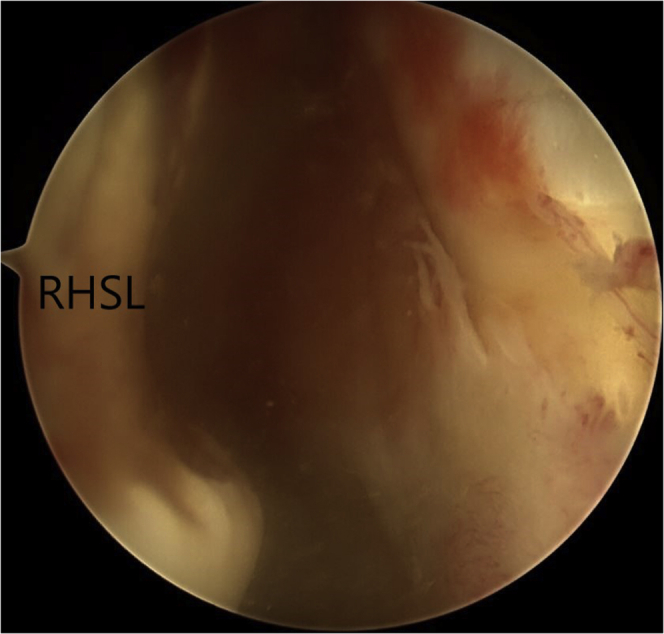
Hill-Sachs lesions (HSLs) can be present after a primary shoulder dislocation and may go unrecognized; this can alter the necessary bony constraint within the glenohumeral joint. To deal with HSLs, remplissage is a safe procedure with low complication rates, low recurrent instability rates, and good patient outcome scores compared with many of the other alternative techniques. On the other hand, a great number of techniques have been described to treat reverse Hill-Sachs lesions (RHSLs). In this article, we propose a method of treatment for combined simultaneous HSL and RHSL shoulder injuries. However, consensus on a specific treatment is yet to be established. We present an arthroscopic treatment guideline for patients with shoulder instability due to anterior and posterior labral lesions, HSL, and RHSL.
初次肩关节脱位后可能出现希尔-萨克斯损伤(HSLs),且可能未被识别;这会改变盂肱关节内必要的骨性限制。为应对HSLs,与许多其他替代技术相比,关节囊移位术是一种安全的手术,并发症发生率低、复发性不稳定率低且患者预后评分良好。另一方面,已有大量技术被描述用于治疗反希尔-萨克斯损伤(RHSLs)。在本文中,我们提出一种治疗HSL和RHSL同时存在的复合性肩部损伤的方法。然而,对于具体治疗方法尚未达成共识。我们为因前后盂唇损伤、HSL和RHSL导致肩关节不稳定的患者提供了一份关节镜治疗指南。