Rivera-Esteban Jesús, Manzano-Nuñez Ramiro, Broquetas Teresa, Serra-Matamala Isabel, Bassegoda Octavi, Soriano-Varela Agnès, Espín Gemma, Castillo Joaquín, Bañares Juan, Carrión José A, Ginès Pere, Graupera Isabel, Pericàs Juan M
Liver Unit, Vall d'Hebron University Hospital, Barcelona, Spain.
Vall d'Hebron Institut de Recerca (VHIR), Vall d'Hebron Barcelona Campus Hospitalari, Barcelona, Spain.
JHEP Rep. 2022 Nov;4(11):100574. doi: 10.1016/j.jhepr.2022.100574. Epub 2022 Aug 27.
BACKGROUND & AIMS: The COVID-19 pandemic has had a major negative impact on health systems and many chronic diseases globally. We aimed to evaluate the impact of the first year of the pandemic on the outcomes of people with NAFLD cirrhosis.
We conducted a before-after study in four University hospitals in Catalonia, Spain. Study subperiods were divided into Pre-pandemic (March/2019-February/2020) Pandemic (March/2020-February/2021). The primary outcome was the rate of first liver-related event (LRE). Overall clinical outcomes (LREs plus cardiovascular plus all-cause mortality) were also assessed.
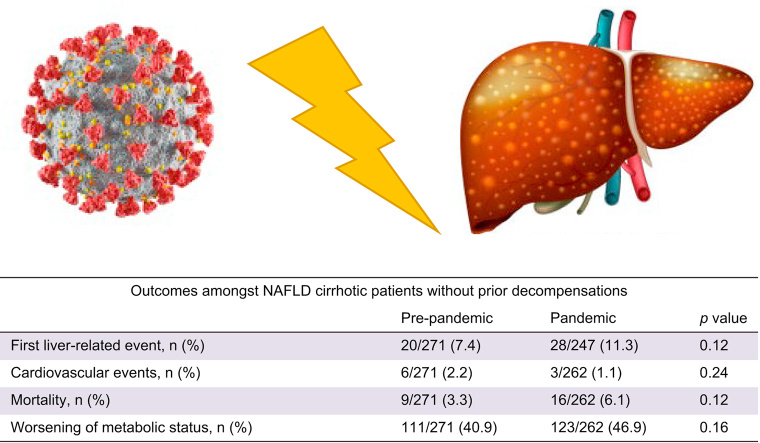
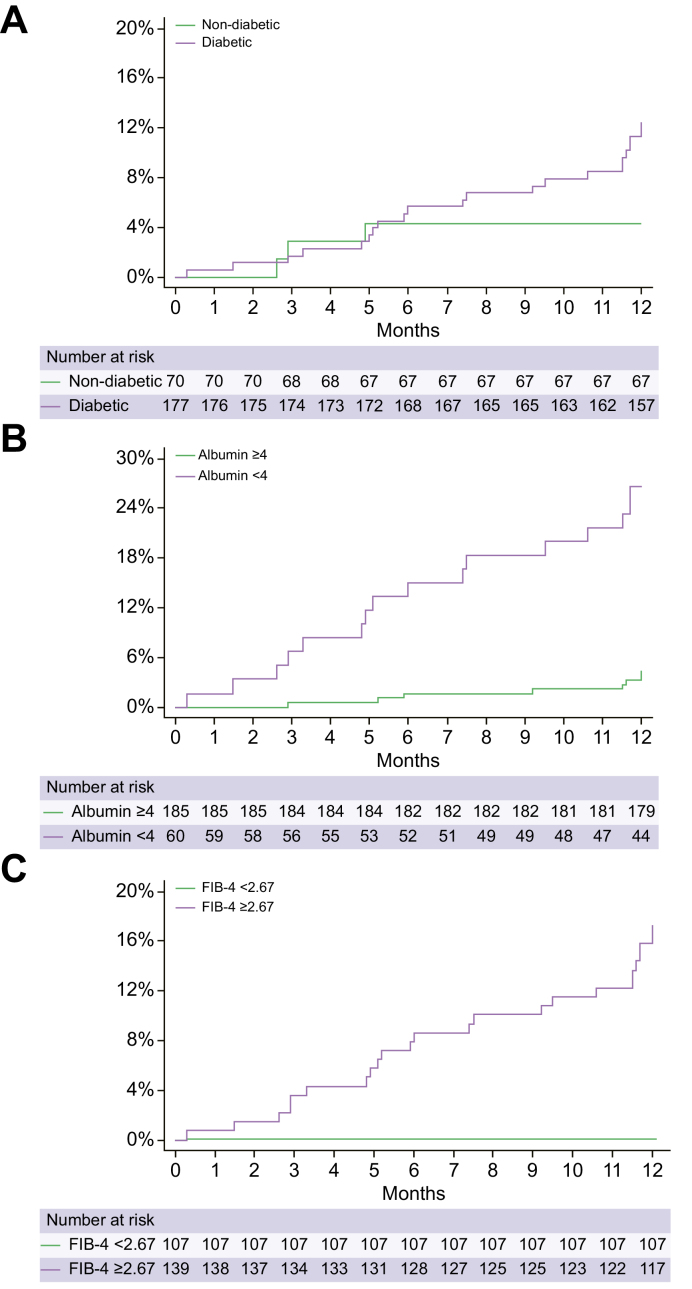
A total of 354 patients were included, all of whom were compensated at the beginning of the study period; 83 individuals (23.5%) had a history of prior hepatic decompensation. Mean age was 67.3 years and 48.3% were female. Median BMI was 31.2 kg/m and type 2 diabetes was present in 72.8% of patients. The rates of first LRE in the Pre-pandemic and Pandemic periods were 7.4% and 11.3% ( = 0.12), respectively. Whilst the rate of overall events was significantly higher in the Pandemic period (9.9% 17.8%; 0.009), this was strongly associated with COVID-19-related deaths. The rate of worsened metabolic status was significantly higher in the Pandemic period (38.4% 46.1%; 0.041), yet this was not associated with the risk of first LRE during the Pandemic period, whereas type 2 diabetes (odds ratio [OR] 3.77; 95% CI 1.15-12.32; 0.028), albumin <4 g/L (OR 4.43; 95% CI 1.76-11.17; 0.002) and Fibrosis-4 score >2.67 (OR 15.74; 95% CI 2.01-123.22; 0.009) were identified as risk factors in the multivariable analysis.
Overall, people with NAFLD cirrhosis did not present poorer liver-related outcomes during the first year of the pandemic. Health system preparedness seems key to ensure that people with NAFLD cirrhosis receive appropriate care during health crises.
Mobility restrictions and social stress induced by the COVID-19 pandemic have led to increased alcohol drinking and worsened metabolic control (., weight gain, poor control of diabetes) in a large proportion of the population in many countries. We aimed to analyze whether people with cirrhosis due to non-alcoholic fatty liver disease, who are particularly vulnerable to such lifestyle modifications, were significantly impacted during the first year of the pandemic. We compared the clinical situation of 354 patients one year before the pandemic and one year after. We found that although metabolic control was indeed worse after the first year of the pandemic and patients presented worse clinical outcomes, the latter was mostly due to non-liver causes, namely COVID-19 itself. Moreover, the care provided to these patients did not worsen during the first year of the pandemic.
新冠疫情对全球卫生系统和许多慢性病产生了重大负面影响。我们旨在评估疫情第一年对非酒精性脂肪性肝病(NAFLD)肝硬化患者预后的影响。
我们在西班牙加泰罗尼亚的四家大学医院进行了一项前后对照研究。研究子时期分为疫情前(2019年3月 - 2020年2月)和疫情期间(2020年3月 - 2021年2月)。主要结局是首次肝脏相关事件(LRE)的发生率。还评估了总体临床结局(LREs加心血管疾病加全因死亡率)。
共纳入354例患者,所有患者在研究期开始时病情稳定;83例个体(23.5%)有肝失代偿病史。平均年龄为67.3岁,48.3%为女性。中位体重指数为31.2kg/m²且72.8%的患者患有2型糖尿病。疫情前和疫情期间首次LRE的发生率分别为7.4%和11.3%(P = 0.12)。虽然疫情期间总体事件发生率显著更高(9.9%对17.8%;P = 0.009),但这与新冠相关死亡密切相关。疫情期间代谢状态恶化的发生率显著更高(38.4%对46.1%;P = 0.041),然而这与疫情期间首次LRE的风险无关,但在多变量分析中,2型糖尿病(比值比[OR] 3.77;95%置信区间1.15 - 12.32;P = 0.028)、白蛋白<4g/L(OR 4.43;95%置信区间1.76 - 11.17;P = 0.002)和纤维化 - 4评分>2.67(OR 15.74;95%置信区间2.01 - 123.22;P = 0.009)被确定为风险因素。
总体而言,NAFLD肝硬化患者在疫情的第一年并未出现更差的肝脏相关预后。卫生系统的准备工作似乎是确保NAFLD肝硬化患者在健康危机期间获得适当护理的关键。
新冠疫情引发的行动限制和社会压力导致许多国家很大一部分人口饮酒增加且代谢控制恶化(如体重增加、糖尿病控制不佳)。我们旨在分析非酒精性脂肪性肝病导致的肝硬化患者(这类患者特别容易受到此类生活方式改变的影响)在疫情第一年是否受到显著影响。我们比较了354例患者在疫情前一年和后一年的临床情况。我们发现,尽管疫情第一年过后代谢控制确实更差且患者临床结局更糟,但后者主要是由于非肝脏原因,即新冠病毒本身。此外这些患者在疫情第一年接受的护理并未恶化。