Lancet. 2021 Oct 9;398(10308):1317-1343. doi: 10.1016/S0140-6736(21)01258-7. Epub 2021 Sep 22.
The rapid spread of COVID-19 renewed the focus on how health systems across the globe are financed, especially during public health emergencies. Development assistance is an important source of health financing in many low-income countries, yet little is known about how much of this funding was disbursed for COVID-19. We aimed to put development assistance for health for COVID-19 in the context of broader trends in global health financing, and to estimate total health spending from 1995 to 2050 and development assistance for COVID-19 in 2020.
We estimated domestic health spending and development assistance for health to generate total health-sector spending estimates for 204 countries and territories. We leveraged data from the WHO Global Health Expenditure Database to produce estimates of domestic health spending. To generate estimates for development assistance for health, we relied on project-level disbursement data from the major international development agencies' online databases and annual financial statements and reports for information on income sources. To adjust our estimates for 2020 to include disbursements related to COVID-19, we extracted project data on commitments and disbursements from a broader set of databases (because not all of the data sources used to estimate the historical series extend to 2020), including the UN Office of Humanitarian Assistance Financial Tracking Service and the International Aid Transparency Initiative. We reported all the historic and future spending estimates in inflation-adjusted 2020 US$, 2020 US$ per capita, purchasing-power parity-adjusted US$ per capita, and as a proportion of gross domestic product. We used various models to generate future health spending to 2050.
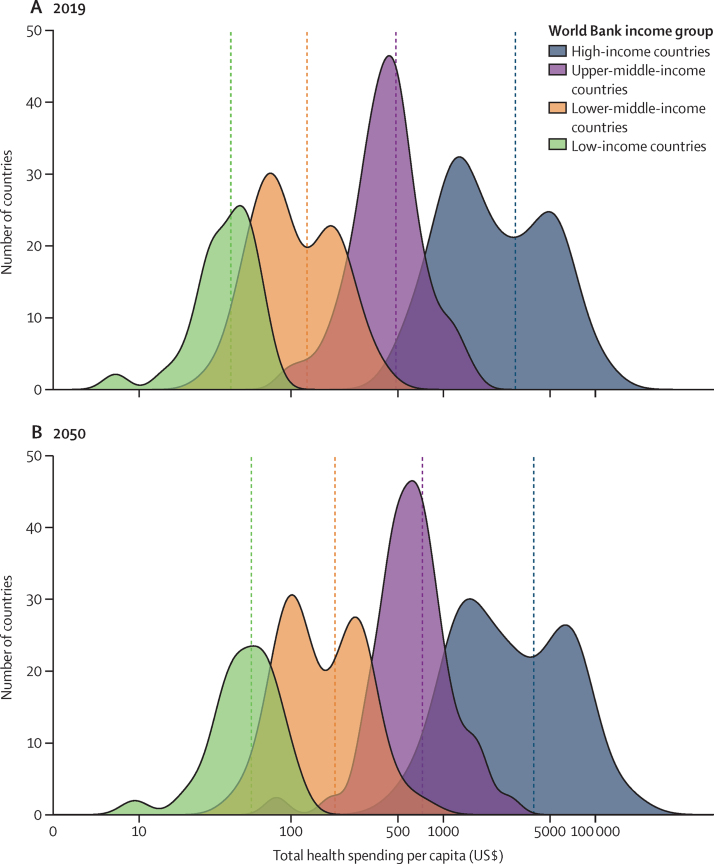
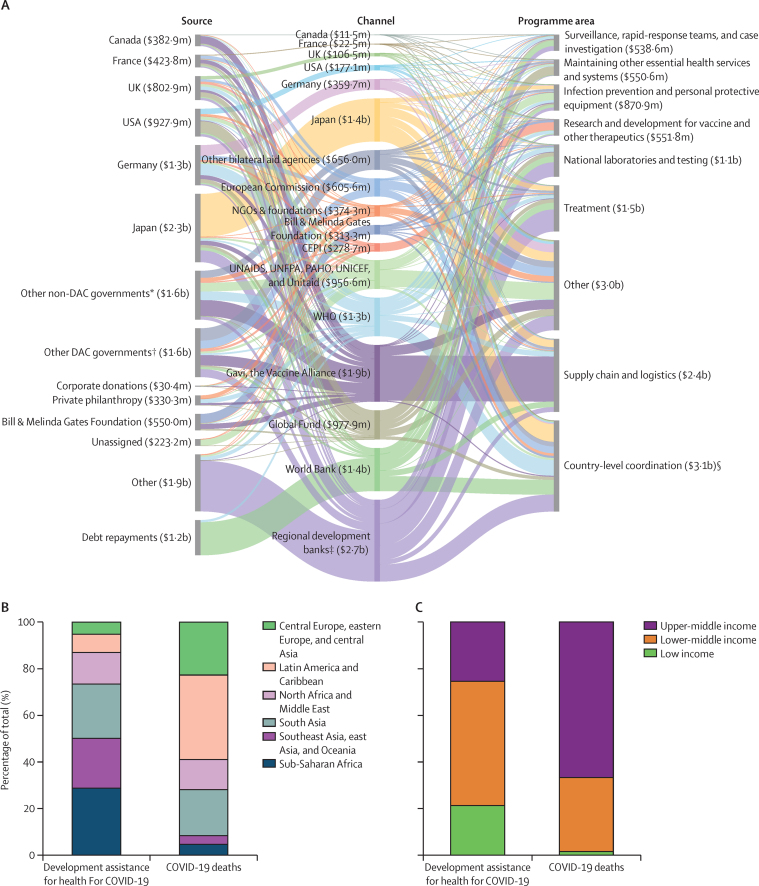
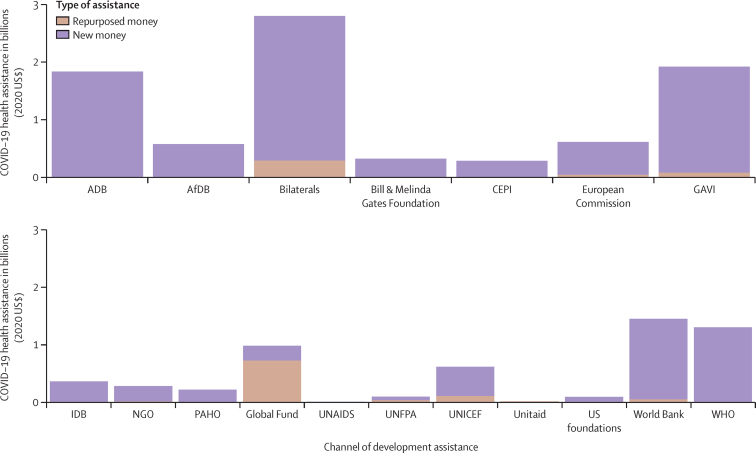
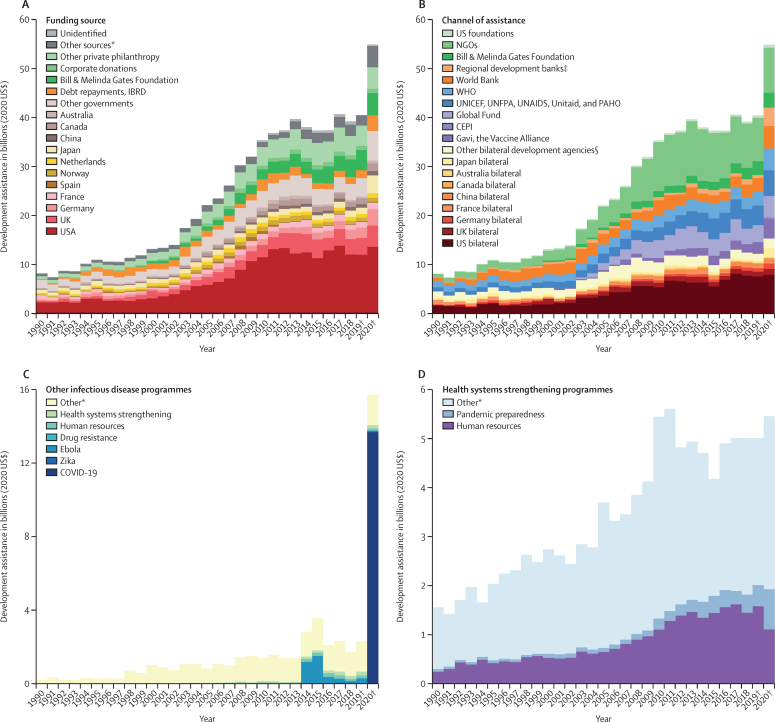
In 2019, health spending globally reached $8·8 trillion (95% uncertainty interval [UI] 8·7-8·8) or $1132 (1119-1143) per person. Spending on health varied within and across income groups and geographical regions. Of this total, $40·4 billion (0·5%, 95% UI 0·5-0·5) was development assistance for health provided to low-income and middle-income countries, which made up 24·6% (UI 24·0-25·1) of total spending in low-income countries. We estimate that $54·8 billion in development assistance for health was disbursed in 2020. Of this, $13·7 billion was targeted toward the COVID-19 health response. $12·3 billion was newly committed and $1·4 billion was repurposed from existing health projects. $3·1 billion (22·4%) of the funds focused on country-level coordination and $2·4 billion (17·9%) was for supply chain and logistics. Only $714·4 million (7·7%) of COVID-19 development assistance for health went to Latin America, despite this region reporting 34·3% of total recorded COVID-19 deaths in low-income or middle-income countries in 2020. Spending on health is expected to rise to $1519 (1448-1591) per person in 2050, although spending across countries is expected to remain varied.
Global health spending is expected to continue to grow, but remain unequally distributed between countries. We estimate that development organisations substantially increased the amount of development assistance for health provided in 2020. Continued efforts are needed to raise sufficient resources to mitigate the pandemic for the most vulnerable, and to help curtail the pandemic for all.
Bill & Melinda Gates Foundation.
COVID-19 的迅速传播再次引发了人们对全球卫生系统的融资方式的关注,尤其是在公共卫生紧急情况下。发展援助是许多低收入国家卫生融资的重要来源,但人们对其中有多少资金用于 COVID-19 知之甚少。我们旨在将 COVID-19 下的卫生发展援助置于更广泛的全球卫生融资趋势背景下,并估计 1995 年至 2050 年的总卫生支出和 2020 年的 COVID-19 发展援助。
我们估计了国内卫生支出和卫生发展援助,以生成 204 个国家和地区的总卫生部门支出估计数。我们利用世卫组织全球卫生支出数据库的数据来产生国内卫生支出的估计数。为了生成卫生发展援助的估计数,我们依赖于主要国际发展机构在线数据库和年度财务报表中的项目一级支出数据,以及收入来源的信息,以获取年度财务报表。为了调整我们对 2020 年的估计数以包括与 COVID-19 相关的支出,我们从更广泛的数据库中提取了关于承诺和支出的项目数据(因为用于估计历史系列的数据源并不全部延伸到 2020 年),包括联合国人道主义援助财务跟踪处和国际援助透明度倡议。我们报告了所有历史和未来的支出估计数,包括以不变价格 2020 年美元、2020 年人均美元、购买力平价调整后的人均美元以及占国内生产总值的比例。我们使用各种模型来生成到 2050 年的未来卫生支出。
2019 年,全球卫生支出达到 8.8 万亿美元(95%不确定性区间[UI]8.7-8.8)或 1132 美元(1119-1143 美元)/人。各国之间和各收入组之间的卫生支出存在差异。在这一总额中,404 亿美元(0.5%,95%UI 0.5-0.5)是提供给低收入和中等收入国家的卫生发展援助,占低收入国家总支出的 24.6%(UI 24.0-25.1)。我们估计,2020 年提供了 548 亿美元的卫生发展援助。其中,137 亿美元用于 COVID-19 卫生应对。123 亿美元是新承诺的,14 亿美元是从现有卫生项目重新分配的。310 亿美元(22.4%)的资金用于国家一级的协调,240 亿美元(17.9%)用于供应链和物流。尽管拉丁美洲报告了 2020 年低收入或中等收入国家记录的 COVID-19 死亡总数的 34.3%,但只有 7.144 亿美元(7.7%)的 COVID-19 发展援助用于该地区。预计到 2050 年,人均卫生支出将上升至 1519 美元(1448-1591 美元),尽管各国之间的支出仍预计存在差异。
全球卫生支出预计将继续增长,但国家之间的分配仍不均衡。我们估计,发展组织在 2020 年大幅增加了提供的卫生发展援助数额。需要继续努力筹集足够的资源,以减轻最脆弱国家的大流行影响,并帮助遏制所有人的大流行。
比尔及梅琳达·盖茨基金会。