Liu Mange, Ren Haitao, Lin Nan, Tan Ying, Fan Siyuan, Guan Hongzhi
Department of Neurology, Peking Union Medical College Hospital, Beijing, China.
Chinese Academy of Medical Sciences, Peking Union Medical College, Beijing, China.
Front Neurol. 2022 Aug 19;13:979203. doi: 10.3389/fneur.2022.979203. eCollection 2022.
The "hot cross bun sign" (HCBs) on magnetic resonance imaging (MRI) has been initially considered specific for multiple system atrophy with cerebellar features. However, a number of other conditions have since been described, which may be associated with this imaging sign. We herein describe a patient with anti-Ri and paraneoplastic cerebellar ataxia, and review the association of the HCBs on imaging with various neurological autoimmune conditions.
We report a 40-year-old woman with anti-Ri-associated paraneoplastic neurological syndrome and breast carcinoma, in whom brain MRI revealed the HCBs late in the disease course. We also reviewed similar cases reported in the literature.
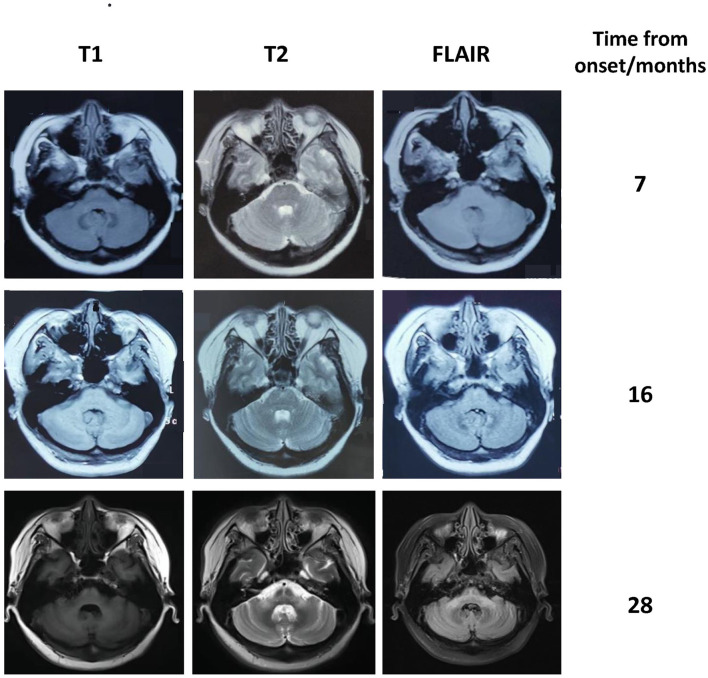
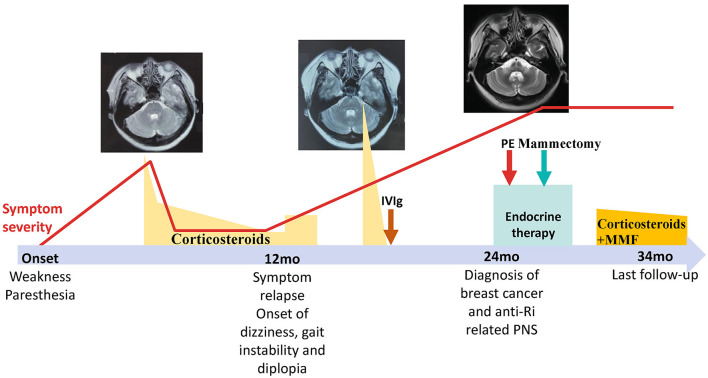
The patient presented with cerebellar ataxia, polyneuropathy, and pyramidal signs. Although brain MRI was initially unremarkable, the HCBs and T2-weighted hyperintensity of the bilateral middle cerebellar peduncles were observed at later follow-up. Anti-Ri was detected in the serum and cerebrospinal fluid. Breast adenocarcinoma was confirmed an axillary lymph node biopsy. Her symptoms partially resolved after the first corticosteroid pulse. However, subsequent immunotherapy and tumor treatments were ineffective. Four autoimmune cerebellar ataxia cases with the HCBs (two paraneoplastic and two non-paraneoplastic) were identified in the literature.
The HCBs can be associated with paraneoplastic and non-paraneoplastic cerebellar ataxia, which may reflect neurodegeneration secondary to autoimmune injury. Thus, the HCBs should not be considered a contraindication for autoimmune cerebellar syndrome.
磁共振成像(MRI)上的“热十字面包征”(HCBs)最初被认为是具有小脑特征的多系统萎缩的特异性表现。然而,此后又描述了许多其他情况,这些情况可能与这种影像学表现相关。我们在此描述一例患有抗Ri抗体和副肿瘤性小脑共济失调的患者,并回顾影像学上HCBs与各种神经自身免疫性疾病的关联。
我们报告一名40岁患有抗Ri抗体相关副肿瘤性神经综合征和乳腺癌的女性,其脑部MRI在病程后期显示出HCBs。我们还回顾了文献中报道的类似病例。
该患者出现小脑共济失调、多发性神经病和锥体束征。尽管最初脑部MRI无明显异常,但在后续随访中观察到了HCBs以及双侧小脑中脚的T2加权高信号。在血清和脑脊液中检测到抗Ri抗体。经腋窝淋巴结活检确诊为乳腺腺癌。首次使用皮质类固醇脉冲治疗后,她的症状部分缓解。然而,随后的免疫治疗和肿瘤治疗均无效。在文献中鉴定出4例伴有HCBs的自身免疫性小脑共济失调病例(2例副肿瘤性和2例非副肿瘤性)。
HCBs可与副肿瘤性和非副肿瘤性小脑共济失调相关,这可能反映了自身免疫损伤继发的神经变性。因此,HCBs不应被视为自身免疫性小脑综合征的排除标准。