Division of Vascular Surgery, Department of Surgery, University of Wisconsin-Madison, Madison, Wisconsin, 53705, USA.
Department of Chemistry, University of Wisconsin-Madison, Madison, Wisconsin, 53705, USA.
J Extracell Vesicles. 2022 Sep;11(9):e12261. doi: 10.1002/jev2.12261.
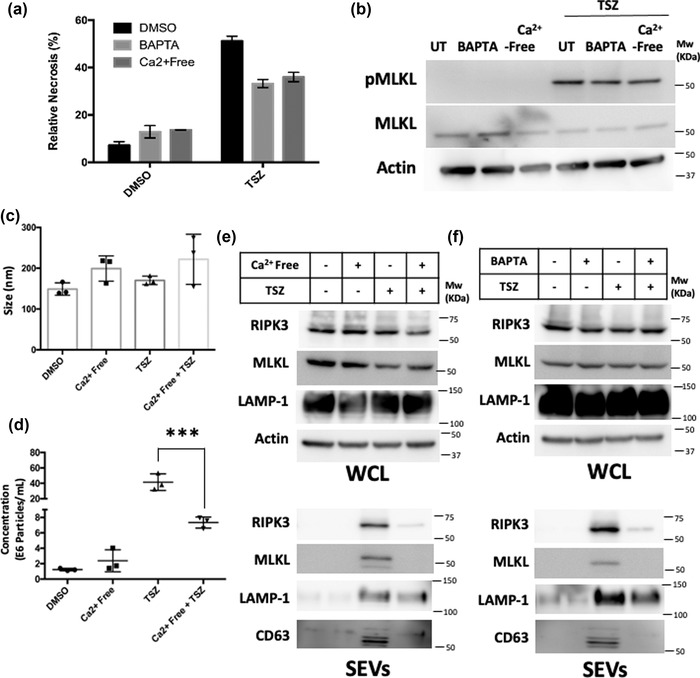
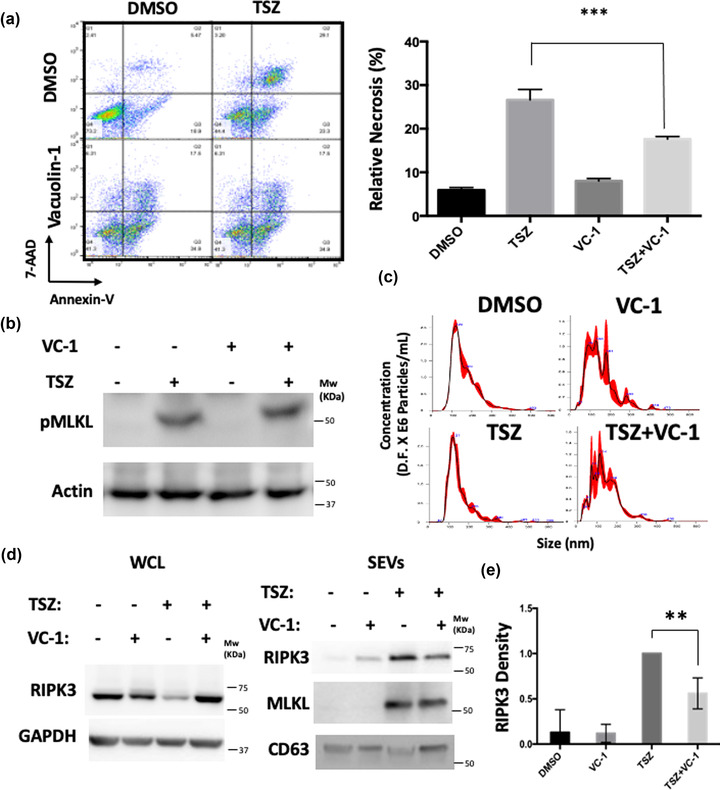
Extracellular vesicle (EV) secretion is an important mechanism used by cells to release biomolecules. A common necroptosis effector-mixed lineage kinase domain like (MLKL)-was recently found to participate in the biogenesis of small and large EVs independent of its function in necroptosis. The objective of the current study is to gain mechanistic insights into EV biogenesis during necroptosis. Assessing EV number by nanoparticle tracking analysis revealed an increased number of EVs released during necroptosis. To evaluate the nature of such vesicles, we performed a newly adapted, highly sensitive mass spectrometry-based proteomics on EVs released by healthy or necroptotic cells. Compared to EVs released by healthy cells, EVs released during necroptosis contained a markedly higher number of unique proteins. Receptor interacting protein kinase-3 (RIPK3) and MLKL were among the proteins enriched in EVs released during necroptosis. Further, mouse embryonic fibroblasts (MEFs) derived from mice deficient of Rab27a and Rab27b showed diminished basal EV release but responded to necroptosis with enhanced EV biogenesis as the wildtype MEFs. In contrast, necroptosis-associated EVs were sensitive to Ca depletion or lysosomal disruption. Neither treatment affected the RIPK3-mediated MLKL phosphorylation. An unbiased screen using RIPK3 immunoprecipitation-mass spectrometry on necroptotic EVs led to the identification of Rab11b in RIPK3 immune-complexes. Our data suggests that necroptosis switches EV biogenesis from a Rab27a/b dependent mechanism to a lysosomal mediated mechanism.
细胞外囊泡 (EV) 的分泌是细胞释放生物分子的一种重要机制。最近发现,一种常见的坏死性细胞凋亡效应因子——混合谱系激酶结构域样 (MLKL)——独立于其在坏死性细胞凋亡中的功能,参与了小和大 EV 的生物发生。本研究的目的是深入了解坏死性细胞凋亡过程中 EV 的生物发生机制。通过纳米颗粒跟踪分析评估 EV 的数量,发现坏死性细胞凋亡过程中释放的 EV 数量增加。为了评估这些囊泡的性质,我们对健康细胞或坏死性细胞释放的 EV 进行了新的、高度敏感的基于质谱的蛋白质组学分析。与健康细胞释放的 EV 相比,坏死性细胞凋亡过程中释放的 EV 含有明显更高数量的独特蛋白质。受体相互作用蛋白激酶-3 (RIPK3) 和 MLKL 是在坏死性细胞凋亡过程中释放的 EV 中富含的蛋白质之一。此外,来自 RIPK3 和 MLKL 缺失的小鼠的胚胎成纤维细胞 (MEF) 显示出基础 EV 释放减少,但对坏死性细胞凋亡的反应是增强 EV 的生物发生,而野生型 MEF 则没有。相比之下,坏死性细胞凋亡相关的 EV 对钙耗竭或溶酶体破坏敏感。这两种处理都不影响 RIPK3 介导的 MLKL 磷酸化。在坏死性细胞凋亡 EV 上使用 RIPK3 免疫沉淀-质谱进行的无偏筛选导致在 RIPK3 免疫复合物中鉴定出 Rab11b。我们的数据表明,坏死性细胞凋亡将 EV 的生物发生从 Rab27a/b 依赖性机制切换为溶酶体介导的机制。