Infectious Disease Epidemiology, Bernhard Nocht Insitute for Tropical Medicine, Hamburg, Germany.
German Center for Infection Research (DZIF), Hamburg-Borstel-Lübeck-Riems, Heidelberg, Germany.
BMC Public Health. 2022 Sep 5;22(1):1676. doi: 10.1186/s12889-022-13918-y.
The current COVID-19 pandemic affects the entire world population and has serious health, economic and social consequences. Assessing the prevalence of COVID-19 through population-based serological surveys is essential to monitor the progression of the epidemic, especially in African countries where the extent of SARS-CoV-2 spread remains unclear.
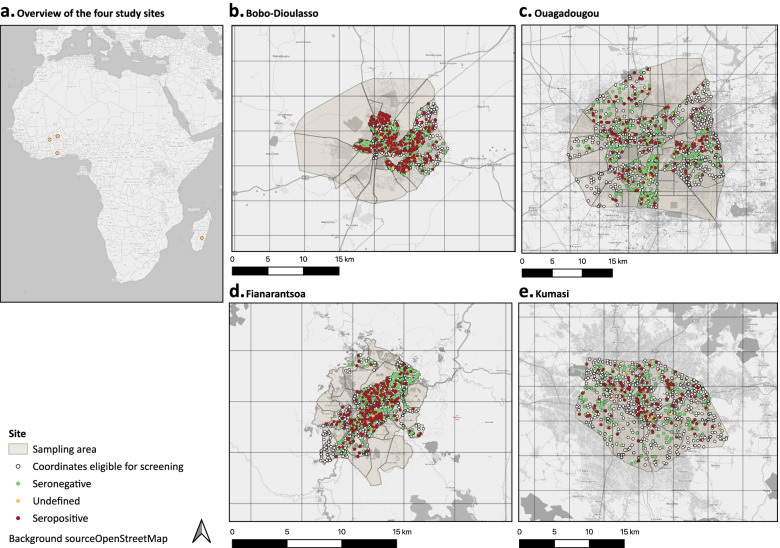
A two-stage cluster population-based SARS-CoV-2 seroprevalence survey was conducted in Bobo-Dioulasso and in Ouagadougou, Burkina Faso, Fianarantsoa, Madagascar and Kumasi, Ghana between February and June 2021. IgG seropositivity was determined in 2,163 households with a specificity improved SARS-CoV-2 Enzyme-linked Immunosorbent Assay. Population seroprevalence was evaluated using a Bayesian logistic regression model that accounted for test performance and age, sex and neighbourhood of the participants.
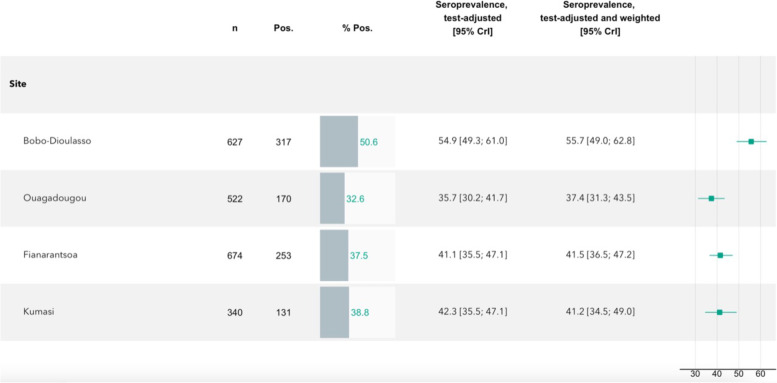
Seroprevalence adjusted for test performance and population characteristics were 55.7% [95% Credible Interval (CrI) 49·0; 62·8] in Bobo-Dioulasso, 37·4% [95% CrI 31·3; 43·5] in Ouagadougou, 41·5% [95% CrI 36·5; 47·2] in Fianarantsoa, and 41·2% [95% CrI 34·5; 49·0] in Kumasi. Within the study population, less than 6% of participants performed a test for acute SARS-CoV-2 infection since the onset of the pandemic.
High exposure to SARS-CoV-2 was found in the surveyed regions albeit below the herd immunity threshold and with a low rate of previous testing for acute infections. Despite the high seroprevalence in our study population, the duration of protection from naturally acquired immunity remains unclear and new virus variants continue to emerge. This highlights the importance of vaccine deployment and continued preventive measures to protect the population at risk.
当前的 COVID-19 大流行影响到全球所有人,并造成严重的健康、经济和社会后果。通过基于人群的血清学调查评估 COVID-19 的流行率对于监测疫情的进展至关重要,特别是在 SARS-CoV-2 传播程度尚不清楚的非洲国家。
2021 年 2 月至 6 月期间,在布基纳法索的博博迪乌拉索和瓦加杜古、马达加斯加的菲亚纳兰楚阿以及加纳的库马西进行了两阶段的基于人群的 SARS-CoV-2 血清流行率调查。采用特异性提高的 SARS-CoV-2 酶联免疫吸附试验检测 2163 户家庭的 IgG 血清阳性率。采用贝叶斯逻辑回归模型评估人群血清流行率,该模型考虑了检测性能以及参与者的年龄、性别和社区特征。
在调整了检测性能和人口特征后,博博迪乌拉索的血清流行率为 55.7%[95%可信区间(CrI)49.062.8],瓦加杜古为 37.4%[95% CrI 31.343.5],菲亚纳兰楚阿为 41.5%[95% CrI 36.547.2],库马西为 41.2%[95% CrI 34.549.0]。在研究人群中,自大流行开始以来,不到 6%的参与者进行过急性 SARS-CoV-2 感染检测。
在所调查的地区发现了 SARS-CoV-2 的高暴露率,尽管低于群体免疫阈值,但急性感染的检测率较低。尽管我们的研究人群中血清阳性率较高,但自然获得性免疫的保护持续时间尚不清楚,新的病毒变体仍在不断出现。这凸显了部署疫苗和持续采取预防措施保护高危人群的重要性。