Department of Statistics and Actuarial Science, College of Science, Kwame Nkrumah University of Science and Technology (KNUST), Kumasi, Ghana.
Department of Economics, University of Aberdeen, Aberdeen, Scotland, United Kingdom.
PLoS One. 2021 Oct 29;16(10):e0258164. doi: 10.1371/journal.pone.0258164. eCollection 2021.
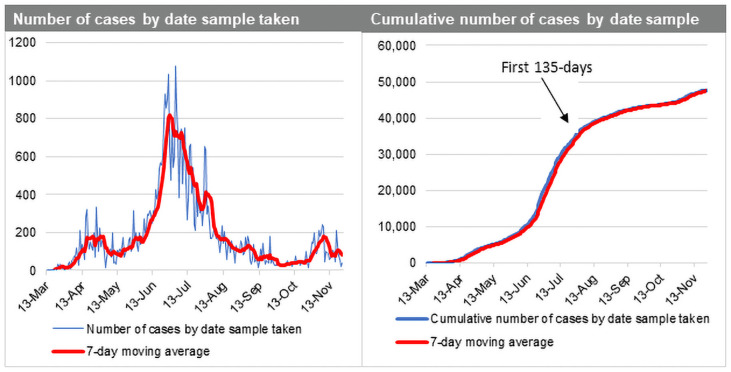
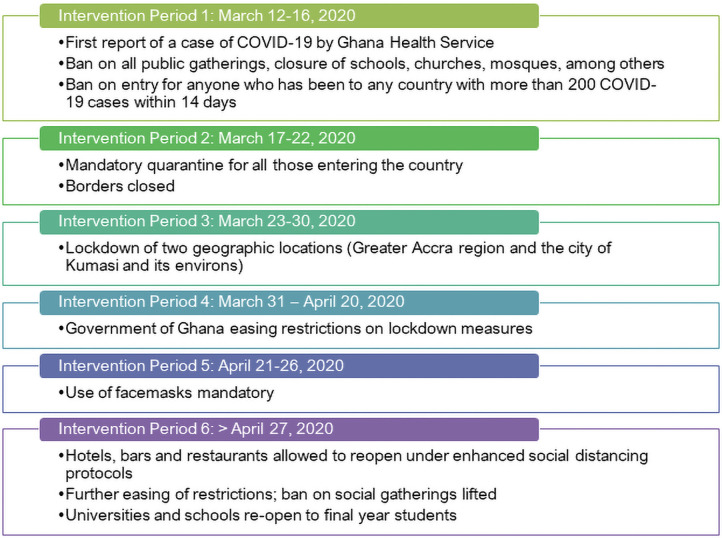
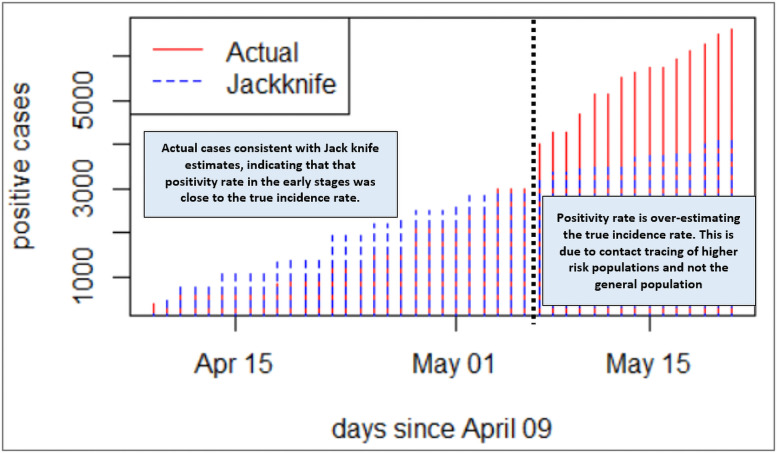
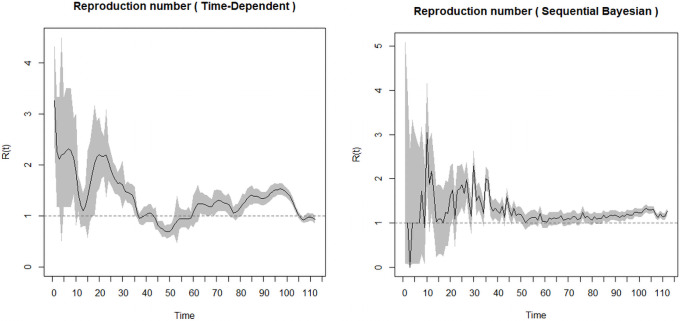
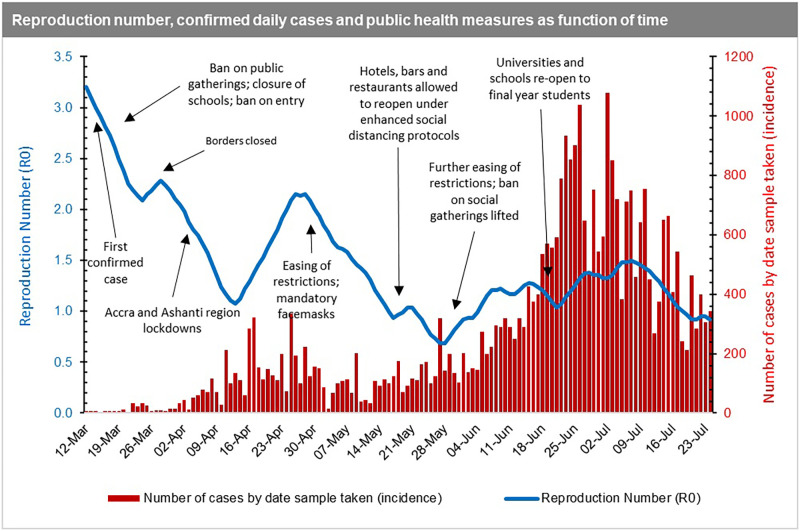
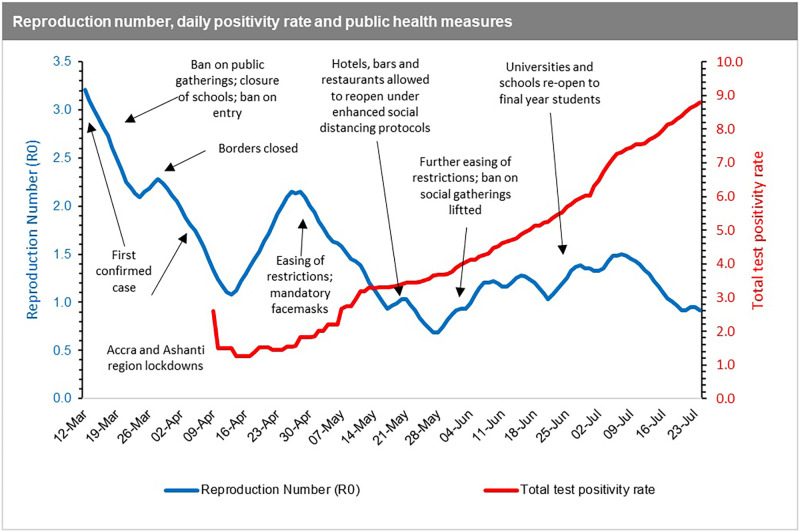
This paper uses publicly available data and various statistical models to estimate the basic reproduction number (R0) and other disease parameters for Ghana's early COVID-19 pandemic outbreak. We also test the effectiveness of government imposition of public health measures to reduce the risk of transmission and impact of the pandemic, especially in the early phase. R0 is estimated from the statistical model as 3.21 using a 0.147 estimated growth rate [95% C.I.: 0.137-0.157] and a 15-day time to recovery after COVID-19 infection. This estimate of the initial R0 is consistent with others reported in the literature from other parts of Africa, China and Europe. Our results also indicate that COVID-19 transmission reduced consistently in Ghana after the imposition of public health interventions-such as border restrictions, intra-city movement, quarantine and isolation-during the first phase of the pandemic from March to May 2020. However, the time-dependent reproduction number (Rt) beyond mid-May 2020 does not represent the true situation, given that there was not a consistent testing regime in place. This is also confirmed by our Jack-knife bootstrap estimates which show that the positivity rate over-estimates the true incidence rate from mid-May 2020. Given concerns about virus mutations, delays in vaccination and a possible new wave of the pandemic, there is a need for systematic testing of a representative sample of the population to monitor the reproduction number. There is also an urgent need to increase the availability of testing for the general population to enable early detection, isolation and treatment of infected individuals to reduce progression to severe disease and mortality.
本文利用公开数据和各种统计模型,对加纳 COVID-19 大流行早期的基本繁殖数 (R0) 和其他疾病参数进行了估计。我们还测试了政府实施公共卫生措施以降低传播风险和大流行影响的效果,特别是在早期阶段。通过统计模型,我们估计 R0 为 3.21,增长率估计为 0.147[95%置信区间:0.137-0.157],COVID-19 感染后康复时间为 15 天。这一初始 R0 的估计与其他非洲、中国和欧洲文献中的报告一致。我们的研究结果还表明,2020 年 3 月至 5 月大流行第一阶段加纳实施公共卫生干预措施(如边境限制、市内流动、检疫和隔离)后,COVID-19 的传播持续减少。然而,2020 年 5 月中旬以后的时间依赖繁殖数(Rt)并不能代表真实情况,因为当时没有实施一致的检测制度。这也得到了我们 Jack-knife 自举估计的证实,该估计表明,自 2020 年 5 月中旬以来,阳性率高估了真实发病率。考虑到对病毒突变、疫苗接种延迟和可能出现的大流行新波次的担忧,需要对代表性人群样本进行系统检测以监测繁殖数。还迫切需要增加普通人群的检测可用性,以实现对感染者的早期发现、隔离和治疗,从而减少向严重疾病和死亡的发展。