Swedish National Veterinary Institute (SVA), 75189, Uppsala, Sweden.
Department of Medicinal Chemistry, Analytical Pharmaceutical Chemistry, Uppsala University, P.O. Box 574, 75123, Uppsala, Sweden.
BMC Vet Res. 2022 Sep 5;18(1):334. doi: 10.1186/s12917-022-03370-w.
Alpha-chloralose (AC) is a compound known to be toxic to various animal species and humans. In 2018 and 2019 an increase in suspected cases of AC poisoning in cats related to the use of AC as a rodenticide was reported to national veterinary and chemical authorities in Finland, Norway and Sweden by veterinarians working in clinical practices in respective country. The aims of this study were to prospectively investigate AC poisoning in cats, including possible secondary poisoning by consuming poisoned mice, and to study metabolism and excretion of AC in cats through analysis of feline urine.
Data on signalment, history and clinical findings were prospectively collected in Finland, Norway and Sweden from July 2020 until March of 2021 using a questionnaire which the attending veterinarian completed and submitted together with a serum sample collected from suspected feline cases of AC-poisoning. The diagnosis was confirmed by quantification of AC in serum samples. Content of AC was studied in four feline urine samples, including screening for AC metabolites by UHPLC-HRMS/MS. Bait intake and amount of AC consumed by mice was observed in wild mice during an extermination of a rodent infestation.
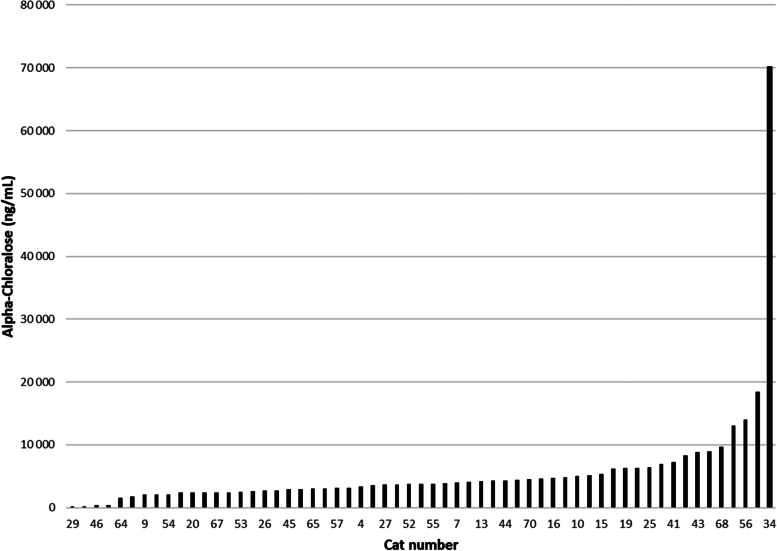
In total, 59 of 70 collected questionnaires and accompanying serum samples were included, with 127 to 70 100 ng/mL AC detected in the serum. Several tentative AC-metabolites were detected in the analysed feline urine samples, including dechlorinated and oxidated AC, several sulfate conjugates, and one glucuronic acid conjugate of AC. The calculated amount of AC ingested by each mouse was 33 to 106 mg with a mean of 61 mg.
Clinical recognition of symptoms of AC poisoning in otherwise healthy cats roaming free outdoors and known to be rodent hunters strongly correlated with confirmation of the diagnosis through toxicological analyses of serum samples. The collected feline exposure data regarding AC show together with the calculation of the intake of bait and subsequent AC concentrations in mice that secondary poisoning from ingestion of mice is possible. The results of the screening for AC metabolites in feline urine confirm that cats excrete AC both unchanged and metabolized through dechlorination, oxidation, glucuronidation and sulfatation pathways.
α-氯醛(AC)是一种已知对多种动物物种和人类有毒的化合物。2018 年和 2019 年,在芬兰、挪威和瑞典,临床兽医向国家兽医和化学当局报告了与使用 AC 作为灭鼠剂有关的猫疑似 AC 中毒病例增加的情况。本研究的目的是前瞻性调查猫的 AC 中毒情况,包括通过食用中毒老鼠可能发生的二次中毒,并通过分析猫尿液研究 AC 在猫体内的代谢和排泄。
2020 年 7 月至 2021 年 3 月,使用问卷调查表在芬兰、挪威和瑞典前瞻性收集有关特征、病史和临床发现的数据,由主治兽医填写并与从疑似猫 AC 中毒病例采集的血清样本一起提交。通过对血清样本中 AC 的定量检测来确认诊断。在四个猫尿样本中研究了 AC 的含量,包括通过 UHPLC-HRMS/MS 筛查 AC 代谢物。在一次灭鼠活动中观察到野生老鼠的诱饵摄入和老鼠消耗的 AC 量。
共收集了 70 份问卷和配套血清样本中的 59 份,血清中检测到的 AC 浓度为 127 至 70 100ng/ml。在分析的猫尿样本中检测到几种暂定的 AC 代谢物,包括脱氯和氧化 AC、几种硫酸结合物以及 AC 的一种葡萄糖醛酸结合物。每只老鼠摄入的 AC 量估计为 33 至 106mg,平均为 61mg。
在户外自由游荡且已知是啮齿动物猎手的健康猫出现 AC 中毒症状,并通过对血清样本进行毒理学分析确认诊断,这强烈表明临床识别 AC 中毒症状的能力。关于 AC 的猫暴露数据表明,从摄入老鼠的角度来看,二次中毒是可能的,这与对老鼠摄入的诱饵和随后的 AC 浓度的计算结果一致。猫尿液中 AC 代谢物筛查的结果证实,猫通过脱氯、氧化、葡萄糖醛酸化和硫酸化途径排泄未改变的 AC 和代谢产物。