Department of Mechanical and Aerospace Engineering, University of California, Davis, CA 95616.
Department of Aerospace Engineering, University of Michigan, Ann Arbor, MI 48109.
Proc Natl Acad Sci U S A. 2022 Sep 13;119(37):e2204847119. doi: 10.1073/pnas.2204847119. Epub 2022 Sep 6.
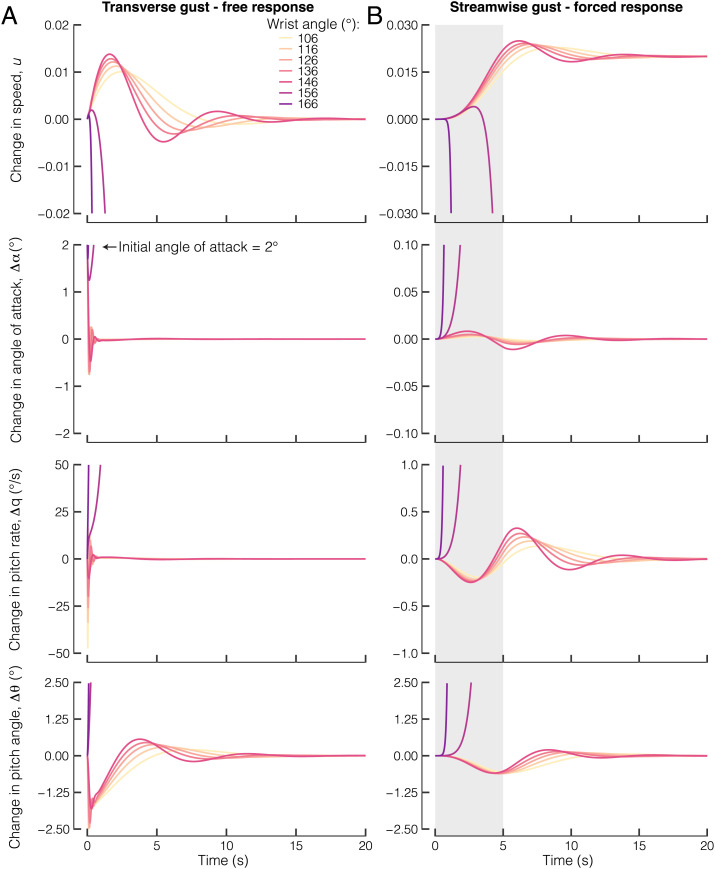
Birds perform astounding aerial maneuvers by actuating their shoulder, elbow, and wrist joints to morph their wing shape. This maneuverability is desirable for similar-sized uncrewed aerial vehicles (UAVs) and can be analyzed through the lens of dynamic flight stability. Quantifying avian dynamic stability is challenging as it is dictated by aerodynamics and inertia, which must both account for birds' complex and variable morphology. To date, avian dynamic stability across flight conditions remains largely unknown. Here, we fill this gap by quantifying how a gull can use wing morphing to adjust its longitudinal dynamic response. We found that it was necessary to adjust the shoulder angle to achieve trimmed flight and that most trimmed configurations were longitudinally stable except for configurations with high wrist angles. Our results showed that as flight speed increases, the gull could fold or sweep its wings backward to trim. Further, a trimmed gull can use its wing joints to control the frequencies and damping ratios of the longitudinal oscillatory modes. We found a more damped phugoid mode than similar-sized UAVs, possibly reducing speed sensitivity to perturbations, such as gusts. Although most configurations had controllable short-period flying qualities, the heavily damped phugoid mode indicates a sluggish response to control inputs, which may be overcome while maneuvering by morphing into an unstable flight configuration. Our study shows that gulls use their shoulder, wrist, and elbow joints to negotiate trade-offs in stability and control and points the way forward for designing UAVs with avian-like maneuverability.
鸟类通过操纵肩部、肘部和腕部关节来改变翅膀形状,从而完成惊人的空中机动动作。类似大小的无人飞行器(UAV)也需要这种机动性,并且可以通过动态飞行稳定性的角度进行分析。量化鸟类的动态稳定性具有挑战性,因为它受到空气动力学和惯性的影响,而这两者都必须考虑到鸟类复杂且多变的形态。迄今为止,鸟类在不同飞行条件下的动态稳定性在很大程度上仍不为人知。在这里,我们通过量化海鸥如何利用翅膀变形来调整其纵向动态响应来填补这一空白。我们发现,有必要调整肩部角度以实现配平飞行,并且除了具有高腕关节角度的配置外,大多数配平配置在纵向都是稳定的。我们的结果表明,随着飞行速度的增加,海鸥可以向后折叠或扫动翅膀以进行配平。此外,配平后的海鸥可以使用其翅膀关节来控制纵向振荡模式的频率和阻尼比。与类似大小的 UAV 相比,我们发现海鸥具有更阻尼的弹道模态,这可能降低了对阵风等扰动的速度敏感性。虽然大多数配置都具有可控制的短周期飞行品质,但高度阻尼的弹道模态表明对控制输入的响应迟钝,这可能在通过变形进入不稳定的飞行配置进行机动时得到克服。我们的研究表明,海鸥利用其肩部、腕部和肘部关节来平衡稳定性和控制之间的权衡,并为设计具有类似鸟类机动性的 UAV 指明了方向。