Department of Pathology, School of Basic Medical Sciences, Medical School, Xi'an Jiaotong University, Xi'an, China.
Key Laboratory of Environment and Genes Related to Diseases, Ministry of Education, Xi'an, China.
JAMA Netw Open. 2022 Sep 1;5(9):e2230359. doi: 10.1001/jamanetworkopen.2022.30359.
The potential effects of long-term occupational exposure to formaldehyde (FA) on human semen quality is not clear.
To assess whether long-term occupational exposure to FA is associated with semen quality.
DESIGN, SETTING, AND PARTICIPANTS: This population-based cohort study was conducted from June 1 to June 30, 2021, in Xi'an, China. Participants were adults aged 23 to 40 years who had lived in the study area for 24 months or longer. Data analysis was performed from September 1 to October 1, 2021.
Long-term occupational exposure to FA was measured using a formaldehyde detector, and the FA exposure index (FEI) was calculated as follows: FEI = final concentration of FA (mg/m3) × work time during a workday (hour) × cumulative workdays (year).
Semen samples were collected by masturbation after 3 to 7 days of abstinence and were then assessed by the computer-automated semen analysis system, Baso-Papanicolaou staining, and sperm-chromatin structure assay.
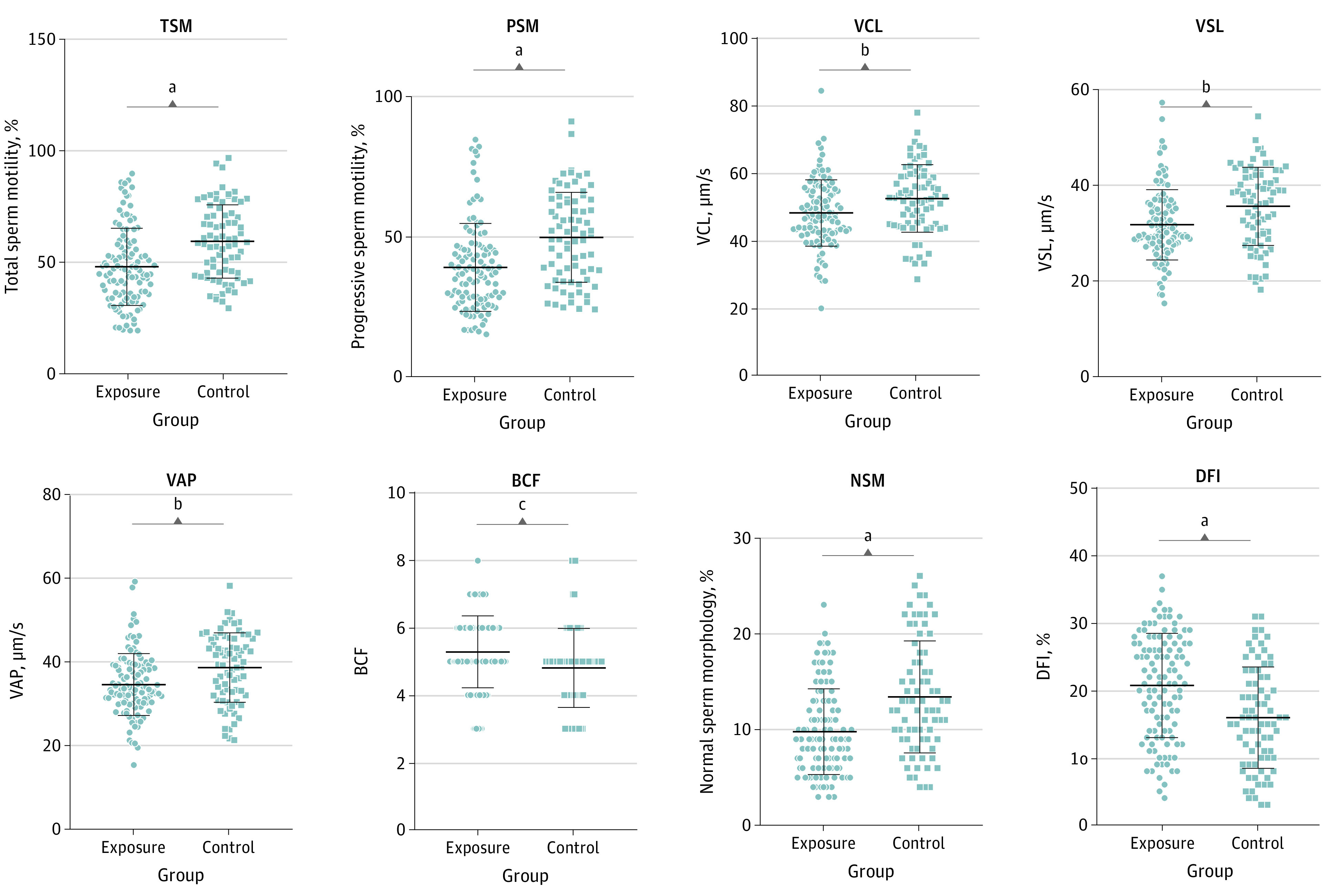
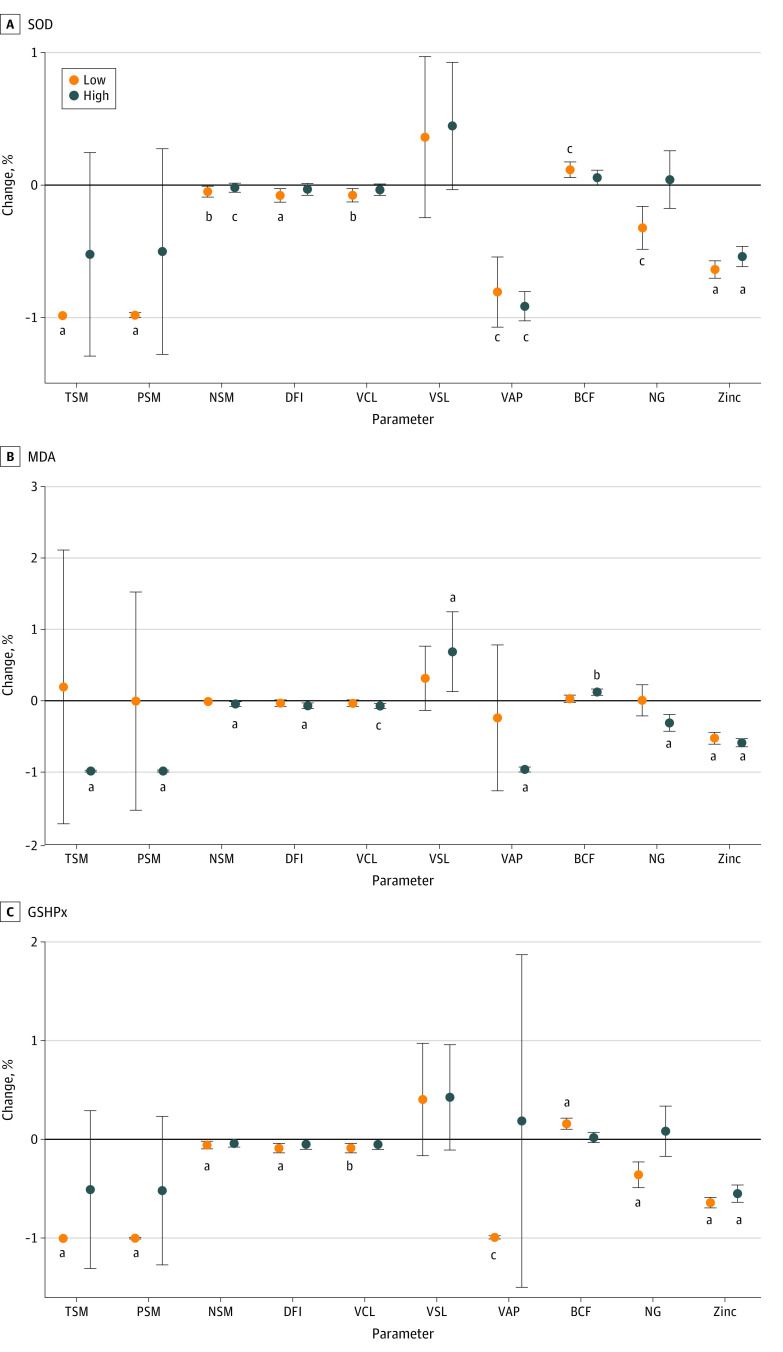
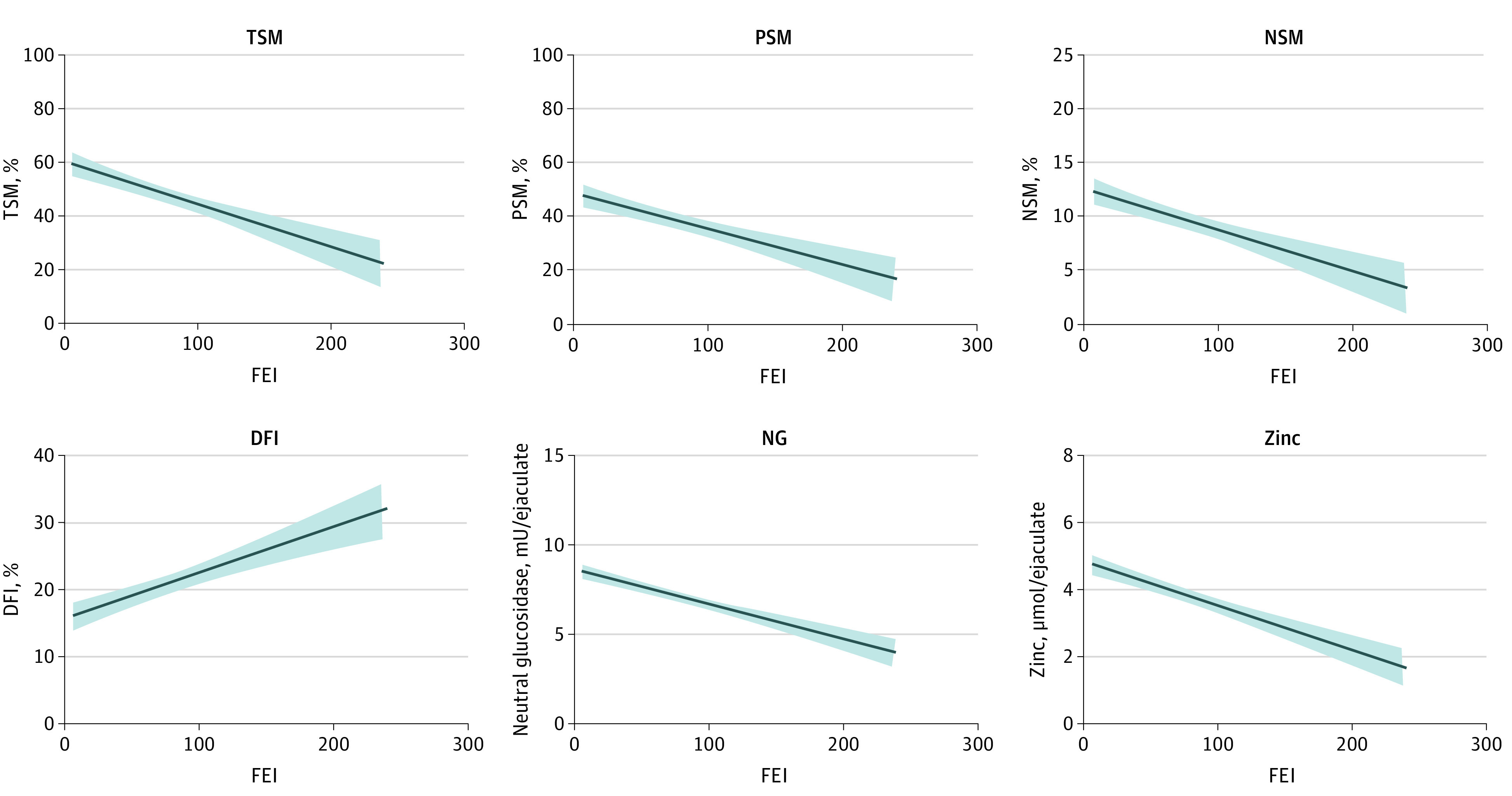
A total of 205 men (mean [SD] age, 29.49 [3.64] years), with 124 individuals in the FA exposure group (mean [SD] FEI, 73.72 [54.86]) and 81 age-matched controls, were included in the final analysis. Long-term personal occupational exposure to FA was significantly associated with poor semen quality. Specifically, a 1-unit increase in FEI was associated with a change of -0.99% (95% CI, -1.00% to -0.98%) in total sperm motility, -0.99% (95% CI, -0.99% to -0.97%) in progressive sperm motility, -0.05% (95% CI, -0.08% to -0.02%) in curvilinear velocity, -0.07% (95% CI, -0.10% to -0.04%) in straight line velocity, -0.07% (95% CI, -0.10% to -0.04%) in time-average velocity, -0.98% (95% CI, -0.99% to -0.93%) in normal sperm morphology, -0.24% (95% CI, -0.35% to -0.11%) in seminal neutral glucosidase, -0.61% (95% CI, -0.66% to -0.56%) in seminal plasma zinc, 0.52% (95% CI, 0.15% to 1.02%) in beat cross frequency, and 0.10% (95% CI, 0.06% to 0.14%) in the DNA fragmentation index. These associations remained significant after adjusting for confounding factors. Furthermore, subgroup analysis found that high levels of oxidative stress might promote the associations between FA exposure and semen quality.
This study found an association between long-term occupational exposure to FA and semen quality. This deterioration was dose and time dependent and might be induced by oxidative stress.
长期职业暴露于甲醛(FA)对人类精液质量的潜在影响尚不清楚。
评估长期职业暴露于 FA 是否与精液质量有关。
设计、地点和参与者:这项基于人群的队列研究于 2021 年 6 月 1 日至 6 月 30 日在中国西安进行。参与者为年龄在 23 至 40 岁之间、在研究区域居住 24 个月或以上的成年人。数据分析于 2021 年 9 月 1 日至 10 月 1 日进行。
FA 的长期职业暴露通过甲醛探测器进行测量,并计算 FA 暴露指数(FEI)如下:FEI=FA 的最终浓度(mg/m3)×工作日期间的工作时间(小时)×累计工作天数(年)。
禁欲 3 至 7 天后通过自慰采集精液样本,然后使用计算机自动精液分析系统、巴氏染色和精子染色质结构分析进行评估。
共纳入 205 名男性(平均[标准差]年龄,29.49[3.64]岁),124 名男性暴露于 FA(平均[标准差]FEI,73.72[54.86]),81 名年龄匹配的对照组,纳入最终分析。长期个人职业接触 FA 与精液质量差显著相关。具体而言,FEI 增加 1 个单位与总精子活力降低 0.99%(95%CI,-0.98%至-0.97%)、前向运动精子活力降低 0.99%(95%CI,-0.99%至-0.97%)、曲线速度降低 0.05%(95%CI,-0.08%至-0.02%)、直线速度降低 0.07%(95%CI,-0.10%至-0.04%)、平均速度降低 0.07%(95%CI,-0.10%至-0.04%)、正常精子形态降低 0.98%(95%CI,-0.99%至-0.93%)、中性葡萄糖苷酶降低 0.24%(95%CI,-0.35%至-0.11%)、精浆锌降低 0.61%(95%CI,-0.66%至-0.56%)、鞭打频率增加 0.52%(95%CI,0.15%至 1.02%)和 DNA 碎片化指数增加 0.10%(95%CI,0.06%至 0.14%)。在调整混杂因素后,这些关联仍然显著。此外,亚组分析发现,高水平的氧化应激可能会促进 FA 暴露与精液质量之间的关联。
这项研究发现长期职业暴露于 FA 与精液质量之间存在关联。这种恶化是剂量和时间依赖性的,可能是由氧化应激引起的。