da Silva Soares Raimundo, Ambriola Oku Amanda Yumi, Barreto Cândida S F, Ricardo Sato João
Center for Mathematics, Computation and Cognition, Universidade Federal do ABC, São Bernardo do Campo, Brazil.
Graduate Program in Neuroscience and Cognition, Federal University of ABC, São Bernardo do Campo, Brazil.
Front Hum Neurosci. 2022 Aug 12;16:889806. doi: 10.3389/fnhum.2022.889806. eCollection 2022.
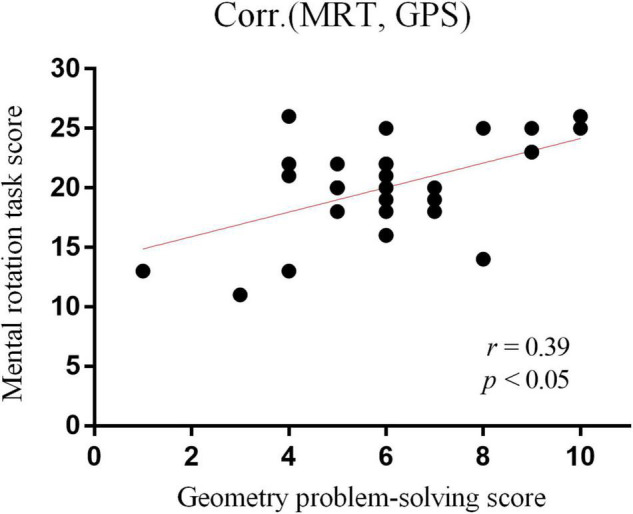
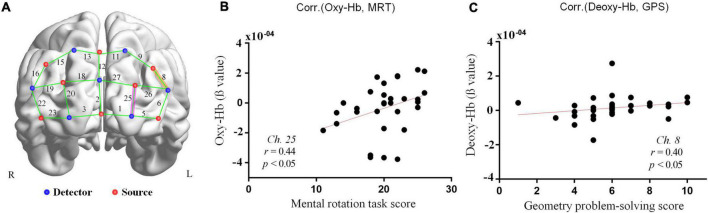
Spatial cognition is related to academic achievement in science, technology, engineering, and mathematics (STEM) domains. Neuroimaging studies suggest that brain regions' activation might be related to the general cognitive effort while solving mental rotation tasks (MRT). In this study, we evaluate the mental effort of children performing MRT tasks by measuring brain activation and pupil dilation. We use functional near-infrared spectroscopy (fNIRS) concurrently to collect brain hemodynamic responses from children's prefrontal cortex (PFC) and an Eye-tracking system to measure pupil dilation during MRT. Thirty-two healthy students aged 9-11 participated in this experiment. Behavioral measurements such as task performance on geometry problem-solving tests and MRT scores were also collected. The results were significant positive correlations between the children's MRT and geometry problem-solving test scores. There are also significant positive correlations between dorsolateral PFC (dlPFC) hemodynamic signals and visuospatial task performances (MRT and geometry problem-solving scores). Moreover, we found significant activation in the amplitude of deoxy-Hb variation on the dlPFC and that pupil diameter increased during the MRT, suggesting that both physiological responses are related to mental effort processes during the visuospatial task. Our findings indicate that children with more mental effort under the task performed better. The multimodal approach to monitoring students' mental effort can be of great interest in providing objective feedback on cognitive resource conditions and advancing our comprehension of the neural mechanisms that underlie cognitive effort. Hence, the ability to detect two distinct mental states of rest or activation of children during the MRT could eventually lead to an application for investigating the visuospatial skills of young students using naturalistic educational paradigms.
空间认知与科学、技术、工程和数学(STEM)领域的学业成绩相关。神经影像学研究表明,在解决心理旋转任务(MRT)时,大脑区域的激活可能与一般认知努力有关。在本研究中,我们通过测量大脑激活和瞳孔扩张来评估儿童执行MRT任务时的心理努力。我们同时使用功能近红外光谱(fNIRS)从儿童前额叶皮层(PFC)收集脑血流动力学反应,并使用眼动追踪系统测量MRT期间的瞳孔扩张。32名9至11岁的健康学生参与了本实验。还收集了诸如几何问题解决测试的任务表现和MRT分数等行为测量数据。结果显示,儿童的MRT与几何问题解决测试分数之间存在显著的正相关。背外侧前额叶皮层(dlPFC)的血流动力学信号与视觉空间任务表现(MRT和几何问题解决分数)之间也存在显著的正相关。此外,我们发现dlPFC上脱氧血红蛋白变化幅度有显著激活,并且在MRT期间瞳孔直径增加,这表明这两种生理反应都与视觉空间任务中的心理努力过程有关。我们的研究结果表明,在任务中付出更多心理努力的儿童表现更好。监测学生心理努力的多模态方法对于提供关于认知资源状况的客观反馈以及增进我们对认知努力背后神经机制的理解可能会非常有意义。因此,在MRT期间检测儿童休息或激活这两种不同心理状态的能力最终可能会导致一种应用,即使用自然主义教育范式来研究年轻学生的视觉空间技能。