Cheng Nicholas, McLaverty Alison, Nelson Barnaby, Markulev Connie, Schäfer Miriam R, Berger Maximus, Mossaheb Nilufar, Schlögelhofer Monika, Smesny Stefan, Hickie Ian B, Berger Gregor E, Chen Eric Y H, de Haan Lieuwe, Nieman Dorien H, Nordentoft Merete, Riecher-Rössler Anita, Verma Swapna, Street Rebekah, Thompson Andrew, Yuen Hok Pan, Hester Robert, Yung Alison Ruth, McGorry Patrick D, Allott Kelly, Amminger G Paul
Orygen, Centre for Youth Mental Health, The University of Melbourne, Australia.
Melbourne School of Psychological Sciences, The University of Melbourne, Australia.
BJPsych Open. 2022 Sep 8;8(5):e165. doi: 10.1192/bjo.2022.572.
Cognitive impairments are well-established features of psychotic disorders and are present when individuals are at ultra-high risk for psychosis. However, few interventions target cognitive functioning in this population.
To investigate whether omega-3 polyunsaturated fatty acid (-3 PUFA) supplementation improves cognitive functioning among individuals at ultra-high risk for psychosis.
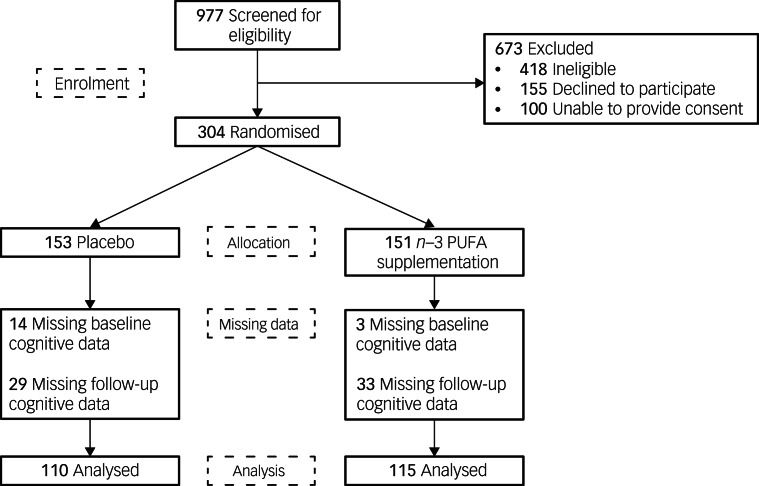
Data ( = 225) from an international, multi-site, randomised controlled trial (NEURAPRO) were analysed. Participants were given omega-3 supplementation (eicosapentaenoic acid and docosahexaenoic acid) or placebo over 6 months. Cognitive functioning was assessed with the Brief Assessment of Cognition in Schizophrenia (BACS). Mixed two-way analyses of variance were computed to compare the change in cognitive performance between omega-3 supplementation and placebo over 6 months. An additional biomarker analysis explored whether change in erythrocyte -3 PUFA levels predicted change in cognitive performance.
The placebo group showed a modest greater improvement over time than the omega-3 supplementation group for motor speed ( = 0.09) and BACS composite score ( = 0.21). After repeating the analyses without individuals who transitioned, motor speed was no longer significant ( = 0.02), but the composite score remained significant ( = 0.02). Change in erythrocyte n-3 PUFA levels did not predict change in cognitive performance over 6 months.
We found no evidence to support the use of omega-3 supplementation to improve cognitive functioning in ultra-high risk individuals. The biomarker analysis suggests that this finding is unlikely to be attributed to poor adherence or consumption of non-trial -3 PUFAs.
认知障碍是精神障碍的既定特征,在个体处于精神病超高风险时就已存在。然而,针对这一人群认知功能的干预措施很少。
研究补充ω-3多不饱和脂肪酸(-3 PUFA)是否能改善处于精神病超高风险个体的认知功能。
分析了一项国际多中心随机对照试验(NEURAPRO)的数据(n = 225)。参与者在6个月内接受ω-3补充剂(二十碳五烯酸和二十二碳六烯酸)或安慰剂。使用精神分裂症认知简短评估量表(BACS)评估认知功能。计算混合双向方差分析,以比较6个月内ω-3补充剂组和安慰剂组认知表现的变化。另一项生物标志物分析探讨红细胞-3 PUFA水平的变化是否能预测认知表现的变化。
安慰剂组在运动速度(p = 0.09)和BACS综合评分(p = 0.21)方面随时间的改善略大于ω-3补充剂组。在排除病情转变的个体后重复分析,运动速度不再显著(p = 0.02),但综合评分仍显著(p = 0.02)。红细胞n-3 PUFA水平的变化在6个月内未能预测认知表现的变化。
我们没有发现证据支持使用ω-3补充剂来改善超高风险个体的认知功能。生物标志物分析表明,这一发现不太可能归因于依从性差或食用了非试验性的-3 PUFAs。