The University of Sydney Sydney Australia.
The University of Melbourne Melbourne Australia.
J Am Heart Assoc. 2022 Sep 20;11(18):e025931. doi: 10.1161/JAHA.122.025931. Epub 2022 Sep 8.
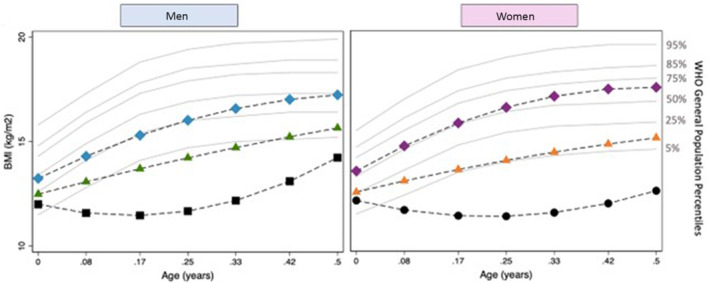
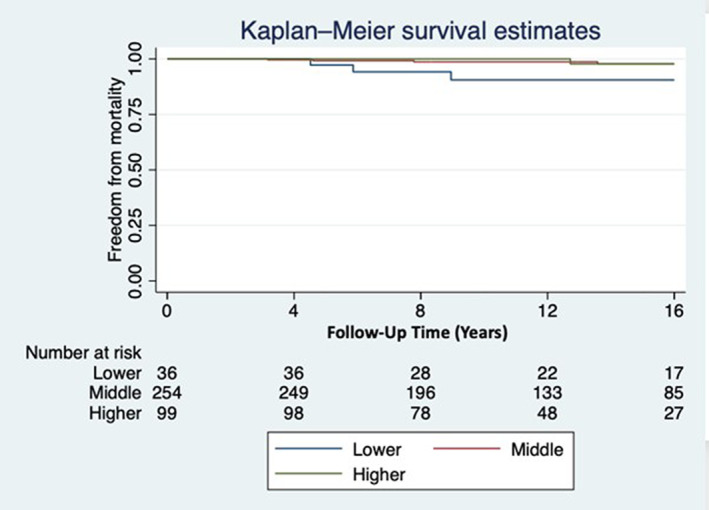
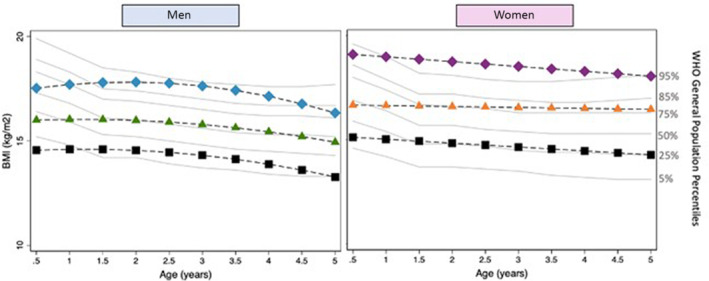
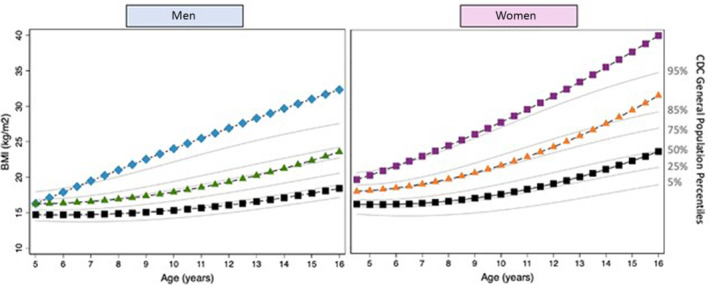
Background Patients with a single ventricle who experience early life growth failure suffer high morbidity and mortality in the perisurgical period. However, long-term implications of poor infant growth, as well as associations between body mass index (BMI) and outcome in adulthood, remain unclear. We aimed to model BMI trajectories of patients with a single ventricle undergoing a Fontan procedure to determine trajectory-based differences in baseline characteristics and long-term clinical outcomes. Methods and Results We performed a retrospective analysis of medical records from patients in the Australia and New Zealand Fontan Registry receiving treatment at the Royal Children's Hospital, The Children's Hospital at Westmead, Royal Melbourne Hospital, and Royal Prince Alfred Hospital from 1981 to 2018. BMI trajectories were modeled in 496 patients using latent class growth analysis from 0 to 6 months, 6 to 60 months, and 5 to 16 years. Trajectories were compared regarding long-term incidence of severe Fontan failure (defined as mortality, heart transplantation, Fontan takedown, or New York Heart Association class III/IV heart failure). Three trajectories were found for male and female subjects at each age group-lower, middle, higher. Subjects in the lower trajectory at 0 to 6 months were more likely to have an atriopulmonary Fontan and experienced increased mortality long term. No association was found between higher BMI trajectory, current BMI, and long-term outcome. Conclusions Poor growth in early life correlates with increased long-term severe Fontan failure. Delineation of distinct BMI trajectories can be used in larger and older cohorts to find optimal BMI targets for patient outcome.
患有单心室的患者在生命早期生长发育不良,围手术期发病率和死亡率较高。然而,婴儿生长不良的长期影响,以及体重指数(BMI)与成年后结局之间的关系仍不清楚。我们旨在建立接受 Fontan 手术的单心室患者的 BMI 轨迹,以确定基于轨迹的基线特征和长期临床结局的差异。
我们对 1981 年至 2018 年期间在澳大利亚和新西兰 Fontan 注册处接受治疗的,皇家儿童医院、韦斯特米德儿童医院、墨尔本皇家医院和皇家阿尔弗雷德王子医院的患者的病历进行了回顾性分析。采用潜在类别增长分析,对 496 例患者在 0 至 6 个月、6 至 60 个月和 5 至 16 岁时的 BMI 轨迹进行建模。对长期严重 Fontan 失败(定义为死亡率、心脏移植、Fontan 拆除或纽约心脏协会 III/IV 级心力衰竭)的发生率进行了比较。在每个年龄组的男性和女性中都发现了三种轨迹-较低、中等、较高。0 至 6 个月时处于较低轨迹的患者更有可能接受房间隔肺静脉 Fontan,并且长期死亡率增加。较高 BMI 轨迹、当前 BMI 与长期结局之间没有关联。
生命早期的生长不良与长期严重的 Fontan 失败相关。明确 BMI 轨迹可用于更大、更年长的队列中,以找到最佳的 BMI 目标,从而改善患者的结局。