From the Office of Population Research, Princeton University, Princeton, NJ.
Epidemiology. 2020 Sep;31(5):649-658. doi: 10.1097/EDE.0000000000001217.
Foreign-born women have heavier infants than US-born women, but it is unclear whether this advantage persists across generations for all races and ethnicities.
Using 1971-2015 Florida birth records, we linked records of female infants within families to assess intergenerational changes in birthweight and prevalence of low birthweight by grandmother's race/ethnicity and foreign-born status. We also assessed educational gradients in low birthweight in two generations.
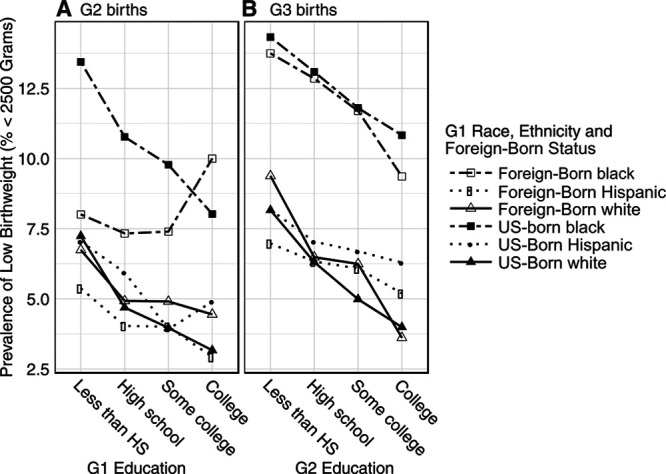
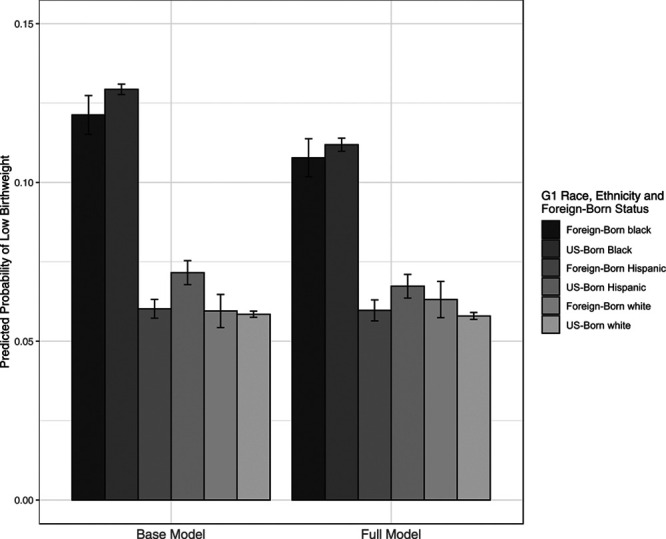
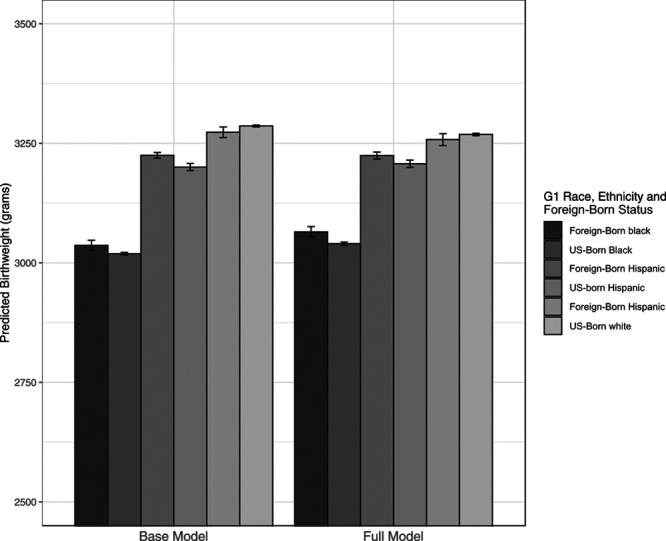
Compared with daughters of US-born black women, daughters of foreign-born black women had substantially higher birthweights (3,199 vs. 3,083 g) and lower prevalence of low birthweight (7.8% vs. 11.8%). Daughters of foreign-born Hispanic women had moderately higher birthweights (3,322 vs. 3,268 grams) and lower prevalence of low birthweight (4.5% vs. 6.2%) than daughters of US-born Hispanic women. In the next generation, a Hispanic foreign-origin advantage persisted in low birthweight prevalence (6.1% vs. 7.2%), but the corresponding black foreign-origin advantage was almost eliminated (12.2% vs. 13.1%). Findings were robust to adjustment for sociodemographic and medical risk factors. In contrast to patterns for other women, the prevalence of low birthweight varied little by maternal education for foreign-born black women. However, a gradient emerged among their US-born daughters.
The convergence of birthweight between descendants of foreign-born and US-born black women is consistent with theories positing that lifetime exposure to discrimination and socioeconomic inequality is associated with adverse health outcomes for black women. The emergence of a distinct educational gradient in low birthweight prevalence between generations underscores hypothesized adverse effects of multiple dimensions of disadvantage.
与美国本土出生的女性相比,外国出生的女性所生婴儿的体重更重,但尚不清楚这种优势是否会在所有种族和族裔中延续到下一代。
利用 1971 年至 2015 年佛罗里达州的出生记录,我们将家庭内的女婴记录进行了关联,以评估祖母的种族/族裔和外国出生身份对出生体重以及低出生体重发生率的代际变化,并评估了两代人中低出生体重的教育梯度。
与美国本土出生的黑人女性的女儿相比,外国出生的黑人女性的女儿出生体重显著更高(3199 克 vs. 3083 克),低出生体重的发生率更低(7.8% vs. 11.8%)。外国出生的西班牙裔女性的女儿出生体重略高(3322 克 vs. 3268 克),低出生体重的发生率较低(4.5% vs. 6.2%)。在下一代中,西班牙裔的外国出生优势在低出生体重的发生率上持续存在(6.1% vs. 7.2%),但黑人的外国出生优势几乎消失(12.2% vs. 13.1%)。研究结果在调整了社会人口学和医疗风险因素后仍然稳健。与其他女性的模式相反,外国出生的黑人女性的低出生体重发生率与母亲的教育程度变化不大。然而,她们的美国本土出生的女儿中出现了明显的梯度。
外国出生和美国本土出生的黑人女性后代的出生体重趋同,这与理论一致,即一生暴露于歧视和社会经济不平等与黑人女性的不良健康结果有关。代际间低出生体重发生率的教育梯度的出现突显了多维度劣势的假定不良影响。