Department of Computer Science, University of Toronto, Toronto, Ontario, Canada.
Program in Molecular Medicine, The Hospital for Sick Children, Toronto, Ontario, Canada.
PLoS Comput Biol. 2022 Sep 8;18(9):e1010452. doi: 10.1371/journal.pcbi.1010452. eCollection 2022 Sep.
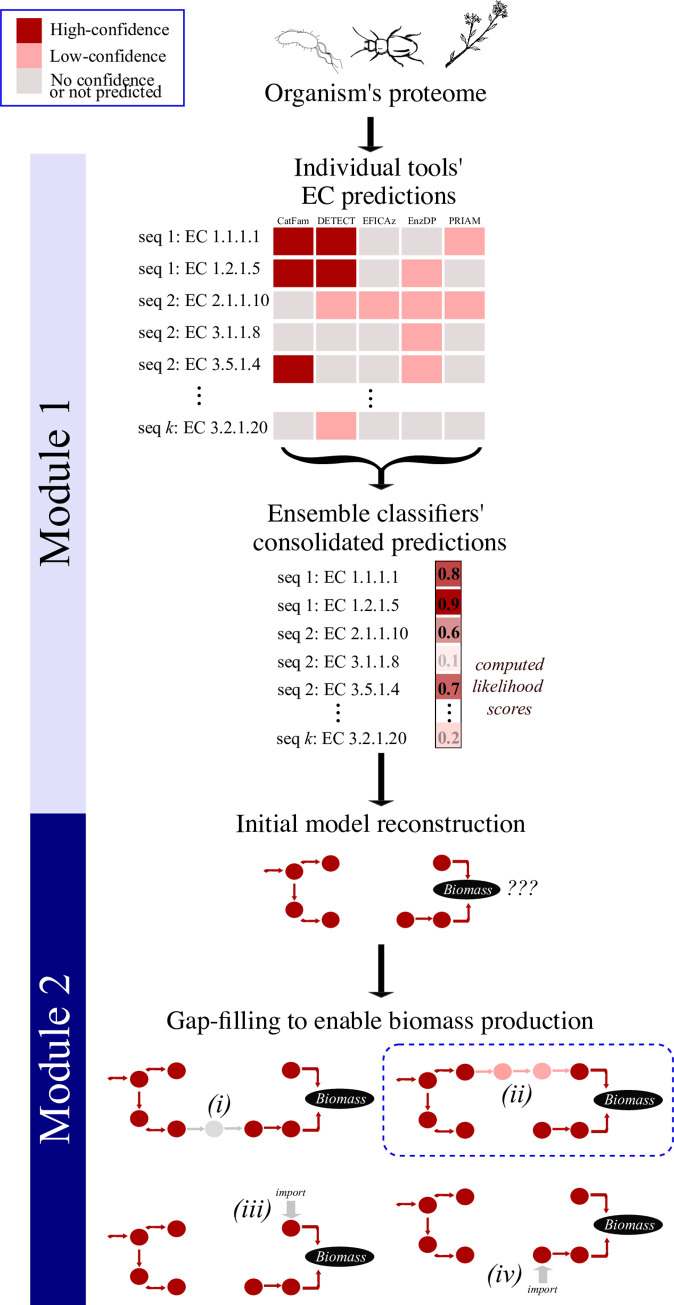
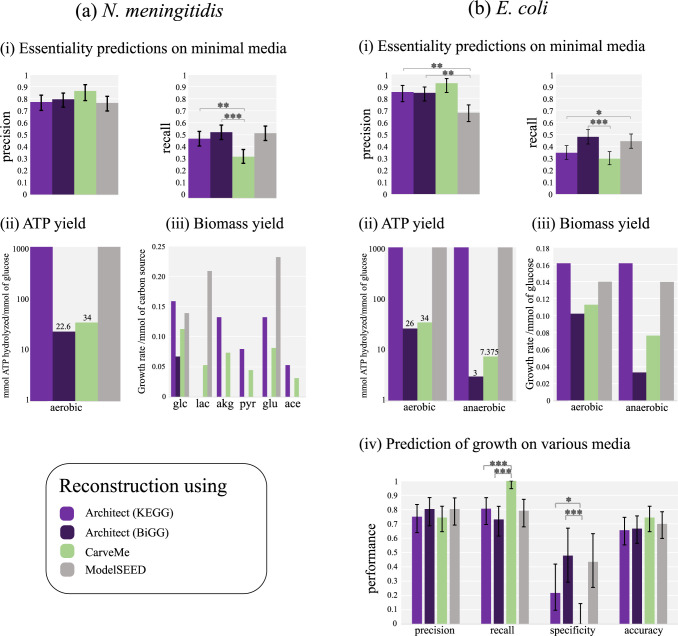
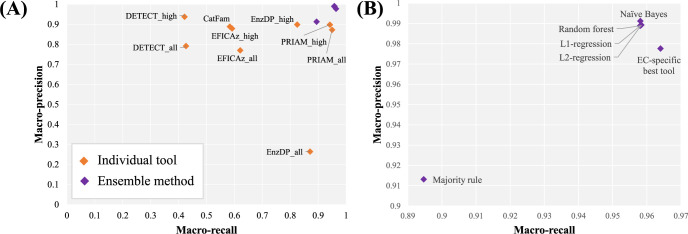
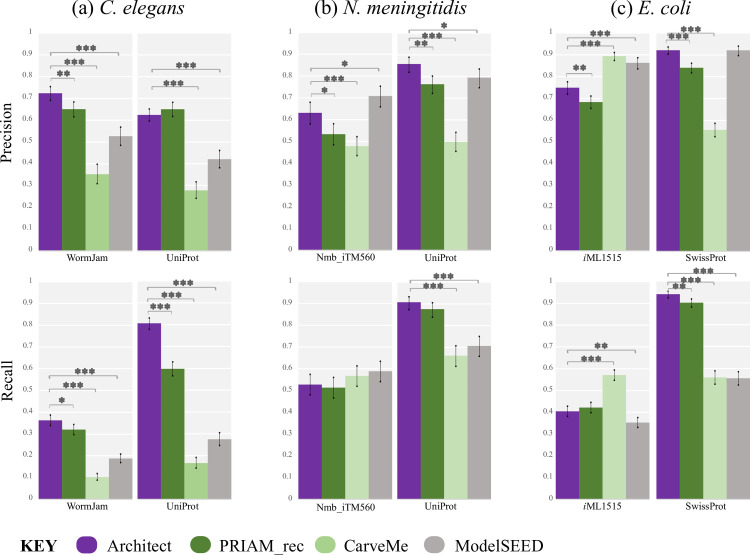
Constraint-based modeling is a powerful framework for studying cellular metabolism, with applications ranging from predicting growth rates and optimizing production of high value metabolites to identifying enzymes in pathogens that may be targeted for therapeutic interventions. Results from modeling experiments can be affected at least in part by the quality of the metabolic models used. Reconstructing a metabolic network manually can produce a high-quality metabolic model but is a time-consuming task. At the same time, current methods for automating the process typically transfer metabolic function based on sequence similarity, a process known to produce many false positives. We created Architect, a pipeline for automatic metabolic model reconstruction from protein sequences. First, it performs enzyme annotation through an ensemble approach, whereby a likelihood score is computed for an EC prediction based on predictions from existing tools; for this step, our method shows both increased precision and recall compared to individual tools. Next, Architect uses these annotations to construct a high-quality metabolic network which is then gap-filled based on likelihood scores from the ensemble approach. The resulting metabolic model is output in SBML format, suitable for constraints-based analyses. Through comparisons of enzyme annotations and curated metabolic models, we demonstrate improved performance of Architect over other state-of-the-art tools, notably with higher precision and recall on the eukaryote C. elegans and when compared to UniProt annotations in two bacterial species. Code for Architect is available at https://github.com/ParkinsonLab/Architect. For ease-of-use, Architect can be readily set up and utilized using its Docker image, maintained on Docker Hub.
基于约束的建模是研究细胞代谢的强大框架,其应用范围从预测生长速率和优化高价值代谢物的生产,到鉴定病原体中可能成为治疗干预目标的酶。建模实验的结果至少在一定程度上受到所使用代谢模型的质量的影响。手动重建代谢网络可以产生高质量的代谢模型,但这是一项耗时的任务。同时,目前用于自动化该过程的方法通常基于序列相似性来转移代谢功能,这一过程已知会产生许多假阳性。我们创建了 Architect,这是一种从蛋白质序列自动重建代谢模型的流水线。首先,它通过集成方法进行酶注释,根据现有工具的预测为 EC 预测计算可能性得分;在这一步骤中,与单个工具相比,我们的方法显示出更高的精度和召回率。接下来,Architect 使用这些注释构建一个高质量的代谢网络,然后根据集成方法的可能性得分对其进行填补。生成的代谢模型以 SBML 格式输出,适合基于约束的分析。通过对酶注释和经过验证的代谢模型进行比较,我们证明了 Architect 优于其他最先进的工具,尤其是在真核生物 C. elegans 上具有更高的精度和召回率,并且与两种细菌中的 UniProt 注释相比也是如此。Architect 的代码可在 https://github.com/ParkinsonLab/Architect 上获得。为了便于使用,Architect 可以通过其 Docker 映像轻松设置和使用,该映像在 Docker Hub 上维护。