Department of Neurology, Affiliated Drum Tower Hospital, Medical School of Nanjing University, Nanjing, Jiangsu, 210008, China.
Basic Medical Sciences, University of Arizona College of Medicine-Phoenix, Phoenix, AZ, 85004, USA.
Transl Psychiatry. 2022 Sep 8;12(1):371. doi: 10.1038/s41398-022-02132-4.
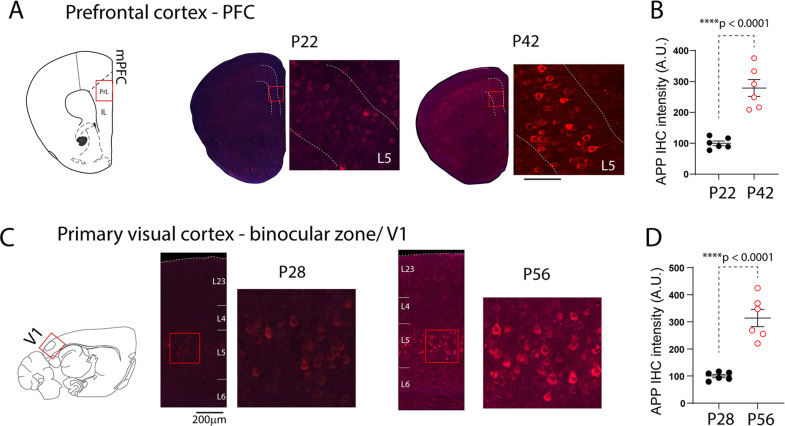
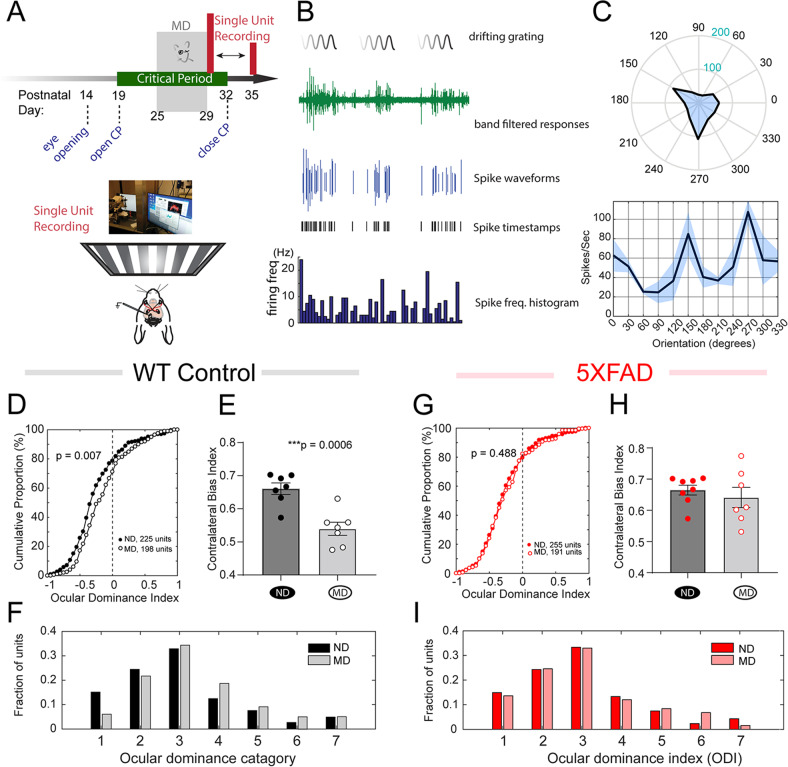
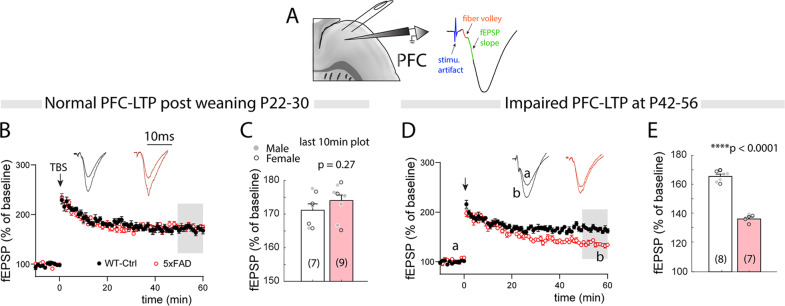
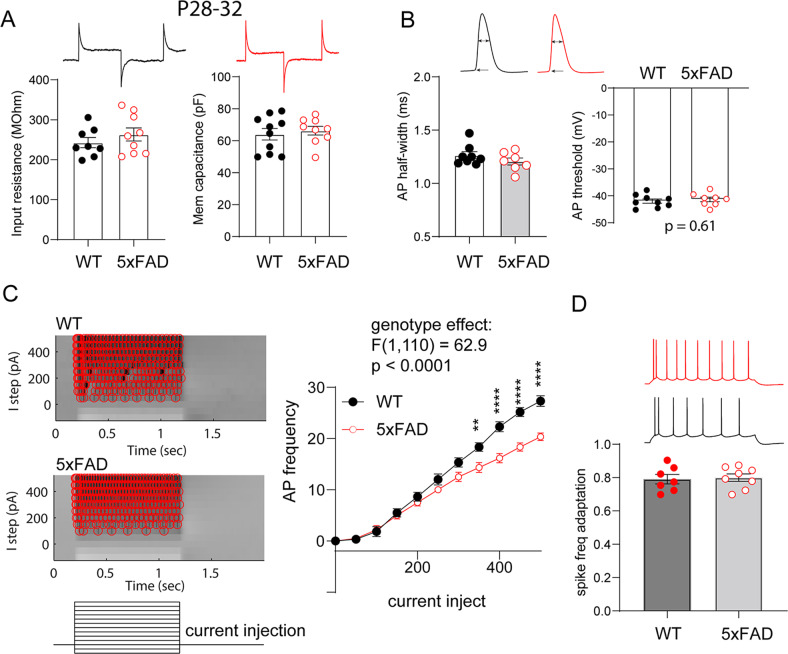
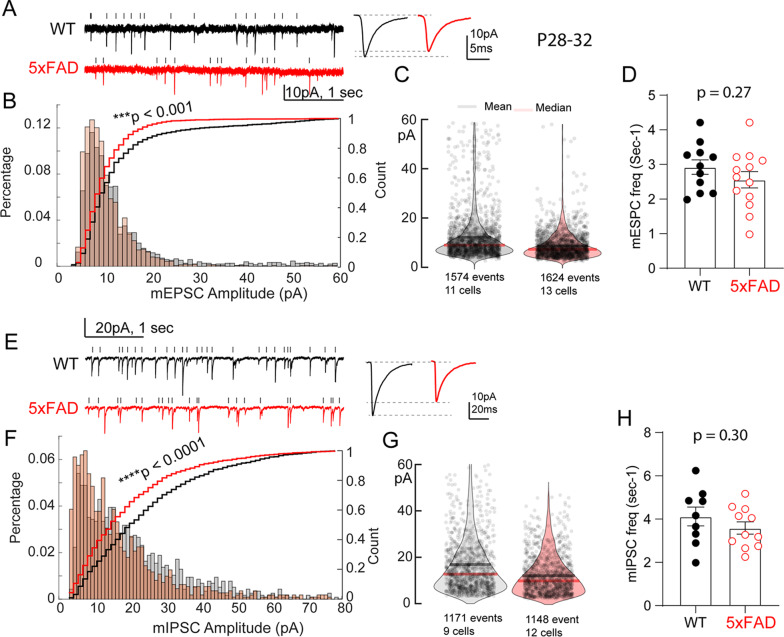
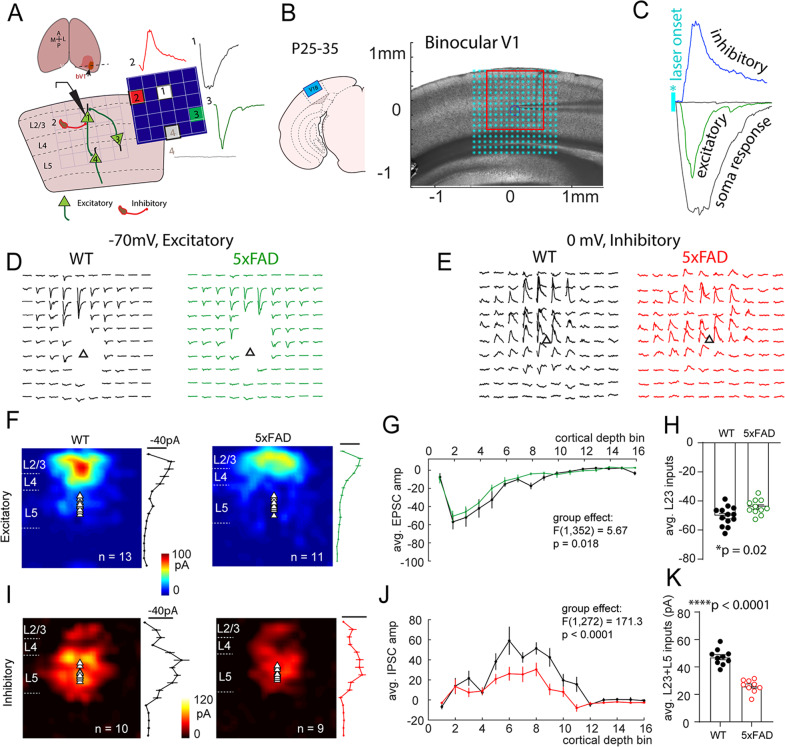
Genetic risk factors for neurodegenerative disorders, such as Alzheimer's disease (AD), are expressed throughout the life span. How these risk factors affect early brain development and function remain largely unclear. Analysis of animal models with high constructive validity for AD, such as the 5xFAD mouse model, may provide insights on potential early neurodevelopmental effects that impinge on adult brain function and age-dependent degeneration. The 5XFAD mouse model over-expresses human amyloid precursor protein (APP) and presenilin 1 (PS1) harboring five familial AD mutations. It is unclear how the expression of these mutant proteins affects early developing brain circuits. We found that the prefrontal cortex (PFC) layer 5 (L5) neurons in 5XFAD mice exhibit transgenic APP overloading at an early post-weaning age. Impaired synaptic plasticity (long-term potentiation, LTP) was seen at 6-8 weeks age in L5 PFC circuit, which was correlated with increased intracellular APP. APP overloading was also seen in L5 pyramidal neurons in the primary visual cortex (V1) during the critical period of plasticity (4-5 weeks age). Whole-cell patch clamp recording in V1 brain slices revealed reduced intrinsic excitability of L5 neurons in 5XFAD mice, along with decreased spontaneous miniature excitatory and inhibitory inputs. Functional circuit mapping using laser scanning photostimulation (LSPS) combined with glutamate uncaging uncovered reduced excitatory synaptic connectivity onto L5 neurons in V1, and a more pronounced reduction in inhibitory connectivity, indicative of altered excitation and inhibition during VC critical period. Lastly, in vivo single-unit recording in V1 confirmed that monocular visual deprivation-induced ocular dominance plasticity during critical period was impaired in 5XFAD mice. Our study reveals plasticity deficits across multiple cortical regions and indicates altered early cortical circuit developmental trajectory as a result of mutant APP/PS1 over-expression.
神经退行性疾病(如阿尔茨海默病,AD)的遗传风险因素在整个生命周期中都有表达。这些风险因素如何影响早期大脑发育和功能在很大程度上仍不清楚。对具有高度 AD 构建效度的动物模型(如 5xFAD 小鼠模型)的分析,可能为潜在的早期神经发育影响提供一些见解,这些影响会影响成年大脑功能和与年龄相关的退化。5xFAD 小鼠模型过度表达具有五个家族性 AD 突变的人淀粉样前体蛋白(APP)和早老素 1(PS1)。这些突变蛋白的表达如何影响早期发育中的大脑回路尚不清楚。我们发现,5xFAD 小鼠的前额叶皮层(PFC)第 5 层(L5)神经元在断奶后早期就表现出转基因 APP 过载。在 6-8 周龄时,L5 PFC 回路中出现了突触可塑性受损(长时程增强,LTP),这与细胞内 APP 增加有关。在视觉皮层(V1)的关键可塑性时期(4-5 周龄),L5 锥体神经元中也观察到 APP 过载。在 V1 脑片中进行全细胞膜片钳记录显示,5xFAD 小鼠的 L5 神经元的内在兴奋性降低,同时自发性微小兴奋性和抑制性输入减少。使用激光扫描光刺激(LSPS)结合谷氨酸解笼技术进行的功能回路映射显示,V1 中 L5 神经元的兴奋性突触连接减少,抑制性连接减少更为明显,表明 VC 关键期兴奋性和抑制性改变。最后,在 V1 中的体内单细胞记录证实,5xFAD 小鼠在关键期的单眼视觉剥夺诱导的眼优势可塑性受损。我们的研究揭示了多个皮层区域的可塑性缺陷,并表明突变 APP/PS1 过表达导致早期皮层回路发育轨迹改变。