Graduate Institute of Clinical Medical Sciences, College of Medicine, Chang Gung University, Taoyuan 333, Taiwan.
Division of Hepato-Gastroenterology, Department of Internal Medicine, Kaohsiung Chang Gung Memorial Hospital and Chang Gung University College of Medicine, Kaohsiung 833, Taiwan.
Int J Mol Sci. 2022 Aug 26;23(17):9689. doi: 10.3390/ijms23179689.
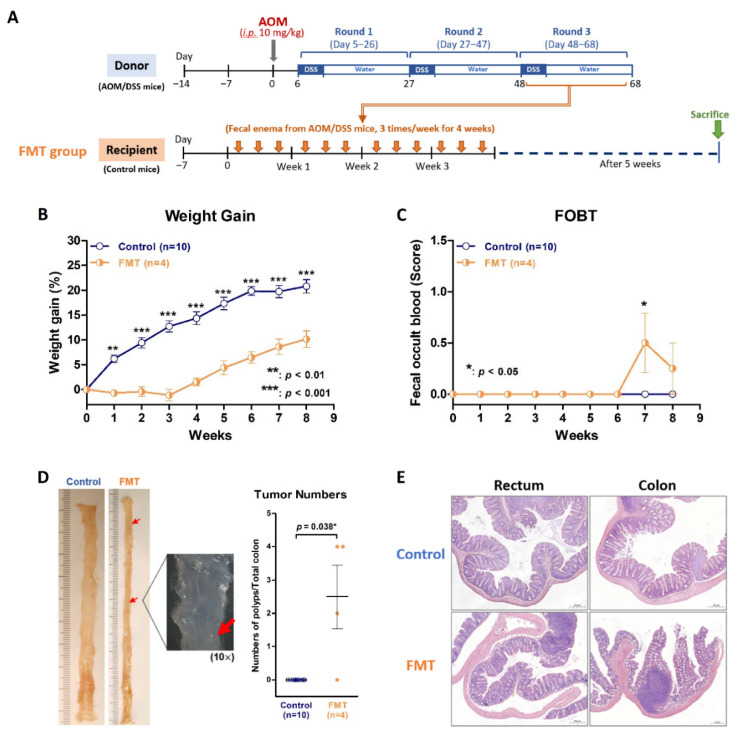
Recent studies have shown dysbiosis is associated with inflammatory bowel disease (IBD). However, trying to restore microbial diversity via fecal microbiota transplantation (FMT) or probiotic intervention fails to achieve clinical benefit in IBD patients. We performed a probiotic intervention on a simulated IBD murine model to clarify their relationship. IBD was simulated by the protocol of azoxymethane and dextran sodium sulfate (AOM/DSS) to set up a colitis and colitis-associated neoplasm model on BALB/c mice. A single probiotic intervention using (CBM) on AOM/DSS mice to clarify the role of probiotic in colitis, colitis-associated neoplasm, gut microbiota, and immune cytokines was performed. We found dysbiosis occurred in AOM/DSS mice. The CBM intervention on AOM/DSS mice failed to improve colitis and colitis-associated neoplasms but changed microbial composition and unexpectedly increased expression of proinflammatory IL-17A in rectal tissue. We hypothesized that the probiotic intervention caused dysbiosis. To clarify the result, we performed inverse FMT using feces from AOM/DSS mice to normal recipients to validate the pathogenic effect of dysbiosis from AOM/DSS mice and found mice on inverse FMT did develop colitis and colon neoplasms. We presumed the probiotic intervention to some extent caused dysbiosis as inverse FMT. The role of probiotics in IBD requires further elucidation.
最近的研究表明,肠道菌群失调与炎症性肠病(IBD)有关。然而,通过粪便微生物群移植(FMT)或益生菌干预来尝试恢复微生物多样性,未能在 IBD 患者中实现临床获益。我们在模拟 IBD 的小鼠模型上进行了益生菌干预,以阐明它们之间的关系。我们通过使用氧化偶氮甲烷和葡聚糖硫酸钠(AOM/DSS)的方案来模拟 IBD,在 BALB/c 小鼠上建立结肠炎和结肠炎相关肿瘤模型。在 AOM/DSS 小鼠上进行单次益生菌干预,使用(CBM)来阐明益生菌在结肠炎、结肠炎相关肿瘤、肠道微生物群和免疫细胞因子中的作用。我们发现 AOM/DSS 小鼠发生了肠道菌群失调。CBM 干预未能改善结肠炎和结肠炎相关肿瘤,但改变了微生物组成,并出人意料地增加了直肠组织中促炎细胞因子 IL-17A 的表达。我们假设益生菌干预导致了肠道菌群失调。为了阐明这一结果,我们使用来自 AOM/DSS 小鼠的粪便对正常受者进行了反向 FMT,以验证来自 AOM/DSS 小鼠的肠道菌群失调的致病作用,发现接受反向 FMT 的小鼠确实发生了结肠炎和结肠肿瘤。我们推测益生菌干预在某种程度上导致了肠道菌群失调,正如反向 FMT 一样。益生菌在 IBD 中的作用需要进一步阐明。