Department of Molecular and Translational Medicine (MTM), Texas Tech University Health Science Center El Paso, El Paso, TX 79905, USA.
Department of Biological Sciences, University of Texas at El Paso, El Paso, TX 79902, USA.
Int J Mol Sci. 2022 Aug 26;23(17):9684. doi: 10.3390/ijms23179684.
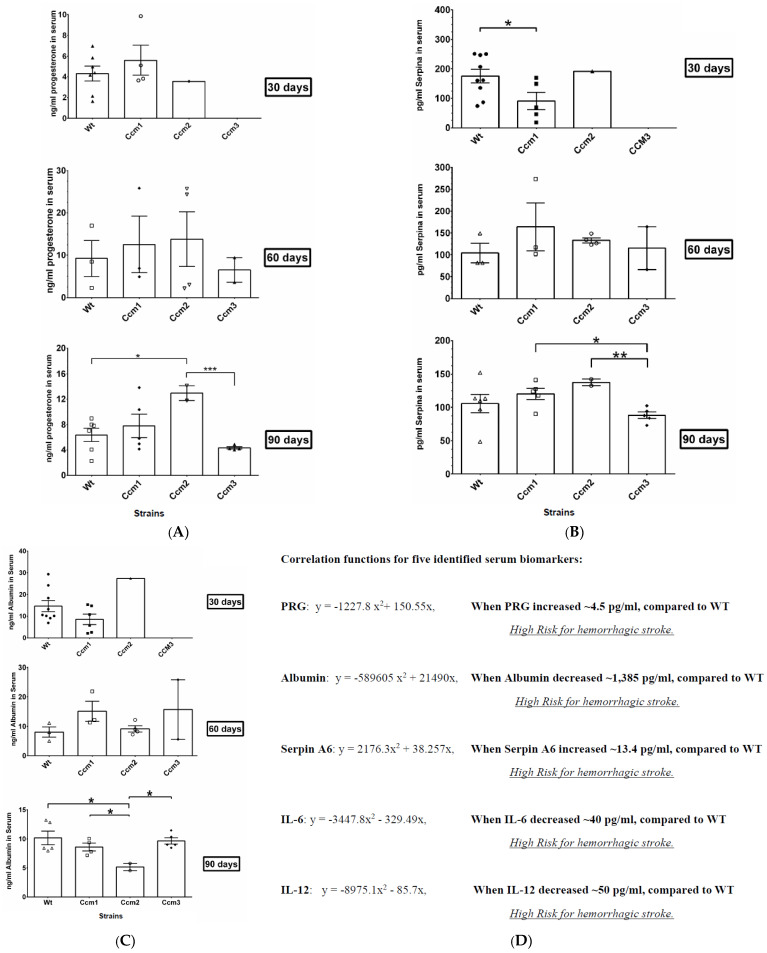
Cerebral cavernous malformations (CCMs) are characterized by abnormally dilated intracranial microvascular sinusoids that result in increased susceptibility to hemorrhagic stroke. It has been demonstrated that three CCM proteins (CCM1, CCM2, and CCM3) form the CCM signaling complex (CSC) to mediate angiogenic signaling. Disruption of the CSC will result in hemorrhagic CCMs, a consequence of compromised blood-brain barrier (BBB) integrity. Due to their characteristically incomplete penetrance, the majority of mutation carriers (presumed CCM patients) are largely asymptomatic, but when symptoms occur, the disease has typically reached a clinical stage of focal hemorrhage with irreversible brain damage. We recently reported that the CSC couples both classic (nuclear; nPRs) and nonclassic (membrane; mPRs) progesterone (PRG)-receptors-mediated signaling within the CSC-mPRs-PRG (CmP) signaling network in nPR(-) breast cancer cells. In this report, we demonstrate that depletion of any of the three genes or treatment with mPR-specific PRG actions (PRG/mifepristone) results in the disruption of the CmP signaling network, leading to increased permeability in the nPR(-) endothelial cells (ECs) monolayer in vitro. Finally, utilizing our in vivo hemizygous mutant mice models, we demonstrate that depletion of any of the three genes, in combination with mPR-specific PRG actions, is also capable of leading to defective homeostasis of PRG in vivo and subsequent BBB disruption, allowing us to identify a specific panel of etiological blood biomarkers associated with BBB disruption. To our knowledge, this is the first report detailing the etiology to predict the occurrence of a disrupted BBB, an indication of early hemorrhagic events.
脑内海绵状血管畸形(CCMs)的特征是颅内微小血管窦异常扩张,导致出血性中风的易感性增加。已经证明,三种 CCM 蛋白(CCM1、CCM2 和 CCM3)形成 CCM 信号复合物(CSC)来介导血管生成信号。CSC 的破坏将导致出血性 CCM,这是血脑屏障(BBB)完整性受损的结果。由于其特征性的不完全外显率,大多数突变携带者(假定的 CCM 患者)大多无症状,但当症状出现时,疾病通常已达到局灶性出血的临床阶段,伴有不可逆转的脑损伤。我们最近报道,CSC 在 nPR(-)乳腺癌细胞中的 CSC-mPRs-PRG(CmP)信号网络中偶联了经典(核;nPRs)和非经典(膜;mPRs)孕酮(PRG)受体介导的信号。在本报告中,我们证明了三种 基因中的任何一种的耗竭或 mPR 特异性 PRG 作用(PRG/mifepristone)的治疗都会导致 CmP 信号网络的破坏,导致体外 nPR(-)内皮细胞(ECs)单层通透性增加。最后,利用我们的体内半合子 突变小鼠模型,我们证明了三种 基因中的任何一种的耗竭,结合 mPR 特异性 PRG 作用,也能够导致体内 PRG 的稳态缺陷和随后的 BBB 破坏,使我们能够确定与 BBB 破坏相关的特定病因学血液生物标志物。据我们所知,这是第一个详细描述病因以预测 BBB 破坏发生的报告,这是早期出血事件的一个迹象。